



Rani Pokhari is usually described as a memorial. That reading is true but incomplete, and it hides the more interesting thing about the pond: it was a piece of hydraulic infrastructure. A 3.1 hectare rectangle of water in the middle of Kathmandu was never just ornament. It held monsoon runoff, leaked that water slowly into the ground, and kept wells and stone spouts flowing downhill through the dry months. This article explains how that system worked, what the 2016 to 2020 restoration actually rebuilt, and why refilling the pond turned out to be far harder than rebuilding it.
What Rani Pokhari Is, and When It Was Built
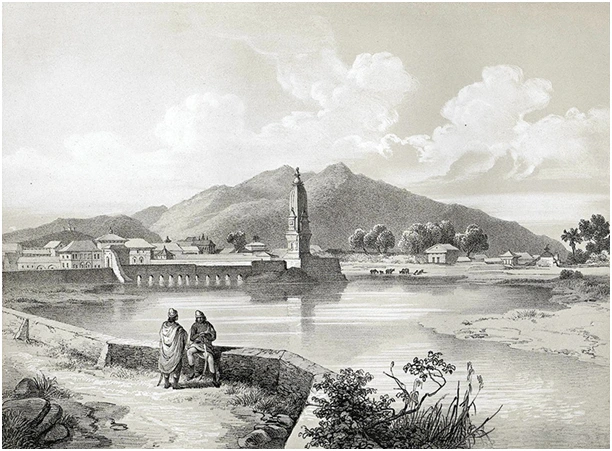
The sunken heritage of Rani Pokhari begins with King Pratap Malla, who ruled Kathmandu from 1641 to 1674. Accounts place the pond’s construction in 1670, with 1671 also cited, built after the death of the king’s son. Its purpose was partly consolation and partly religious.
Pratap Malla had water carried from sacred sites and river confluences across Nepal and northern India and poured into the pond to consecrate it. Gosaikunda, Muktinath, Badrinath and Kedarnath are among the places named in accounts of the ritual. One reconstruction-era account describes water drawn from 51 sacred sites.


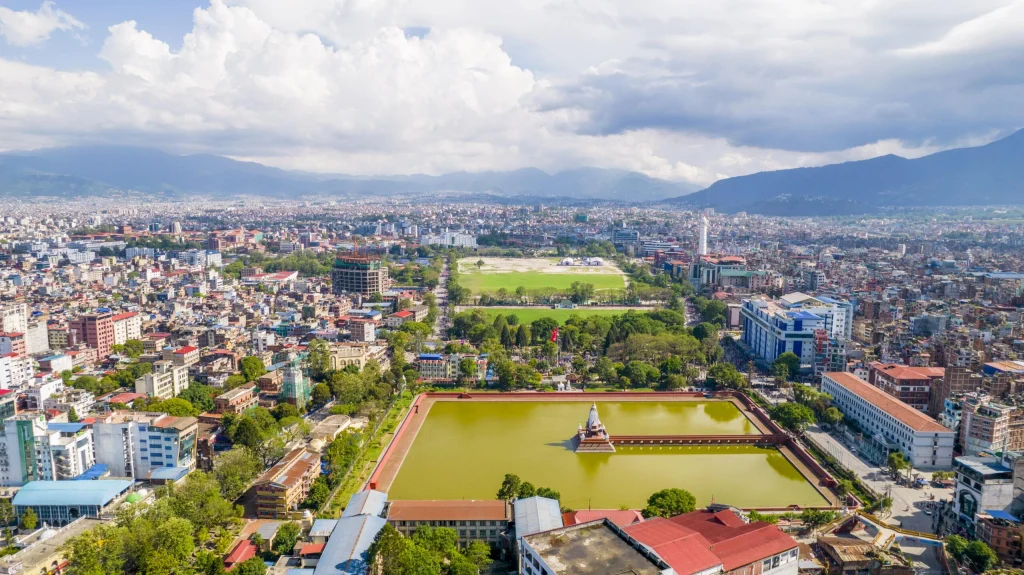
The pond measures roughly 180 m by 140 m, about 7.7 acres, and when full holds on the order of 30 million liters. A shrine known as Balgopaleshwar sits at its center, reached by a causeway. It opens to the public only once a year.
The pond in sequence
| Year | Event |
|---|---|
| 1670 (some accounts 1671) | Pond built under King Pratap Malla |
| 1934 | Great earthquake damages the central temple and destroys the nearby clock tower |
| 2015 | Gorkha earthquake damages the central temple again |
| January 2016 | Water pumped out; Kathmandu Metropolitan City begins work, inaugurated in that month |
| 2016 to 2018 | Public opposition to concrete, fountains and a café; plans revised |
| July 2019 | Monsoon rain holds in the pond for the first time in over three years |
| October 2020 | Restored pond and temple inaugurated |
| December 2021 | National Reconstruction Authority hands the site to Kathmandu Metropolitan City |
The Water Architecture: How a Pond Becomes Infrastructure
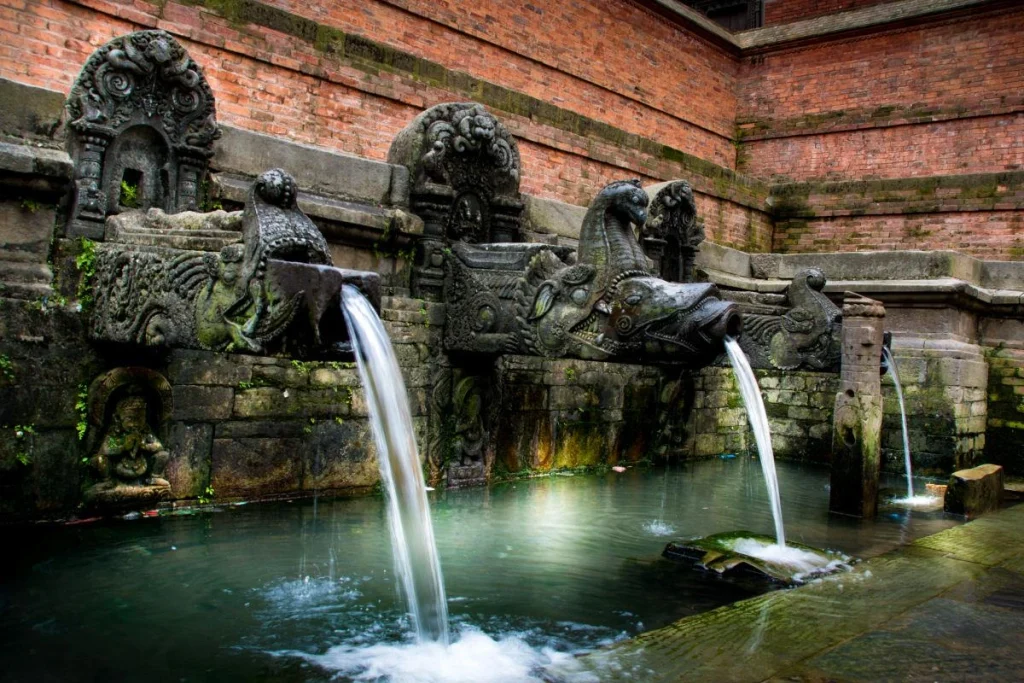
Kathmandu Valley has a layered traditional water system, and ponds sit near the top of it. Rainfall and surface runoff collect in the pond. A semi-permeable bed lets some of that water pass downward into shallow groundwater. Stone spouts, locally called hiti or dhunge dhara, then tap that shallow groundwater at lower elevations and deliver it at the surface year round.
Professor Sudarshan Tiwari, a conservation architect at the Institute of Engineering who advised on the restoration, has described the pond as having shaped the water management system around it. Monsoon runoff from as far as Asan market drained toward Rani Pokhari, and overflow moved on to the Tukucha rivulet. Seepage from the clay bed recharged groundwater that kept nearby wells and spouts flowing in the dry season.
Many spouts in the Valley were fed by state canals known as rajkulo. A 2022 review in Environmental Challenges by Shrestha and colleagues notes that these long canals were built under King Pratap Malla in Kathmandu and King Jitamitra Malla in Bhaktapur, serving both religious needs and the supply of conduits and farmland. Other spouts drew on independent subsurface sources rather than the canals.
Why the bed material matters
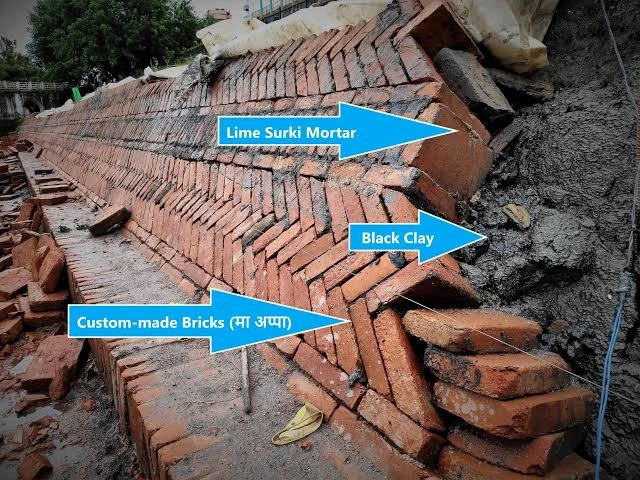
Make a pond bed watertight and you store water but recharge nothing. Make it too porous and the pond empties. The traditional answer was a bed of black clay, locally dyo cha, laid with trapezoidal dachhi appa brick. Clay of this kind is semi-permeable: it holds a standing body of water while allowing controlled seepage downward.
During the restoration, craftspeople from Bhaktapur were brought in to line the bed with layers of black soil, sand and traditional brick. A small test pond was built inside Rani Pokhari first to check whether the assembly leaked. Reconstruction team head Krishna Prasad Dumaru told The Himalayan Times in July 2019 that the test pond had shown no leakage.
Not everyone was confident. Reporting at the time raised the concern that debris could eventually clog the gaps between the trapezoidal bricks and block the seepage that the design depends on. Whether that happens is a question of maintenance over decades, and there is no published long-term monitoring to settle it.
The Restoration Fight
Work began in January 2016, and the pond was drained. Original plans leaned on concrete, decorative fountains and a lakeside café, with revenue generation in view. Residents, heritage conservationists and the Department of Archaeology pushed back.
Opposition changed the project. The National Reconstruction Authority took over from Kathmandu Metropolitan City and formed a committee with the city, the Department of Archaeology and local experts. Rs 120 million had been allocated for the job. The central temple, rebuilt in a domed form before 2015, was returned to a granthakut style that residents and the Department of Archaeology identified as closer to the Malla-era original.
Heritage conservationist Alok Siddhi Tuladhar was among those who opposed a plan to fill the pond from a tubewell. Pumping groundwater into a pond whose historical function was to recharge groundwater inverts the system. That objection is worth sitting with, because it captures the difference between a pond that looks right and a pond that works.
The Refilling Problem
Here is where most accounts of the restoration stop short. Rebuilding a pond is a construction problem. Supplying it is a watershed problem, and that watershed has changed beyond recognition.
Reporting during the project described the original artesian wells and underground channels as dried up or destroyed by construction. Options discussed included a trial feed from the Melamchi tunnel and rainwater harvesting from the roofs of Darbar High School and Tri Chandra College. Monsoon rain filled the basin in July 2019 during construction, which showed the bed could hold water, but seasonal rain is not the same as a year-round supply.
The broader numbers explain why. Shrestha and colleagues report that the Kathmandu Valley water board identified 573 stone spouts in a 2019 survey. Of those, 94 were completely lost, leaving 479. Only 224 were functioning, with a combined discharge of about 2.4 million liters per day. The same review reports groundwater extraction lowering the water table by roughly 2.5 m per year, and notes that paving and construction cut the infiltration that recharge depends on.
A pond designed to leak into an aquifer is in trouble when the aquifer is falling and the surfaces that once fed it are sealed. Public reporting on Rani Pokhari’s water level since the handover has been intermittent, and we found no current official monitoring data, so the honest statement is that the supply question has not been publicly resolved rather than that it has been solved or abandoned.
What the Pond Still Does
Rani Pokhari remains fenced for most of the year. The central shrine opens to the public on Bhai Tika, the last day of Tihar. Chhath is also observed there, with particular prominence among Maithil communities, when women stand in the water to offer prayers to the sun. Practice at Chhath varies by community and region, and Rani Pokhari is one site among many in Nepal.
Treating the pond only as a photograph stop misses its point. If you are walking the old city, the useful exercise is to trace the slope: look for where water would have moved, and find the sunken spout courtyards below. Several are still in use. Several are dry.
Reading the System Elsewhere in the Valley
- Ponds (pokhari): storage and recharge. Rani Pokhari is the largest in the old city core, and other named ponds survive in Kathmandu, Patan and Bhaktapur in varying condition.
- Canals (rajkulo): state-built channels feeding conduits and farmland. Ownership and upkeep became unclear after the Malla period, which the 2022 review identifies as a reason for decline.
- Spouts (hiti, dhunge dhara): sunken courtyards where carved spouts tap shallow groundwater. Their flow depends on the aquifer above them.
- Wells (inar, tun): direct access to shallow groundwater, including the wells reported inside Rani Pokhari itself.
Read as one system, these are not four kinds of heritage object. They are four parts of one design. Restoring a single part and leaving the rest sealed under asphalt produces a monument, not a water system.
For more on how Valley craft traditions and buildings were designed around climate and use, our guide to the ankhi jhyal lattice window covers a related piece of the same building culture, and the pottery workshops of Bhaktapur show the clay knowledge that the pond restoration drew on.
Visiting Respectfully
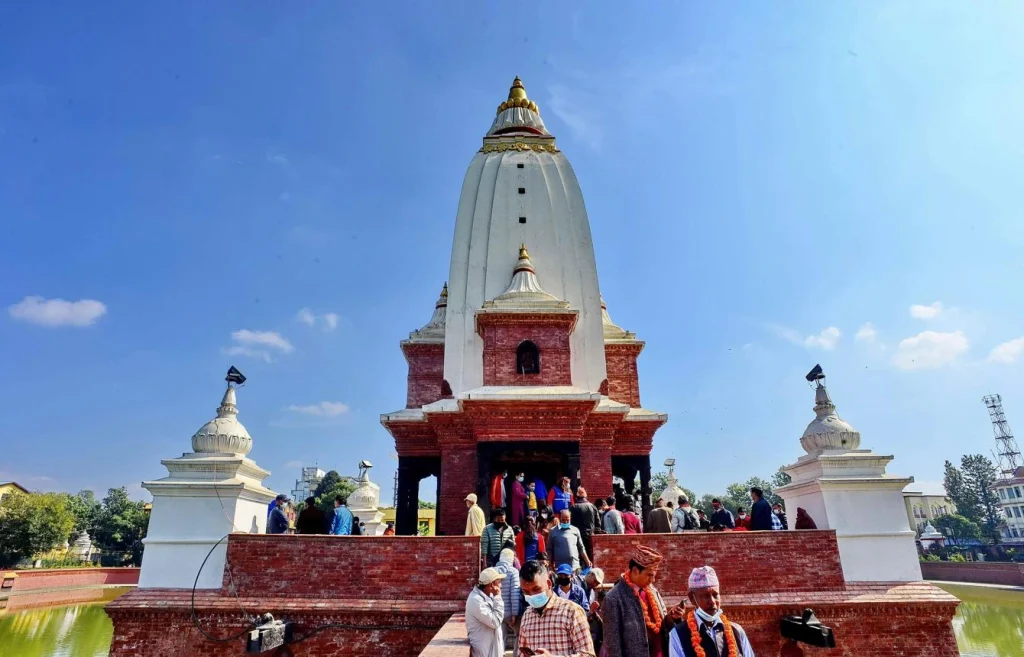
Rani Pokhari sits beside Ratna Park in central Kathmandu, a short walk from Asan and Indra Chowk. Most of the year you will see it from the perimeter railing. Access to the causeway and the shrine is limited to festival days, and those days are busy with people who are there to worship rather than to sightsee. Keep out of the way, ask before photographing people mid-ritual, and do not enter the water.
If you are planning a walking route through the old city, our Kathmandu city walking guide and our notes on holy places in the Kathmandu Valley help with sequencing. For festival days specifically, our guidance on attending a jatra respectfully applies here too.3
Frequently Asked Questions
Who built Rani Pokhari and why?
King Pratap Malla, who ruled Kathmandu from 1641 to 1674, built the pond around 1670. Accounts link it to the death of his son and describe it as both a consolation for the grieving queen and a religious work, consecrated with water carried from sacred sites across Nepal and northern India.
Can you go inside Rani Pokhari?
Not on most days. The pond is fenced and the central Balgopaleshwar shrine opens to the public once a year, on Bhai Tika at the end of Tihar. Chhath is also observed at the site. Outside those occasions you view it from the perimeter.
What is a hiti, and how is it connected to the pond?
A hiti, or dhunge dhara, is a stone spout set in a sunken courtyard that taps shallow groundwater. Ponds like Rani Pokhari fed that shallow groundwater by seeping through a semi-permeable clay bed, which kept spouts and wells downhill flowing in the dry season.
Why did the restoration take so long?
Work started in January 2016 and the site was inaugurated in October 2020. Early plans using concrete, fountains and a café were abandoned after public opposition, the project changed hands from Kathmandu Metropolitan City to the National Reconstruction Authority, the temple design was revised to a granthakut form, and the traditional clay and brick bed had to be tested before it was laid.
Does Rani Pokhari hold water now?
The rebuilt bed demonstrably holds water: monsoon rain filled the basin during construction in July 2019 after more than three years dry. What remains unresolved is a reliable year-round supply, since the original artesian wells and underground channels are reported as dried up or destroyed. Options including a Melamchi feed and roof rainwater harvesting have been discussed. We found no current published monitoring data on the water level.
How many stone spouts survive in the Kathmandu Valley?
A 2019 survey by the Kathmandu Valley water board, cited in a 2022 review in Environmental Challenges, identified 573 spouts. Of those, 94 were completely lost and 224 were functioning, with a combined discharge of about 2.4 million liters per day.
What is a rajkulo?
A rajkulo is a state-built canal that carried water to spouts, ponds and farmland. The 2022 review attributes the Kathmandu canals to Pratap Malla and the Bhaktapur canals to Jitamitra Malla, who ruled from 1673 to 1696, and identifies unclear ownership and funding after the Malla period as a cause of their decline.
Is the central temple original?
No. The shrine has been rebuilt after the 1934 and 2015 earthquakes. Its current form, granthakut, was identified during the restoration as closer to the Malla-era original than the domed version that stood before 2015. Exactly how the seventeenth-century structure looked is reconstructed from historical sources rather than directly documented, so some uncertainty remains.
Nepal’s heritage is easier to understand when you read it as a system rather than a list of monuments. Explore more of our Kathmandu Valley coverage, save this guide for your next walk through the old city, and follow NepalVue for more reporting on the places behind the postcard.


