



Most festivals invite people to worship gods, goddesses, or elements of nature. Mha Puja takes a different approach. It asks people to turn inward and honour themselves.
Celebrated by Newar communities during Tihar, Mha Puja is one of Nepal’s most distinctive cultural traditions. Family members sit before individually prepared mandalas as the eldest woman performs rituals and offers blessings for their health and long life.
The celebration also marks the beginning of Nepal Sambat, the traditional Newar calendar. In 2026, Mha Puja falls on November 10, welcoming Nepal Sambat 1147.


From its meaning and history to its colourful mandalas and traditional offerings, here’s everything you need to know about Mha Puja.
Quick Facts About Mha Puja 2026
- Date: Tuesday, November 10, 2026 (Kartik 24, 2083 BS)
- New Year: Nepal Sambat 1147 begins
- Meaning: Worship of the self or body
- Celebrated by: Hindu and Buddhist Newar communities
- Main ritual: Worshipping each family member in front of a specially prepared mandala
- Following day: Kija Puja (Bhai Tika), November 11, 2026
What Is Mha Puja?
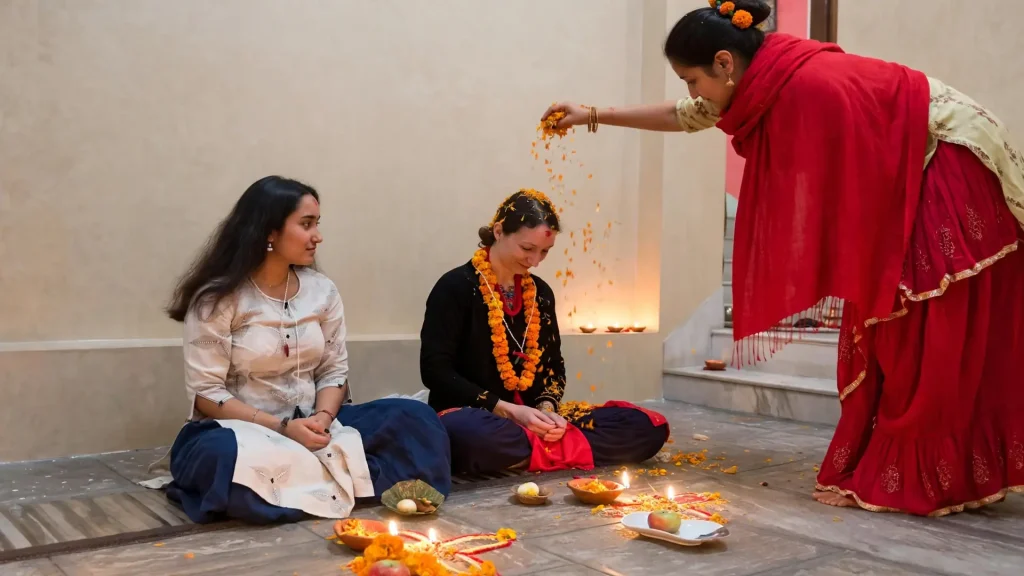
Mha Puja (म्हपुजा) is a traditional Newar festival centred on self-worship, purification, and renewal.
In the Newar language, ‘Mha’ means body or self, while ‘Puja’ means worship. Together, the words describe a ritual in which people honour their own existence.
The festival is observed by both Hindu and Buddhist Newars in Nepal and abroad. It is an important part of Newar cultural identity and carries a deeper message about self-respect, gratitude, and inner well-being.
According to the Nepal Tourism Board, Mha Puja honours the inner self and the life force that sustains human existence. The rituals symbolise cleansing negativity and beginning the new year with positive intentions.
What Makes Mha Puja Different?
Unlike many other festivals, Mha Puja places the individual at the centre of worship.
Every family member receives their own mandala and is worshipped individually. Children, adults, and elderly family members all take part in the same ritual.
This makes the celebration particularly meaningful. It reminds everyone that their life has value and deserves respect.
Although Mha Puja shares its date with Govardhan Puja in many parts of Nepal, its rituals and cultural significance are distinctly Newar.
When Is Mha Puja in 2026?
Mha Puja will be celebrated on Tuesday, November 10, 2026, corresponding to Kartik 24, 2083 BS.
The festival falls on Kartik Shukla Pratipada, the first day of the waxing moon following Laxmi Puja.
The same day also marks the beginning of Nepal Sambat 1147, the traditional Newar New Year.
Here are the important dates:
- November 10, 2026: Mha Puja and Nepal Sambat 1147 New Year.
- November 11, 2026: Kija Puja (Bhai Tika).
While many Nepalis celebrate Govardhan Puja and Goru Puja on November 10, Newar families observe Mha Puja as their own new year tradition.
Mha Puja and the Nepal Sambat New Year
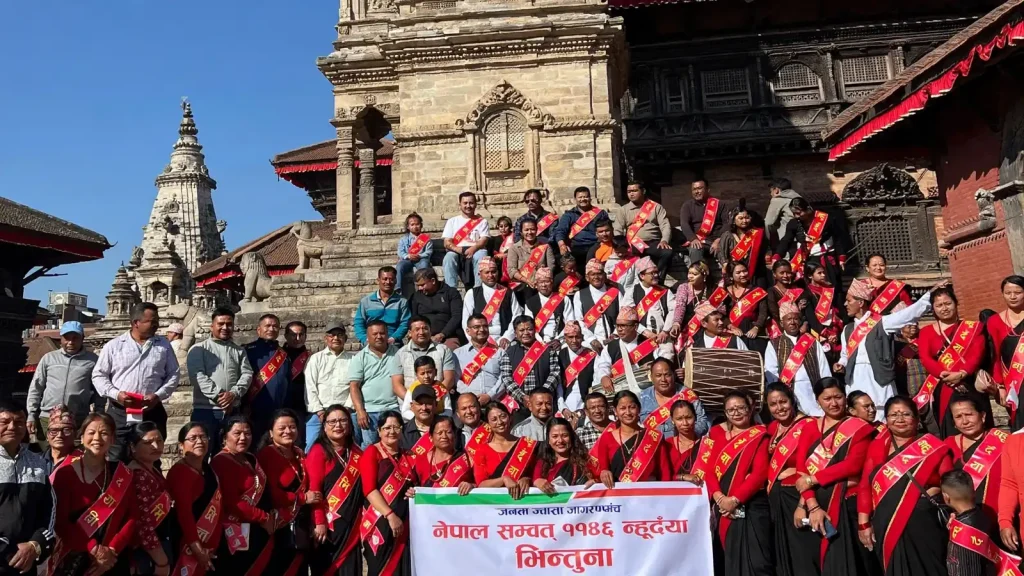
Mha Puja and Nepal Sambat are closely connected. For Newar communities, the festival is not only a celebration of the self but also the beginning of a new calendar year.
What Is Nepal Sambat?
Nepal Sambat is a traditional lunisolar calendar associated with the Newar community. It continues to guide the dates of many important Newar festivals, cultural events, and religious ceremonies.
Its new year begins during Swanti, the Newar celebration that runs alongside Tihar.
The History Behind Nepal Sambat
The origins of Nepal Sambat are generally traced to the late ninth century. Historical accounts place its beginning around 879 CE, although some sources suggest slightly different dates.
The calendar is traditionally associated with Sankhadhar Sakhwa, a merchant remembered in Newar folklore for clearing the debts of the people of Kathmandu Valley.
According to the popular legend, Sankhadhar used his wealth to free the people from their financial obligations. This act became the foundation of a new calendar, symbolising a fresh beginning for the community.
Sankhadhar Sakhwa’s Recognition
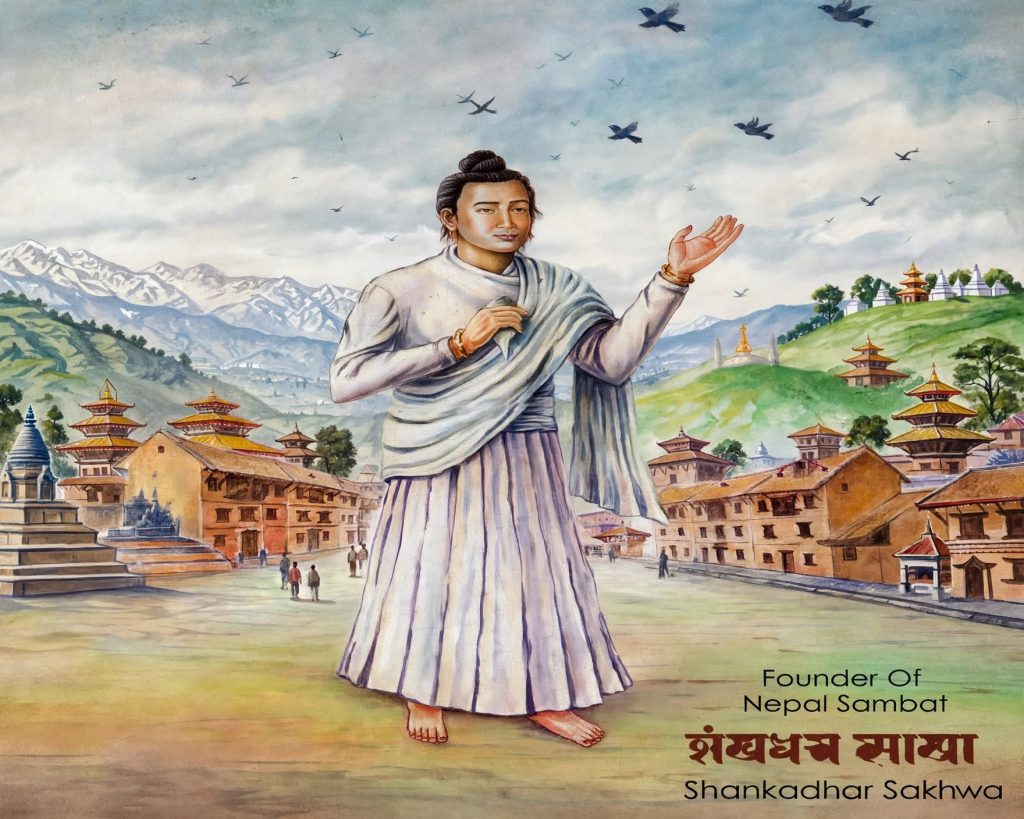
Sankhadhar Sakhwa’s contribution received national recognition in modern Nepal.
On November 18, 1999, the government declared him a national hero. Nepal Sambat also gained recognition as a national calendar in 2007.
Today, its new year remains an important occasion for Newar communities, with cultural processions, celebrations, and greetings across Nepal.
Where Does Mha Puja Fit Into Swanti and Tihar?
Mha Puja is the fourth day of Swanti, the Newar version of the five-day Tihar celebration.
Each day carries its own religious and cultural significance.
- Kwah Puja: The first day honours crows, which are traditionally regarded as messengers.
- Khicha Puja: The second day is dedicated to dogs, celebrating their loyalty and companionship.
- Laxmi Puja: Families worship Goddess Laxmi, the goddess of wealth and prosperity, and prepare special household shrines.
- Mha Puja: The fourth day celebrates the self and marks the beginning of Nepal Sambat.
- Kija Puja: The final day honours brothers through rituals performed by their sisters. It is also known as Bhai Tika.
After Swanti, another family tradition involves parents inviting their married daughters to share food associated with the offerings made during Laxmi Puja.
The Mandala: The Heart of Mha Puja
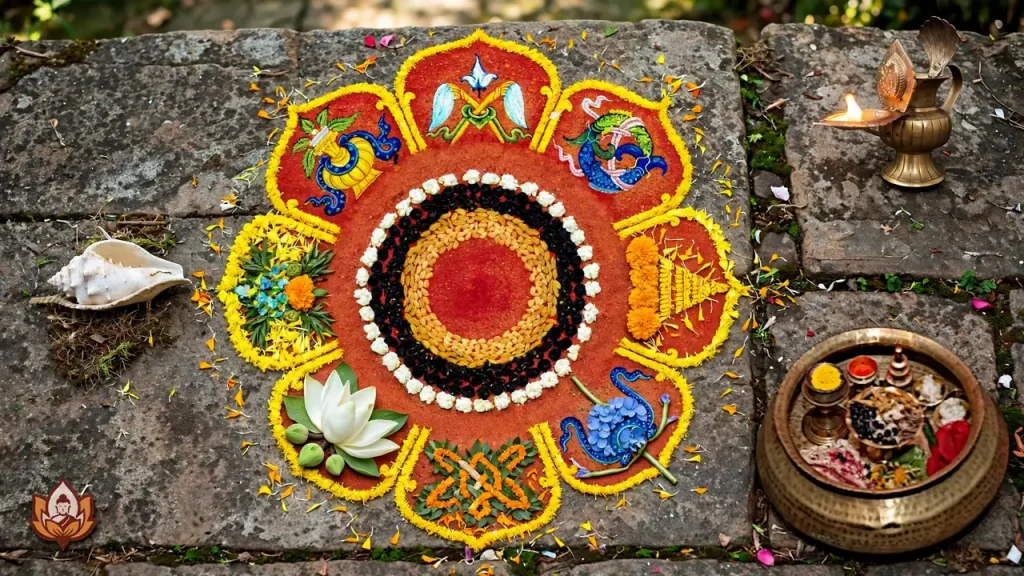
One of the most beautiful parts of Mha Puja is the mandala.
Before the ceremony begins, families prepare individual mandalas on the floor. Each family member sits in front of one, making the mandala an important part of the worship.
These designs are not simply decorative patterns. They carry spiritual meanings connected to the human body, the universe, and the elements of life.
How Is the Mha Puja Mandala Made?
The traditional mandala consists of several concentric circles. Families create these circles using different natural and ritual materials, including:
- Water
- Oil
- Rice
- Unhusked rice (paddy)
- Yellow powder
- Red powder
Each material contributes to the design and its ritual significance.
What Is Jajamka?
At the centre of the mandala is a special arrangement known as Jajamka.
It consists of five compact circles decorated with rice, paddy, flowers, and ritual threads.
The five circles represent the five elements and the divine presence within a person.
What Does the Mandala Symbolise?
The mandala represents the connection between an individual and the universe.
It reflects the belief that human existence is part of a much larger cosmic order. The Nepal Tourism Board also describes the mandala as a representation of the cosmos.
During the ritual, a burning lamp symbolises inner awareness and enlightenment.
Together, the mandala and its offerings remind people to recognise the value of their own existence.
How Is Mha Puja Celebrated? Rituals Explained
Although some details vary between families, the central rituals follow a traditional sequence.
The ceremony usually takes place inside the family home, where everyone gathers for the worship.
1. Family Members Gather Together
The family sits in a row, with each person having a designated place for the ceremony.
Age and gender do not determine who receives worship. Every member participates in the celebration.
2. Individual Mandalas Are Prepared
A separate mandala is arranged in front of each family member.
The designs are prepared using traditional materials such as rice, paddy, oil, water, and coloured powders.
3. The Eldest Woman Performs the Puja
The eldest woman in the household leads the ceremony.
She worships each family member individually, offering flowers, applying tika, and performing the traditional rituals.
This role makes her an important figure in the celebration, as she becomes the person who offers blessings to the entire household.
4. The Sacred Flame Is Offered
One of the important moments involves a burning oil-fed wick called Khelu-Ita.
Traditionally, its length corresponds to the length of a human face. It is offered as a symbol connected to the individual’s life force and longevity.
5. Family Members Receive Sagun
After the main worship, each person receives sagun, an assortment of auspicious foods offered as part of the ritual.
These offerings carry symbolic meanings and are an essential part of Mha Puja.
6. Blessings for a Long Life
The ceremony concludes with traditional gifts and blessings associated with longevity, strength, and prosperity.
Walnuts, jackfruit, common citron, and Gwae Swan flowers are among the items used for this purpose.
What Is Sagun in Mha Puja?
Sagun is an auspicious offering given during important Newar ceremonies and celebrations.
During Mha Puja, it represents good fortune, well-being, and the blessings of a prosperous life.
According to traditional descriptions on the Nepal Sambat website, the Mha Puja sagun includes six items associated with the five tantric Makaras and an additional whole egg.
| Offering | Symbolic meaning |
|---|---|
| Whole egg | Wholeness and the unbroken cycle of life |
| Fish | Fluidity, adaptability, and abundance |
| Meat | Strength and physical nourishment |
| Wine | Spirit, joy, and devotion |
| Fried ginger | Offering, warmth, and the body |
| Bean cake | Completeness of the offering |
The exact offerings can differ between households and religious traditions. Therefore, this list describes a traditional arrangement rather than a rule followed by every family.
Traditional Gifts That Symbolise Long Life
Mha Puja also includes special gifts associated with longevity.
Some of the traditional items include:
- Walnuts: Symbolise strength and endurance.
- Jackfruit: Represents longevity through its long-lasting tree.
- Common citron: Symbolises preserved vitality.
- Gwae Swan: A long-lasting flower that retains its shape for months or even years.
Among these, Gwae Swan holds particular importance as a symbol of long life in Newar culture.
The Philosophy Behind Mha Puja
The meaning of Mha Puja goes beyond the rituals and offerings. Its central message is about recognising the value of human life.
The Divine Within Every Person
Mha Puja reflects the belief that divinity exists within every individual.
By worshipping themselves, people acknowledge their own existence and develop a sense of self-respect and gratitude.
The Nepal Tourism Board connects this tradition with mindfulness and inner peace. Its message is simple: creating peace within ourselves is an important step towards creating peace in the world.
Everyone Deserves Equal Respect
Another important aspect of Mha Puja is the way it brings family members together.
Every person receives individual worship, regardless of age or gender.
A young child and an elderly grandparent are both honoured through the same central ritual. This reflects the festival’s emphasis on the value of every individual.
The Important Role of Women
The eldest woman leads the Mha Puja ceremony and offers blessings to each family member.
Her role reflects the importance of women in preserving and passing down traditional family rituals.
A Fresh Beginning for the New Year
Mha Puja is also a time for renewal.
As Nepal Sambat begins, families gather to seek good health, prosperity, and long life. The rituals offer an opportunity to reflect on the past and welcome the coming year with positive intentions.
Mha Puja vs Govardhan Puja: What’s the Difference?
Both Mha Puja and Govardhan Puja can fall on the same day, but they have different religious and cultural meanings.
Govardhan Puja is observed by many Hindu communities and is associated with the worship of Govardhan Hill. Goru Puja also honours cattle and their contribution to agricultural life.
Mha Puja, meanwhile, is a distinct Newar tradition centred on self-worship and the beginning of Nepal Sambat.
Although these celebrations share the same calendar date, their rituals and purposes are different.
Where Is Mha Puja Celebrated?
Mha Puja is observed by Newar communities across Nepal and in different parts of the world.
Hindu and Buddhist Newar Communities
Both Hindu and Buddhist Newars celebrate Mha Puja.
Despite differences in certain household practices, the festival remains a shared cultural tradition that strengthens Newar identity.
Beyond Kathmandu Valley
Although closely associated with Kathmandu Valley, Mha Puja is not limited to Kathmandu, Lalitpur, and Bhaktapur.
Newar families across Nepal continue the tradition. It is also celebrated by diaspora communities abroad, including those in India and Tibet.
Public Celebrations and Processions
Alongside private family rituals, Newar communities organise public celebrations to welcome the Nepal Sambat New Year.
Kathmandu Valley often sees cultural processions, traditional music, and public gatherings in historic Newar settlements.
Patan, Bhaktapur, and Kirtipur are among the places where visitors can experience Newar culture and celebrations.
However, public event schedules can change each year. Check local announcements before planning your visit.
How Can Visitors Experience Mha Puja Respectfully?
If you are visiting Nepal during Tihar, Mha Puja offers a wonderful opportunity to understand Newar culture beyond the usual tourist attractions.
However, it is important to remember that the main ceremony is a family ritual, usually performed inside private homes.
Here are a few ways to experience the celebration respectfully.
Respect household privacy: Do not enter someone’s home expecting to watch the ceremony. Wait for a personal invitation.
Accept invitations graciously: If a Newar friend, host, or local family invites you to join, consider it a special opportunity to experience the tradition.
Dress appropriately: Wear clean, modest clothing when attending a family celebration or cultural gathering.
Follow your host’s instructions: Every household may have slightly different practices. Observe first and follow the family’s guidance.
Ask before taking photographs: The mandalas and rituals can be fascinating to photograph, but always seek permission before capturing people or private ceremonies.
Learn a traditional greeting: You can wish people “Nepal Sambat ko shubhakamana” or simply say “Happy New Year.”
Explore public celebrations: Visit historic Newar settlements such as Patan, Bhaktapur, and Kirtipur to experience the cultural atmosphere and public festivities.
Respect the offerings: Traditional sagun may include meat and alcohol. Different families follow different practices, so avoid making assumptions about what they offer.
For travellers interested in Nepal’s living traditions, Mha Puja provides a meaningful way to understand how culture, spirituality, and family life come together.
Common Mha Puja Terms You Should Know
Understanding a few traditional terms makes it easier to follow the rituals and appreciate their significance.
| Term | Meaning |
|---|---|
| Mha | Body or self |
| Puja | Worship |
| Swanti | Newar five-day festival celebrated alongside Tihar |
| Nepal Sambat | Traditional Newar lunisolar calendar |
| Sagun | Auspicious ritual offering |
| Jajamka | Special arrangement at the centre of the mandala |
| Khelu-Ita | Sacred oil-fed wick |
| Gwae Swan | Long-lasting flower associated with longevity |
| Kija Puja | Traditional ceremony honouring brothers |
Final Thoughts: Why Mha Puja Matters
Mha Puja offers a different way to welcome a new year. Instead of focusing only on what lies ahead, it encourages people to recognise the value of the life they already have.
Through mandalas, traditional offerings, family gatherings, and blessings, the festival celebrates self-respect, gratitude, and the connection between people and the universe.
On November 10, 2026, Newar families will welcome Nepal Sambat 1147 with these traditions, keeping a centuries-old cultural practice alive.
For travellers, understanding Mha Puja is also an opportunity to discover another side of Nepal. Beyond its mountains, temples, and popular festivals, the country has traditions that reveal how people live, celebrate, and connect with their cultural roots.
Mha Puja is a reminder that sometimes the most meaningful celebration begins with honouring yourself.
Frequently Asked Questions
What is Mha Puja?
Mha Puja is a Newar ritual of self-worship performed on the first day of the Nepal Sambat new year. “Mha” means body or self, and “Puja” means worship.
When is Mha Puja in 2026?
Mha Puja falls on Tuesday, November 10, 2026 (Kartik 24), the fourth day of Tihar. Nepal Sambat 1147 begins the same day.
Why do Newars worship themselves on Mha Puja?
The ritual honors the divine within each person. It purifies the soul, renews the spirit for the new year, and affirms self-respect, mindfulness, and gratitude.
Who performs the puja?
The eldest woman of the family worships every member in turn, regardless of age or sex.
What is the Mha Puja mandala made of?
It is drawn with concentric circles of water, oil, rice, paddy, and yellow and red powders. At the center is the Jajamka, a group of five circles.
What is sagun?
Sagun is an auspicious offering of six ritual items: a whole egg, fish, meat, wine, fried ginger, and bean cake. Households vary in what they offer.
How is Mha Puja different from Govardhan Puja?
Govardhan Puja honors cattle and is common among non-Newar Hindus. Mha Puja focuses on the self and the Newar new year, though both fall on the same day.
What is Nepal Sambat?
Nepal Sambat is the Newar lunisolar calendar. Its new year, Nepal Sambat 1147 in 2026, begins on Mha Puja.
Who was Sankhadhar Sakhwa?
He was a merchant honored as the founder of Nepal Sambat. According to folklore, he started the calendar after clearing the debts of the people of the valley. Nepal declared him a national hero in 1999.
Can tourists watch Mha Puja?
Mha Puja is mainly a family ritual at home. Visitors should attend only by invitation, and can enjoy public Nepal Sambat processions and greetings in Newar towns.
What comes after Mha Puja?
Kija Puja, the Newar version of Bhai Tika, follows on November 11. Parents also traditionally invite married daughters after Swanti to share the feast offered to Goddess Laxmi.


