



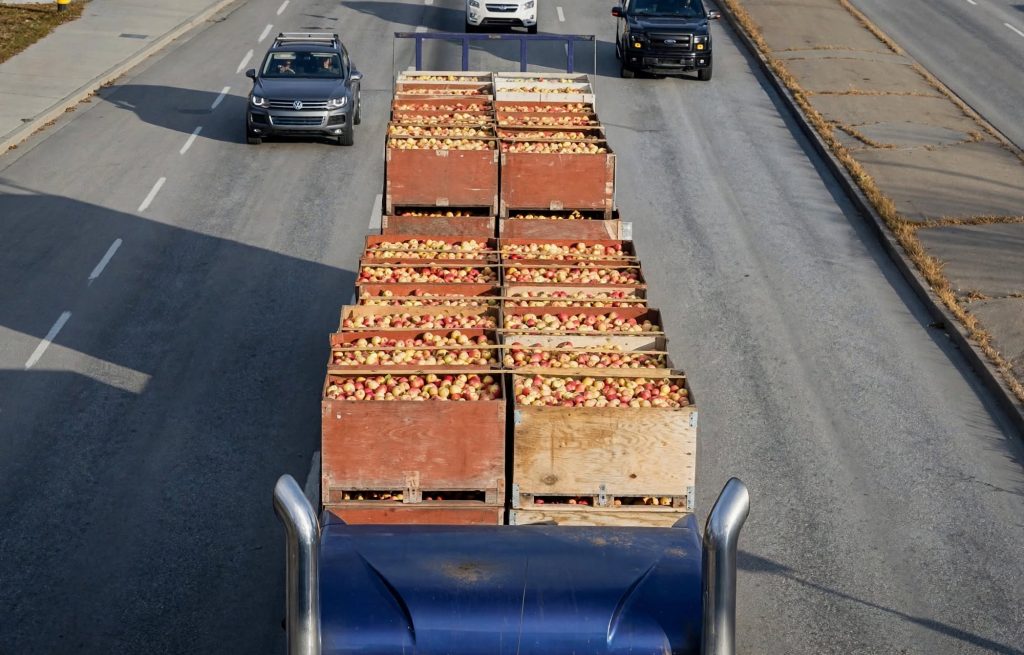
On 27 September 2026, the Beni to Jomsom road closed. Landslides and river erosion from heavy rain cut the only practical route out of Mustang for two weeks, at the exact moment the district’s biggest crop was coming off the trees.
By mid-October, officials estimated only 30% of Mustang’s apples had reached outside markets, against the 70% normal for that date. Behind that logistics failure sits a more interesting story. Marpha apples come from a cold, almost rainless valley that became Nepal’s apple capital in living memory, and both the water system that sustains it and the climate it depends on are shifting.
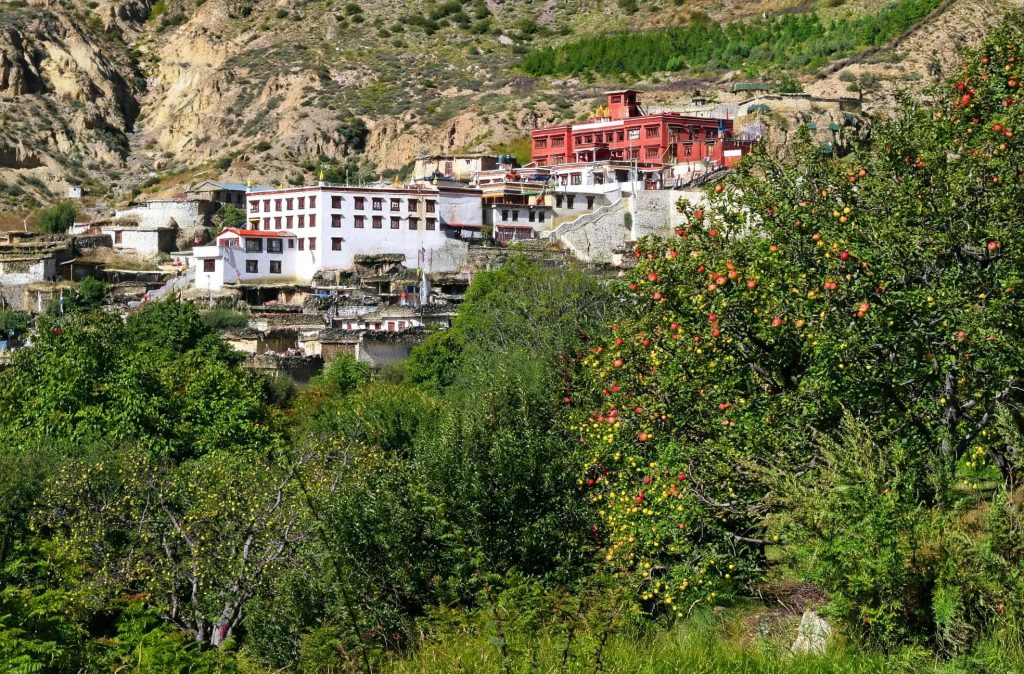
Where Marpha sits, and why that matters
Marpha is a Thakali village at roughly 2,670 m on the west bank of the Kali Gandaki, about 10 km north of Jomsom. It lies behind the Annapurna and Dhaulagiri ranges, inside one of the driest zones in Nepal. Published research puts annual rainfall across Mustang, Manang and Dolpa at under 200 mm, with under 150 mm falling during the monsoon itself.


Apples need three things that this valley supplies unusually well. Cold winters give the trees the dormancy they require. Intense high-altitude sunlight and wide day-night temperature swings build sugar and color in the fruit. Dry air suppresses many of the fungal diseases that plague orchards in wetter hills.
What the valley does not supply is rain. Everything grown here is grown on channeled meltwater.
The water system
Farming in the upper Kali Gandaki depends on gravity-fed channels, known in Nepali as kulo, which divert water from side streams fed by snowmelt and ice above the villages. Channels run for kilometers along contour lines, often cut into loose scree, and deliver water to terraced plots and orchards below. Maintenance is collective. Clearing silt, repairing breaches and allocating turns are village responsibilities rather than state ones, and the arrangements vary from settlement to settlement.
Dependence on that infrastructure is total, and it is why water source failure is an existential issue rather than an inconvenience. Reporting by The Kathmandu Post in April 2025 documented the consequences in Upper Mustang. In Samjong, 18 families began leaving in 2014 and 2015 after their springs dried. In Dhe, more than 20 families left in 2007 for the same reason and resettled at Thamsung, at 3,700 m on the Kali Gandaki. Tetang has not been abandoned, but ward member Dhurpo Gurung described irrigation springs four hours uphill drying out and canal flows weakening.
Snow is the hinge. Winter snowfall recharges the groundwater and springs that feed these channels through the growing season. ICIMOD’s snow monitoring ranked 2024 as the second-lowest Himalayan snow cover on record, part of a declining trend over the past 13 years. Surendra Hirachan, who has grown apples in Mustang for close to 50 years, told The Annapurna Express that his trees once depended entirely on snowfall.
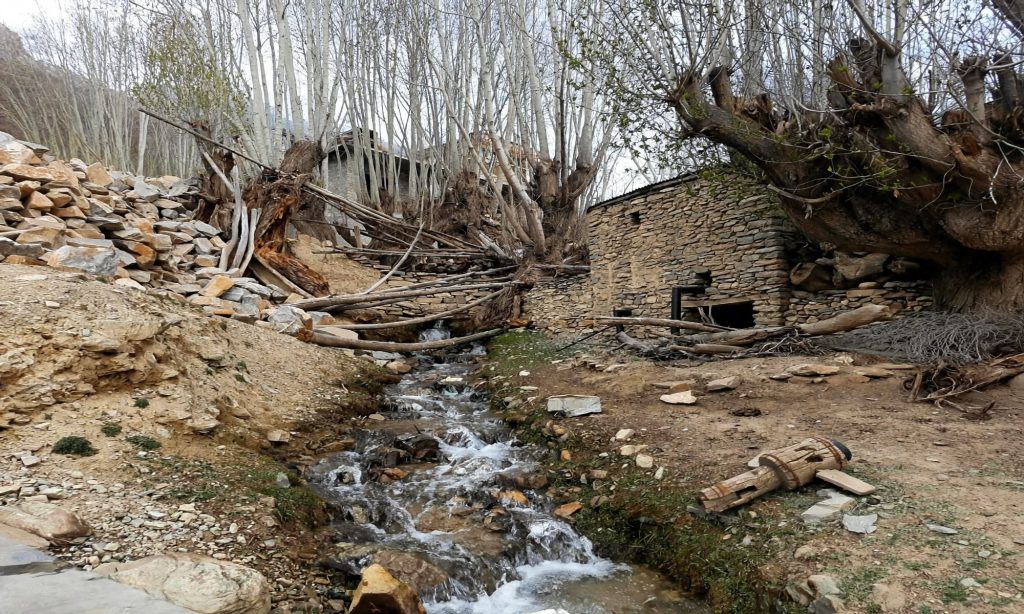
How apples arrived
Apple cultivation in Mustang is recent by the standards of Himalayan agriculture. Growing began in the 1960s, credited locally to Buddhi Ratna Sherchan, remembered in the district as the “apple father.” A government temperate horticulture center at Marpha has supplied planting material, grafting expertise and variety trials to growers across the district since the early decades of that effort.
Before apples, these villages grew barley, buckwheat, mustard and potatoes, and many still do. Mustang’s position on the old salt and grain route to Tibet gave Thakali households trading capital and a commercial instinct, and apples fit that pattern: a durable, high-value product that could be processed if transport failed.
Processing is now substantial. Growers make brandy, wine, juice, jam, dried apple and candy locally, and more than a dozen apple-based enterprises operate in the area. Value-added products matter precisely because the road is unreliable. Brandy does not rot when a landslide closes the highway.
What the numbers say
Mustang’s apple output has grown substantially, though the figures come from different reporting bodies and should not be read as a single clean series.
| Year | Scope | Area (ha) | Production (Mt) | Yield (Mt/ha) |
|---|---|---|---|---|
| 2015/16 | Marpha center reporting | 957 | 3,600 | 3.76 |
| 2017/18 | Marpha center reporting | 900 | 5,188 | 5.76 |
| 2019/20 | Marpha center reporting | 908 | 5,818 | 6.41 |
| 2077/78 BS | Mustang district | 1,440 planted, 550 productive | 6,845 | 12.45 |
| 2026 | Mustang district estimate | Not stated | 10,000 | Not stated |
Figures for 2015/16 through 2077/78 BS come from Bhola Nath Dhakal’s 2023 study in the RR Interdisciplinary Journal. The 2026 estimate of 10,000 metric tonnes, up from 7,000 last year, comes from Bharat Gautam, head of the National Agriculture Modernization Program in Mustang, quoted in October 2026. Sales this season are expected to approach Rs 2 billion.
Yield is the number worth watching. Dhakal recorded Marpha yields below Nepal’s national average of 8.53 Mt per hectare over the period he studied, which points to aging trees, uneven management and gaps between planted and productive area rather than to poor land.
Microclimate at orchard scale
Two orchards a kilometer apart in this valley can behave like different farms. Wind is one reason. Strong up-valley winds build through the Kali Gandaki every afternoon, and sheltered pockets behind spurs or stone walls hold heat and lose less soil moisture than exposed ground. Aspect is another. South-facing terraces warm earlier in spring, which advances flowering and exposes blossom to late frost, while shaded north-facing plots flower later and dodge it.
Cold air drainage matters most. On clear nights, dense cold air slides downhill and pools on flat valley floors. Orchards sited in those frost hollows lose blossom in a bad spring, while trees on mid-slope benches a few meters higher come through intact. Growers in Marpha and Tukuche have read this terrain for generations, and the siting of old orchards reflects it.
Soil is thin and stony, derived from glacial and river deposits, with little organic matter. Fertility here is built rather than inherited, through manure from livestock and composted crop residue. Loss of household livestock, as younger people leave for Pokhara, Kathmandu and overseas work, quietly removes the nutrient supply that these orchards were built on.
What is actually going wrong
Growers interviewed by researchers and reporters name problems in a consistent order, and transport leads.
- Roads and marketing: 60% of surveyed growers in Marpha cited seasonal roads and weak marketing infrastructure as their main constraint.
- Technical knowledge: 42.1% cited limited access to orchard management expertise.
- Input timing: 37.2% reported inputs arriving too late in the season to be useful.
- Pests: 32.4% reported insect damage.
- Storage: 26.9% lacked cold storage, which forces sale at harvest-time prices.
Those survey figures date from fieldwork in 2017, so treat them as a ranking of persistent constraints rather than a current snapshot. September 2026 suggests the ranking still holds. Aitaram Tamang, who manages Chimle Orchard Agriculture Farm in Gharpajhong-5, sent six truckloads to Kathmandu within two days of the road reopening. Capacity was never the issue. Access was.
The climate problem is specific, not vague
Apple trees need chilling. Most varieties planted in Mustang are high-chill types that require a cumulative number of hours below a threshold temperature in winter before they will flower properly in spring. Warmer, drier winters shorten that accumulation. Flowering turns irregular, fruit set weakens, and quality drops even when tree numbers stay the same.
Field reporting across the district shows the pattern moving uphill. At Lete, around 2,480 m, apple farming has effectively ended. Resident Shanti Tulachan described too much rain and almost no winter snow. In Kobang, Basanta Sherchan found fungal spotting on trees he attributed to warmer conditions and now sprays up to five times a year, while some neighbors have switched to walnut. Above Kagbeni, Tsering Norbu Gurung reported apples that are smaller but more numerous, with harvest sliding from September into October.
Meanwhile the northern limit is moving. Growers are planting as far north as Lo Manthang at 3,840 m, ground long considered too cold. In Ghiling, Maitri Ratna Nepal established an orchard of nearly 1,000 trees. Ram Subedi, a local official, told The Kathmandu Post that summer temperatures had risen from 22 to 23°C up to around 27°C, adding that “just those few degrees have made all the difference.” Frost still bites: spring frost cut the Ghiling orchard to 3,500 kg one year, against an expectation of around 15,000 kg the next.
Rainfall in the rain shadow is also rising. Jomsom’s annual total went from under 300 mm in 2010 to 665 mm in 2023, and Upper Mustang’s highest annual figure rose from under 200 mm before 2009 to 331 mm in 2023. More summer rain in a desert valley is not a gift for apple growers. Rain near harvest splits fruit, feeds fungal disease and destabilizes slopes that irrigation channels are cut into.
What adaptation looks like here
Responses on the ground are practical rather than programmatic. Growers are experimenting with lower-chill varieties and with rootstocks suited to drier soils. Some are adding drip irrigation to stretch limited channel flows. Others are moving plantings higher, or hedging into walnut, apricot and seabuckthorn.
Cold storage and processing capacity do more for grower income than yield gains, because both decouple sale from the road’s condition. Tourism offers a third channel. Visitors on the Jomsom and Kagbeni route and the Upper Mustang overland itinerary buy fresh fruit, brandy and dried apple directly, at prices no wholesaler offers.
None of this is settled. Whether Mustang’s apple belt shifts north intact or fragments depends on winter snowfall, which models handle poorly in complex terrain. Researchers disagree on how far and how fast chilling thresholds will be breached in Himalayan valleys, and the district-level data needed to resolve that is thin.
Frequently asked questions
Why is Marpha known for apples?
Cold winters, intense sunlight, wide daily temperature swings and very low rainfall suit apple growing, and a government horticulture center at Marpha has supplied planting material and grafting expertise to growers since the early decades of cultivation.
How are the orchards watered if it barely rains?
Through gravity-fed channels that divert snowmelt and stream water from above the villages along contour lines. Maintenance and water allocation are managed collectively by the village rather than by a central agency.
When is apple harvest in Mustang?
Broadly September into October, with growers in several villages reporting the harvest shifting later over recent decades. Picking continues through October in higher orchards.
How much does Mustang produce?
Officials estimated around 10,000 metric tonnes for 2026, up from about 7,000 the previous year. District figures for 2077/78 BS recorded 6,845 metric tonnes from 550 productive hectares.
What are Mustang apples made into?
Fresh fruit is the main product, with brandy, wine, juice, jam, dried apple and candy produced locally. Processing matters because road closures can strand fresh fruit for weeks.
Is climate change ending apple farming in Mustang?
Not ending it, but relocating it. Lower villages such as Lete have lost commercial apple growing, while plantings are advancing north toward Lo Manthang. Declining winter snowfall and shortened chilling are the central mechanisms.
Can visitors buy apples directly from growers?
Yes. Marpha, Tukuche and nearby villages sell fresh apples and apple products directly during and after harvest, and several orchards and small distilleries welcome visitors.
Why do Mustang apples sometimes fail to reach Kathmandu?
Because one road carries almost everything. In 2026 the Beni to Jomsom road was blocked for two weeks from 27 September by landslides and river erosion, and only about 30% of the crop had been exported by mid-October.
Sources used
Production and climate material here draws on The Kathmandu Post’s reporting on apple farming and climate in Mustang and on Nepal News coverage of the 2026 harvest and road disruption.
Mustang repays slow travel and close attention. If this was useful, save it for your route planning, pass it to anyone heading up the Kali Gandaki, and explore more of the region with NepalVue, including our wider Mustang travel guide.


