



What is actually happening when a healer in a Dolakha village drums through the night, begins to shake, and speaks as a deity? Two answers are usually offered. The practitioners have one, worked out over generations and encoded in chanted oral texts. Researchers in anthropology and neuroscience have another, far less complete than popular accounts suggest. This article sets out both, in that order, and is careful about which claims the evidence supports. It also explains why Dolakha in particular is a district where several distinct traditions sit side by side.
First, the Words
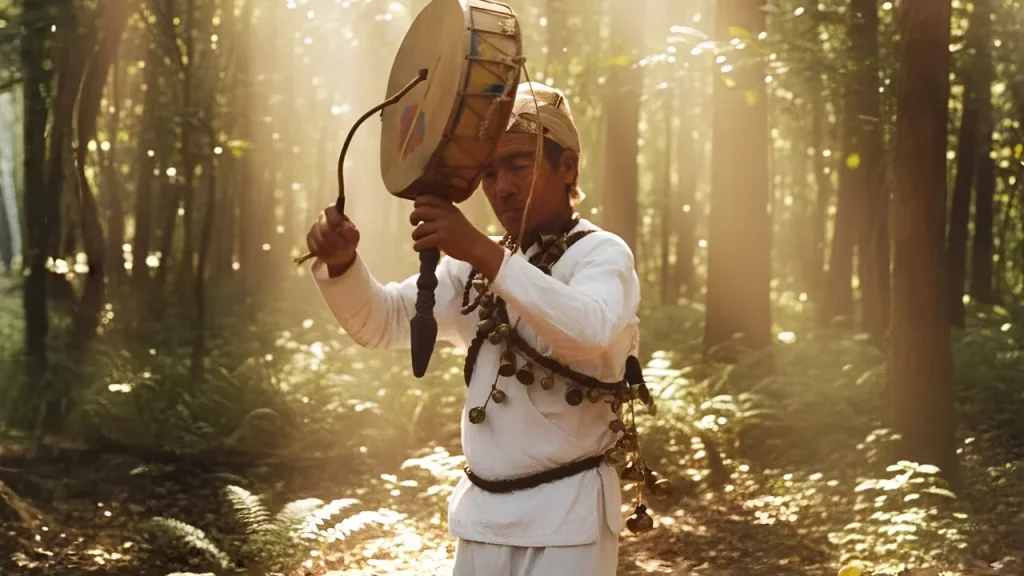
English-language writing about Nepal tends to flatten a dozen different roles into one word. That is worth undoing before anything else.
Jhankri is a Nepali term, widely used across hill communities, for a ritual specialist who diagnoses and treats affliction through drumming, chanting and possession by a tutelary deity. Dhami is often paired with it in the compound dhami-jhankri, though researchers note the two are distinct roles rather than synonyms.


Other communities use their own terms. Tamang practitioners are called bombo. Among the Thangmi, the ritual specialist is a guru. These are not translations of each other. They sit in different ritual systems with different cosmologies, different oral texts and different relationships to Hindu and Buddhist practice.
So when you read “Nepali shamanism” as a single thing, treat the phrase with suspicion. Nepal recorded 124 caste and ethnic groups and more than 120 languages in its census work. Ritual practice varies accordingly.
Why Dolakha
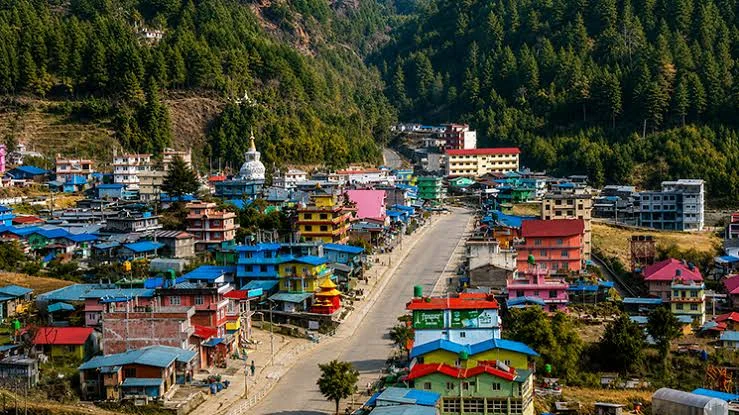
Dolakha district, in Bagmati Province, had a population of roughly 172,700 in the 2021 census. It stretches from about 300 meters in its lowest tropical zone to above 5,000 meters, with Charikot as its headquarters and Jiri and Bhimeshwar as its urban municipalities.
Its linguistic composition is the reason it matters here. In 2021, first-language speakers broke down roughly as follows.
| Language | Share of first-language speakers, Dolakha, 2021 |
|---|---|
| Nepali | 62.20% |
| Tamang | 16.60% |
| Thami (Thangmi) | 9.04% |
| Sherpa | 4.89% |
| Jirel | 2.41% |
| Newari | 2.27% |
| Sunuwar | 1.03% |
Tamang are the largest Janjati group in the district, and Thangmi the second largest. Dolakha and neighboring Sindhupalchok form the Thangmi homeland. That concentration is unusual, and it means a single district contains several ritual systems that are genuinely separate, not regional variants of one practice.
Anthropologists Sara Shneiderman and Mark Turin, who have worked with Thangmi communities in Nepal and India, estimate a total Thangmi population of 33,000 to 38,500, against official census figures they consider underestimates. They record a parallel descent system in which men and women inherit clan membership from their same-sex parent, an endangered Tibeto-Burman language, and an origin story chanted at the opening of every ritual.
The Practitioners’ Account
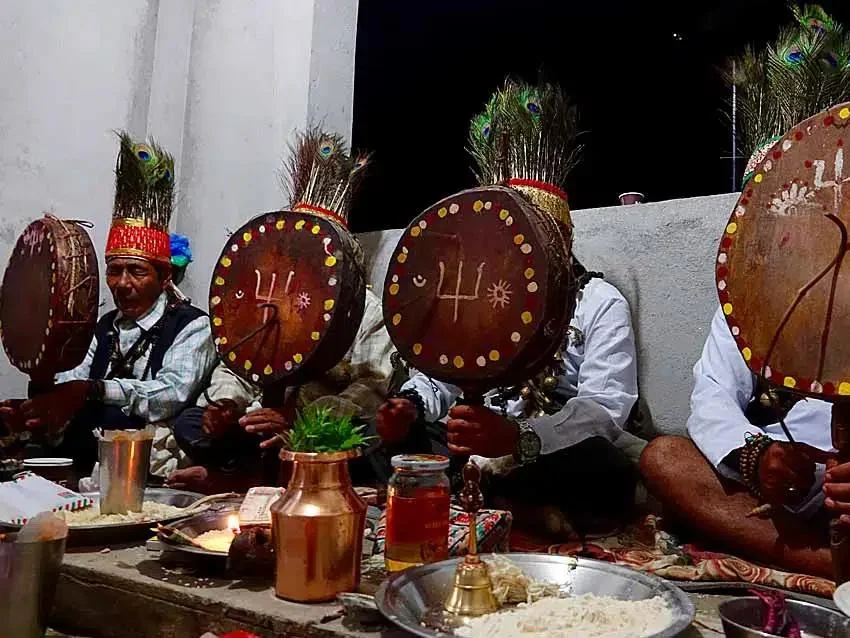
Start where the tradition starts, because reversing the order quietly tells the reader which explanation is real.
In the framework most jhankris work within, serious misfortune is not random. Illness, accident and persistent bad luck can have causes that a clinic does not address: a disturbed deity, an ancestral obligation left unmet, a bhut pret or ghost attachment, or the displacement of what Nepali speakers call saato, roughly the soul or vital essence.
The Nepali verb lagne covers this category of supernatural affliction. It is not a metaphor in use. It is a diagnostic term.
A jhankri’s work is therefore investigative before it is therapeutic. The practitioner must determine what is attached, what is owed, or what has been lost. Possession by the practitioner’s own tutelary deity is the instrument for finding out. Drumming on a frame drum, chanted mantra, and the shaking that signals the deity’s arrival are the method, not the spectacle.
Researchers working in rural Nepal have documented the vocabulary of specific techniques: phukne, a blowing technique directed at the afflicted person, and chinta, a night-long healing ceremony.
Becoming a jhankri is not a career choice in the ordinary sense. Across many of these traditions, the role begins with a calling that the person does not seek and often resists, followed by a long apprenticeship under a guru in which oral texts are memorized. Those texts can be extremely long. The transmission is verbal, and the accuracy of transmission is itself a matter of ritual seriousness.
What Research Actually Shows
Now the second account, with its limits stated.
How common is this?
Traditional healers are not a residual practice. Pham, Koirala and Kohrt, writing in the International Journal of Mental Health Systems in 2021, conducted 124 in-depth interviews in rural southeastern Nepal with 40 traditional healers, 79 community members and 5 physicians. Thirty-three of the healers were dhami-jhankri.
Their findings complicate the idea that people choose between tradition and biomedicine.
- 63% of respondents combined medical and magico-religious explanations for illness.
- 52% used both types of service, regardless of how they explained the illness.
- 36% sought traditional care first.
- 58% favored stronger collaboration between healers and clinicians, with 13% specifically proposing two-way referrals.
- Among those who felt judged for traditional beliefs, 19.4% reported dissatisfaction with medical care.
Note what that last figure implies. Dismissing a patient’s framework is not neutral. It has a measurable cost in whether that patient returns.
Two cautions on this study. It was conducted in southeastern Nepal, not Dolakha, and the authors withheld the specific locations for anonymity. One reported percentage in the paper does not reconcile with its own sample size. We are citing it as strong evidence of a pattern, not as a precise national statistic.
What about the brain?
Popular writing runs well ahead of the data here.
The most directly relevant study is Huels and colleagues, published in Frontiers in Human Neuroscience in 2021. Researchers there recorded high-density EEG from 18 practitioners of shamanic traditions and 19 controls during rest, 25 minutes of recorded solo drumming, and classical music.
Practitioners scored higher than controls on 8 of 11 domains of an altered-states questionnaire, with some scores comparable to those reported under psilocybin or ketamine. On the EEG measures, the practitioners showed higher gamma power, altered alpha and beta connectivity, lower gamma-band signal diversity, and higher values on a measure of neural criticality.
Read the authors’ own limitations before drawing conclusions from that. The sample was small. They did not correct for multiple comparisons, and state that some findings may not survive correction. They did not record electromyography, so the gamma findings could partly reflect muscle activity. Conditions and groups were not blinded. Practitioners were cognitively engaged during drumming while controls listened passively. Participants came from diverse traditions, none of them specified as Nepali.
So the honest summary is this. Trained practitioners report distinctive subjective states, and those states are accompanied by measurable differences in brain activity. Which neural mechanism produces which element of the experience is not established. Anyone who tells you that drumming at a particular tempo drives the brain into a specific frequency and that this explains possession is stating a hypothesis as a finding.
More importantly, an EEG trace does not adjudicate anything. Showing that a state has a neural signature says nothing about whether the practitioner’s account of what is happening is correct, any more than measuring brain activity during prayer resolves a theological question. These are different kinds of claim.
Living Practice, Not a Vanishing One
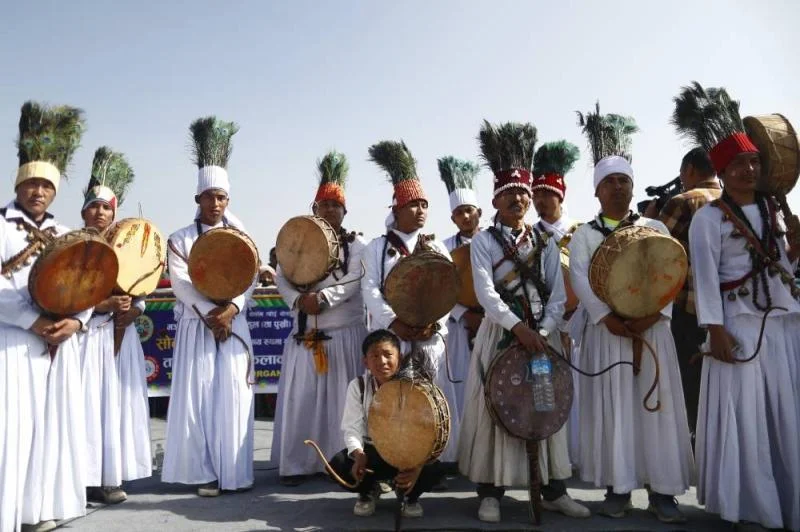
A great deal of travel writing frames Nepali ritual specialists as the last of something. The framing is comfortable and mostly wrong.
Shneiderman and Turin specifically document how earlier accounts of the Thangmi went astray: a 1928 Gurkha recruiting manual described the community in demeaning terms, a 1967 classification wrongly linked them to the Tamang, a 1993 volume reported them as having no notable ritual life, and a 1974 population estimate was substantially inflated. Several of these errors were copied forward for decades by writers who had never met a Thangmi person.
That is the standing risk when outsiders write about ritual practice. The accounts get repeated, and the community spends generations correcting them.
Meanwhile the practice continues. Healers in the Pham study were valued for accessibility, community ties and flexible payment, in contrast to clinics limited by distance and cost. That is a functioning system responding to real conditions, not a residue.
A Note on Visiting
Some of what follows is blunt, and intentionally so.
Healing ceremonies are private medical events. A chinta is held because a specific person in a specific household is unwell. There is a market in Nepal for “shaman tours” and arranged ritual viewing, and we are not going to supply directions to it.
If you are in Dolakha, the appropriate posture is straightforward.
- Do not photograph ritual activity without explicit permission from the practitioner and the family, asked beforehand and not during.
- Do not attend a healing ceremony as a spectator. You are in someone’s home during an illness.
- Do not ask a practitioner to perform outside of ritual context for your benefit.
- Where a practice is described to you as restricted or sacred, accept that and do not press for detail.
- Use the community’s own term for its specialists when you know it. Guru, bombo and jhankri are not interchangeable.
Dolakha is worth traveling in for other reasons entirely: the Bhimeshwar temple at Dolakha Bazar, the Kalinchowk Bhagawati temple at around 3,842 meters, and Jiri, long known as the old walking start of the Everest route.
For wider context on Nepal’s linguistic and cultural range, see our pieces on Nepal’s many languages, Magar culture and cuisine, Tharu festivals of the Terai and the mythology and rituals of Indra Jatra.
Frequently Asked Questions
What is the difference between a dhami and a jhankri?
They are frequently paired in the compound term dhami-jhankri, and researchers note that this compound covers two distinct healer types rather than one. Usage varies by region and community, and a single clean definition that holds everywhere in Nepal does not exist.
Are jhankris Hindu or Buddhist?
Neither label fits cleanly. These practices predate and sit alongside both traditions, and individual practitioners may operate within Hindu or Buddhist frameworks depending on community. Tamang bombo practice sits in relation to Buddhist practice differently than a Thangmi guru’s does. The accurate answer is that the systems overlap without being reducible to either.
Do Nepali people still consult traditional healers?
Yes, and often alongside clinical care rather than instead of it. In Pham, Koirala and Kohrt’s 2021 rural study, 52% of respondents used both traditional and biomedical services, and 63% held both kinds of explanation for illness.
Does science explain what happens during trance?
Partially, and less than popular accounts claim. EEG research has found measurable differences in brain activity in shamanic practitioners during drumming, but the studies are small, exploratory and limited by the authors’ own account. No specific neurological mechanism for possession is established.
Is the drumming what causes the trance?
Rhythmic drumming is clearly central to the practice and is associated with altered states in laboratory work. Whether drumming causes the state, or is one element within a trained practice that includes chanting, fasting, expectation and years of apprenticeship, is not settled. The laboratory studies isolate drumming because it is isolatable, not because it is the whole thing.
Can a foreigner train as a jhankri?
Training is a long apprenticeship under a guru within a community context, usually beginning with a calling rather than an application. Commercial arrangements marketed to visitors should be treated with skepticism about what they actually are.
Which communities in Dolakha have their own ritual specialists?
Dolakha includes Tamang, Thangmi, Sherpa, Jirel, Sunuwar and Newar communities, among others, alongside Khas groups. Each has its own practices and terms. Tamang bombo and Thangmi guru traditions are distinct systems, not local versions of a single one.
Are these traditions disappearing?
Evidence of continued use is substantial, and framing the traditions as vanishing has a poor track record. Earlier outside accounts of the Thangmi claimed they had little ritual life at all, which Shneiderman and Turin document as an error repeated for decades. Practices do change, which is different from disappearing.
Keep Exploring
Dolakha rewards slow attention. Its ritual life is not a single tradition but several, held by communities with distinct languages and histories, and it is best approached as someone else’s living practice rather than a sight. Save this piece, share it with anyone heading into the eastern hills, and follow NepalVue for more reporting grounded in Nepal’s own communities and scholarship.


