



2Nepal’s gharial numbers are going up. In the Narayani, they are going down. That contradiction sits at the center of one of South Asia’s longest-running reintroduction programs. Chitwan National Park’s December 2025 census counted 366 gharials in the Rapti and Narayani rivers combined, a rise from 352 the previous year. Split by river, the picture reverses: the Rapti gained, the Narayani lost. This article explains what gharials are, why a breeding program that has released more than 2,300 animals has produced so few wild adults, and what the Narayani’s decline says about the health of the river itself.
What a Gharial Is, and Why It Is Not a Crocodile You Know
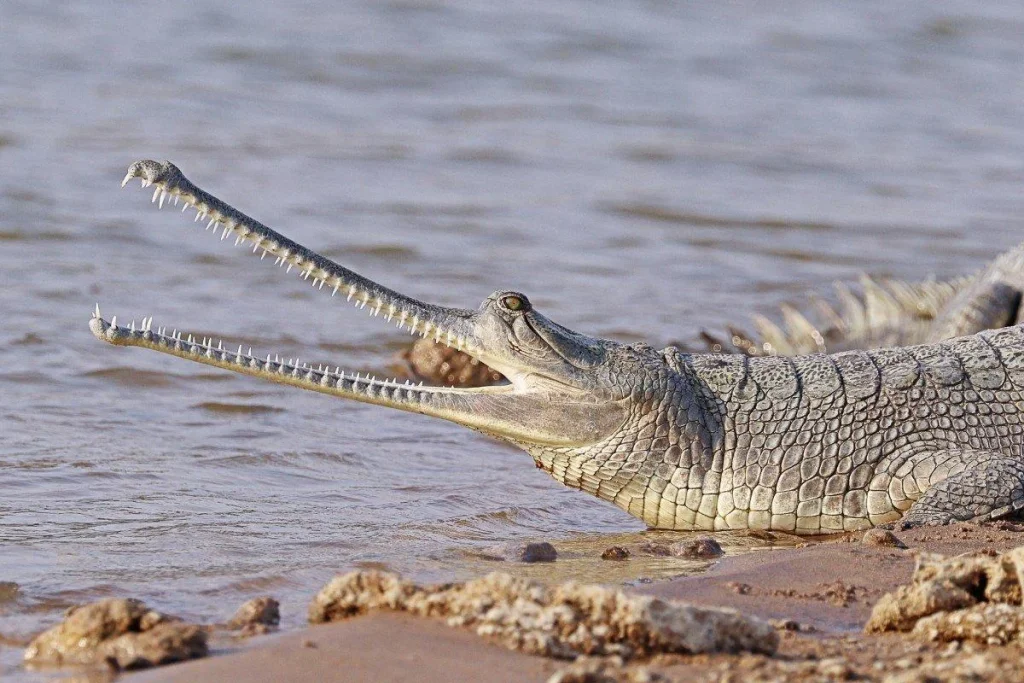
The gharial (Gavialis gangeticus) is a crocodilian, but an unusual one. Its snout is extremely long and narrow, built for a single job: catching fish. It does not take large mammals. It cannot. The jaw is a fish trap, lined with interlocking needle-like teeth, and the animal sweeps it sideways through water.
Adult males develop a bulbous growth on the snout tip called a ghara, from the Nepali and Hindi word for an earthen pot. That structure gives the species its name and is used in display and vocalization.


Because gharials eat fish and nothing else, they are what ecologists call an indicator species. A river that cannot feed gharials is a river running short of fish. That single fact explains most of what follows.
The IUCN lists the gharial as Critically Endangered. Nepal’s Gharial Conservation Action Plan records a decline of roughly 96% over three generations, from an estimated 5,000 to 10,000 animals across South Asia in the 1940s to about 2% of the historical range by the mid-1970s.
Where Gharials Live in Nepal
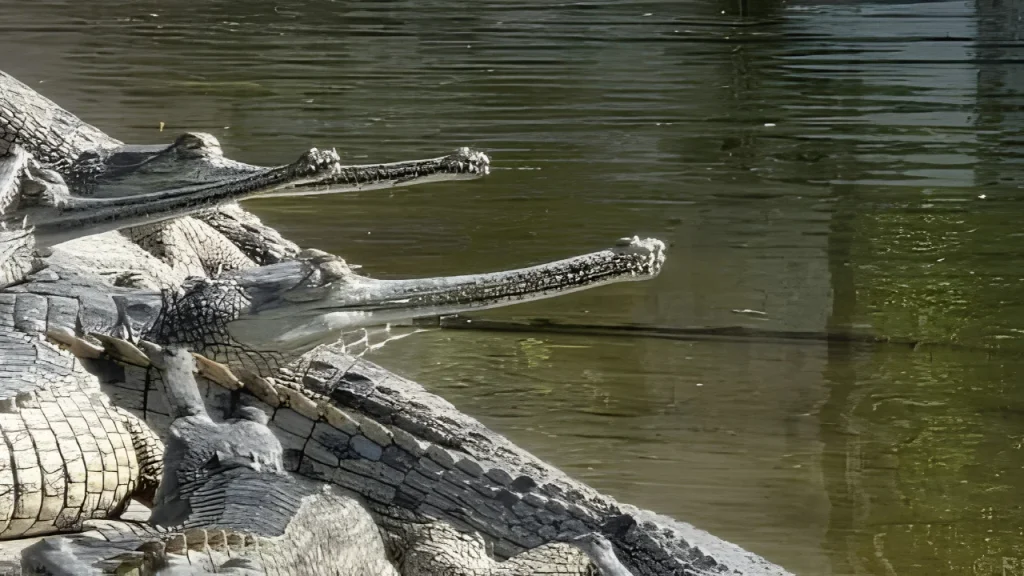
Historically, gharials occurred in the Koshi, Gandaki, Karnali and Mahakali river systems. Today the core population sits in two protected-area clusters: the Rapti and Narayani rivers in Chitwan National Park, and the Babai and Karnali in Bardia National Park. Gharials are reported seasonally from the Mohana, Reu, Khageri and Budhi Rapti.
The Koshi is the cautionary tale. Between 1981 and 2010, 95 gharials were released there. None has been recorded since 1998.
| River | 2016 count | Dec 2025 count | Direction |
|---|---|---|---|
| Narayani | 84 | 135 | Up over a decade, down year on year from 146 |
| Rapti | 82 | 231 | Up |
| Babai | 31 | Not in the Chitwan census | Monitored separately |
| Karnali | 1 | Not in the Chitwan census | Monitored separately |
| Koshi | 0 | 0 | No records since 1998 |
Two clarifications about that table. The 2016 figures come from Nepal’s Gharial Conservation Action Plan, which recorded 198 gharials nationally. December 2025 figures come from Chitwan National Park’s census, conducted from 7 to 15 December and covering only the Rapti and Narayani. They are not directly comparable totals, and we have not added them together to produce a national number.
The Breeding Center at Kasara
Nepal’s gharial breeding center operates at Kasara inside Chitwan National Park. Accounts of its founding vary slightly between sources: some date it to 1975, others to 1978. It began when fewer than 100 gharials were thought to remain in the country.
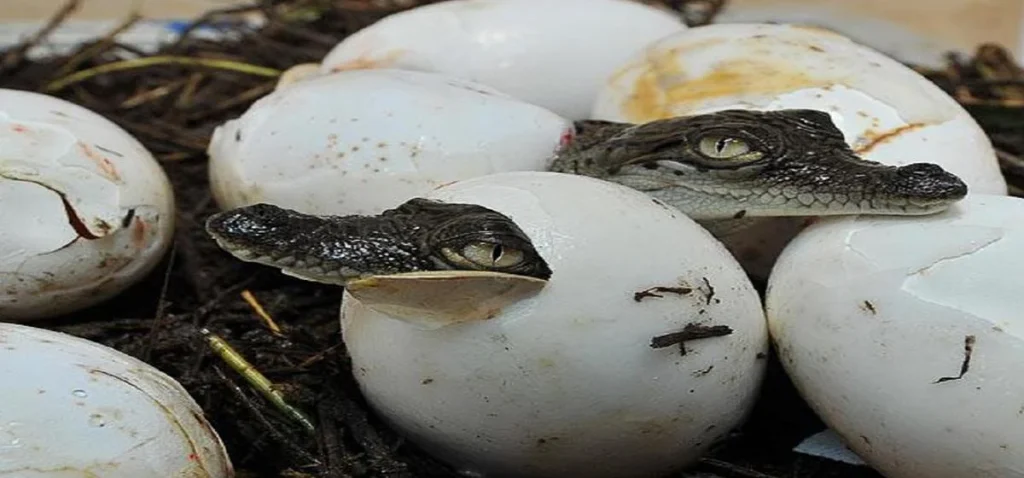
The method is straightforward. Eggs are collected from wild nests before flooding, predation or disturbance can destroy them. Hatchlings are raised in captivity for about five years, past the size at which most natural mortality occurs. Then they are released.
Radio Nepal reported a cumulative release total of 2,315 animals over roughly 45 years, with the Rapti receiving the largest share at 1,560. Sujita Shrestha, chief of the Kasara center, gave a figure of more than 2,275 releases since 1978 in a separate interview. Around 500 animals remain in the captive population.
Releases continue. Park officials reported 52 gharials released into the wild in one recent fiscal year, including a batch of 20 into the Rapti.
The Number That Should Worry You
Here is where the program’s arithmetic turns uncomfortable. Nepal’s Gharial Conservation Action Plan estimates that about 17% of released animals survive. Survival for wild-hatched gharials is estimated at around 1%.
Run those figures against the release totals. More than 2,300 animals released. A wild census of 366. Four decades of sustained institutional effort has produced a population smaller than one-sixth of what has been put into the rivers.
Captive breeding is doing what it was designed to do: it produces juveniles. What it does not do is fix the river. A gharial released into water with too few fish, too many gill nets and no stable sandbanks will not become a breeding adult, however well it was raised.
Sex ratio makes this sharper. December 2025 census work recorded just nine adult males across both rivers: seven in the Rapti, two in the Narayani. Nepal’s action plan describes an adult sex ratio of roughly two males to ten females. Gharials have temperature-dependent sex determination, and park reporting indicates male hatchlings are more likely at incubation temperatures of about 30 to 32 degrees Celsius. A population with nine known adult males is not demographically secure regardless of its headline count.
Why the Narayani Is Losing Animals
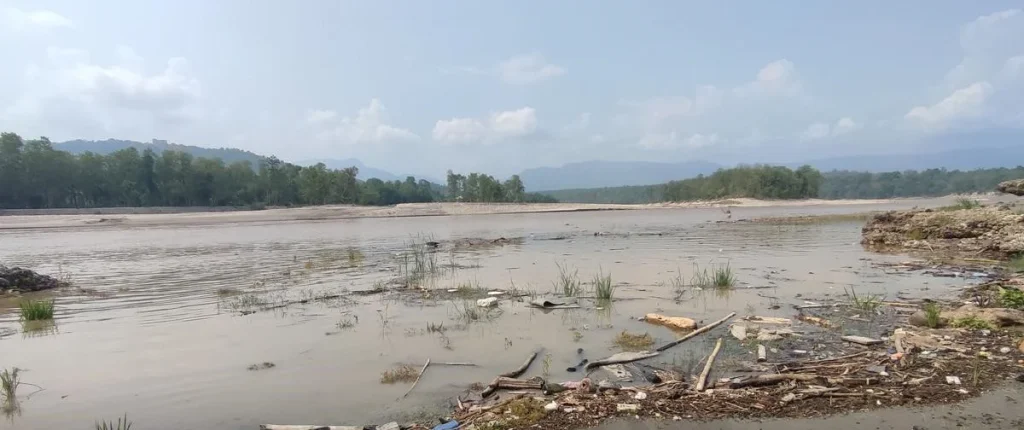
The Narayani forms where the Trishuli and Kaligandaki meet at Devghat and runs along Chitwan’s western boundary before crossing into India. It is also the most industrially pressured of Nepal’s gharial rivers.
Fishing gear
Gill nets and fine-mesh nets kill gharials directly. The animals entangle and drown. Chitwan park officials rescued a gharial about ten years old from a fishing net in the Budhi Rapti near Chitrasari Bridge in December 2025. Conservationists quoted in that reporting noted that many deaths go unrecorded, which means the documented cases are a floor, not an estimate.
Prey depletion
The action plan lists poisoning, explosives and electrocution as fishing methods that strip rivers of fish. For a species that eats nothing else, this is not a secondary threat. It is the threat.
Sand and gravel extraction
Gharials need exposed sandbanks to bask and to nest. Females nest on sandy banks, typically in March and April. Commercial extraction removes exactly that substrate and disturbs the quiet stretches gharials prefer.
Barrages and altered flow
Dams and barrages fragment the river and block upstream and downstream movement. Downstream of Nepal, the Narayani becomes the Gandak, and the Gandak barrage sits on that system. Monsoon floods also carry gharials downstream into India, where return upstream is considered unlikely.
Pollution
The action plan names sewage, industrial effluent and agricultural chemicals among the pressures on gharial habitat. Nepal’s Narayani corridor carries substantial industrial activity. We have not found a current, publicly available water-quality dataset specific to the gharial reaches that we can cite with confidence, so we are stating the threat as the conservation plan states it rather than attaching numbers to it.
One Hopeful Sign, Read Carefully
In early March 2026, residents near Devghat reported a gharial basking on a sandbar on the Nawalparasi side, where the Trishuli and Kaligandaki join. It stayed about a week.
Dal Bahadur Bote, a 71-year-old resident, told the Kathmandu Post he remembered seeing 20 to 25 gharials there at a time, and had not seen one in 30 to 35 years. Hiralal Bote, another resident, believed the animal had arrived on its own.
Officials were more cautious. Sujita Shrestha of the Kasara breeding center said it was unclear whether the gharial had arrived naturally or been released after a rescue. Divisional Forest Officer Bishnu Prasad Acharya said his office knew of no recent release in the area.
Conservationists speculated the animal might be searching for a nesting site, given the timing. That remains speculation. A single animal in a single location for a single week is an observation, not a trend, and the people closest to the program were the first to say so.
What Would Actually Change the Trajectory
Based on what the conservation literature and Nepal’s own action plan identify, the leverage points are river-side rather than hatchery-side.
- Fishing gear enforcement. Fine-mesh and gill nets are already punishable under Nepali law. The gap is enforcement across long river stretches with limited patrol capacity.
- Prey base recovery. Gharial numbers cannot exceed what the fish stock supports. Restoring fish populations is a prerequisite, not a parallel project.
- Protecting nesting substrate. Regulating sand and gravel extraction in known nesting reaches during the March to April season.
- Transboundary coordination. Animals moving into India during floods are effectively lost to the Nepali population under current arrangements.
- Release siting. Releasing into habitat that has already failed, as the Koshi record suggests happened there, consumes animals without building populations.
If you are interested in how Nepal’s conservation record looks across other species and landscapes, see our guides to Chitwan National Park, rewilding the Terai Arc corridor, Koshi Tappu Wildlife Reserve and wildlife across Nepal.
Seeing Gharials Responsibly
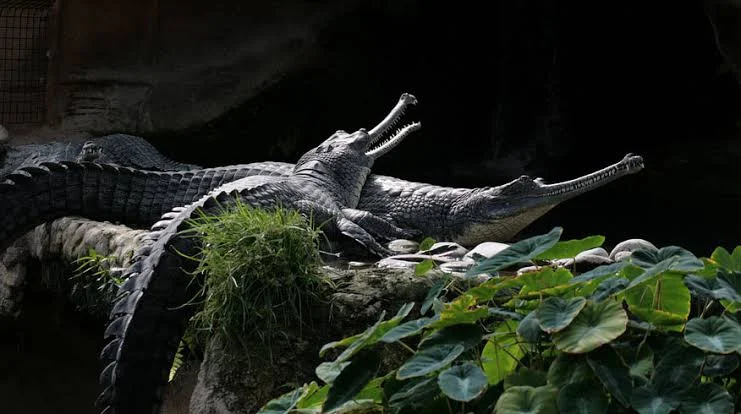
Gharials are visible in Chitwan, most reliably along the Rapti and on canoe trips, and at the Kasara breeding center. A few practical points.
- Gharials are not dangerous to people. They cannot take large prey. Keep distance anyway, because disturbance at a basking site costs the animal thermoregulation time.
- Basking is most likely on cool, sunny mornings in winter. That is also when census work happens, for the same reason.
- Do not ask a boatman to approach a basking animal closely. A gharial that slides into the water has lost its morning.
- March and April is nesting season. Sandbank disturbance matters most then
Frequently Asked Questions
How many gharials are left in Nepal?
Chitwan National Park’s December 2025 census counted 366 in the Rapti and Narayani rivers. Smaller numbers occur in the Babai, Karnali, Kaligandaki and Saptakoshi, counted separately. There is no single current national total that we can cite from one source, so we have not constructed one.
Are gharials dangerous to humans?
No. The gharial’s narrow snout and interlocking teeth are adapted exclusively for catching fish. It cannot take large prey. Attacks on people are not a feature of this species, unlike the mugger crocodile, which shares some of the same rivers.
Why are there so few male gharials?
The December 2025 census found only nine adult males, seven in the Rapti and two in the Narayani. Nepal’s conservation action plan describes a skewed adult sex ratio of roughly two males to ten females. Gharials have temperature-dependent sex determination, and incubation around 30 to 32 degrees Celsius favors males. Whether captive incubation practice contributes to the skew is a question for the program’s own records, and we have not found published data settling it.
If thousands have been released, why is the wild population only in the hundreds?
Nepal’s action plan estimates around 17% survival for released animals and about 1% for wild-hatched ones. Releasing animals into degraded habitat does not produce breeding adults. The constraint is river condition, not hatchery output.
What is the ghara on a male gharial’s snout?
A bulbous growth at the snout tip, present in adult males, named after the Nepali and Hindi word for an earthen pot. It is used in display and in producing sound. Its presence is how surveyors identify adult males in a census.
Is the gharial the same as a mugger crocodile?
No. The mugger (Crocodylus palustris) is a broad-snouted generalist predator that also lives in Nepal’s lowland rivers and wetlands. Visitors often confuse the two. Snout shape is the quickest field distinction.
Can I visit the gharial breeding center?
The breeding center at Kasara is inside Chitwan National Park and is a standard stop on park itineraries. Entry follows normal park procedures and fees. Check current arrangements with the park office or your operator, since access rules change.
Why did gharials disappear from the Koshi?
Ninety-five animals were released into the Koshi between 1981 and 2010, and none has been recorded since 1998. Nepal’s action plan does not attribute the failure to a single cause. Barrage effects, fishing pressure and habitat change are all plausible contributors, and the honest answer is that the reasons are not fully documented.
Keep Exploring
The gharial is a useful species to follow, because its numbers track something larger: whether Nepal’s lowland rivers are still functioning as rivers. Save this guide, share it with anyone planning a Chitwan trip, and follow NepalVue for continued reporting on the country’s conservation work.


