



Calling paubha a “lost art” is only half right, and the half that is wrong matters more. Newar painters in the Kathmandu Valley are still working, still training apprentices, and still grinding mineral into color. What has thinned out is the knowledge system underneath: the proportional canons, the pigment recipes, and the ritual framework that made a painting a devotional object rather than a decorative one. The lost art of paubha is better described as a tradition under pressure, documented unevenly, and sustained by a small number of families. Here is what is actually known about how these paintings are built, and where the record runs out.
What a Paubha Is, and What It Is Not
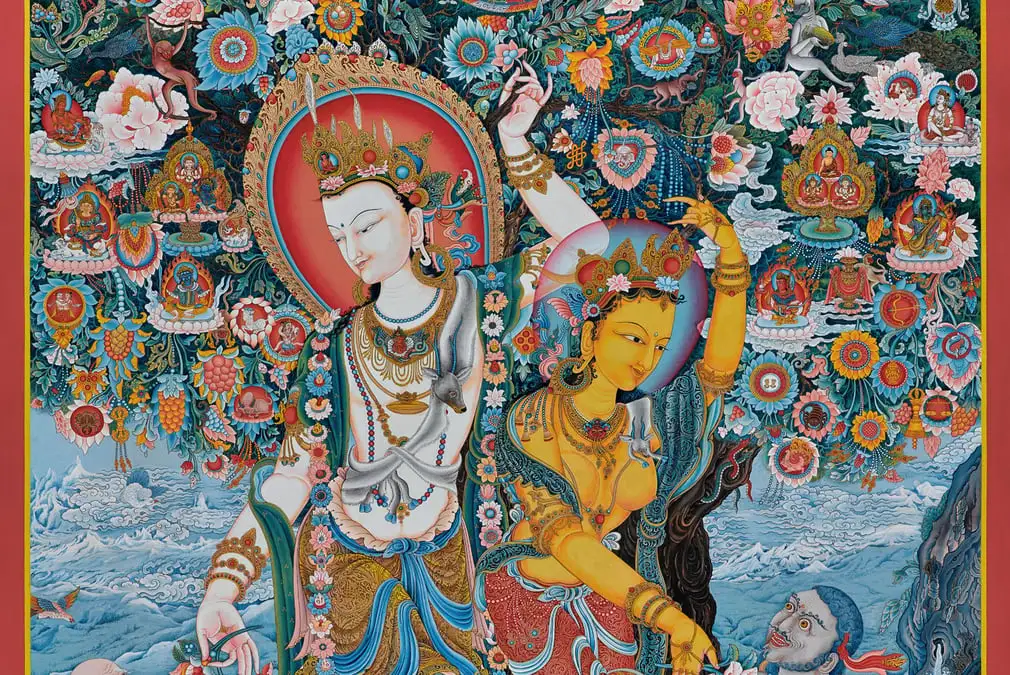
Paubha is the Nepal Bhasa term for a devotional scroll painting made by Newar artists of the Kathmandu Valley. A paubha depicts deities, mandalas, or sacred monuments, and functions as a support for meditation and ritual rather than as wall decoration. Tibetan thangka is its closest relative, and the two traditions have influenced each other for centuries.
One distinction is substantive. Thangka painting is Buddhist. Paubha serves both Hindu and Buddhist Newar patrons, because Newar religious life has long accommodated both, sometimes within the same family and the same courtyard. A painter may produce a Vajrayana mandala one month and a Hindu deity the next.


Visitors often hear paubha and thangka used interchangeably in Thamel shops. Lok Chitrakar, among the best known living paubha painters, told the Kathmandu Post in 2016 that much of what is sold in Nepal is largely influenced by Tibetan style, even where the painter is Newar. Buying terminology is not scholarly terminology.
Who Paints Them
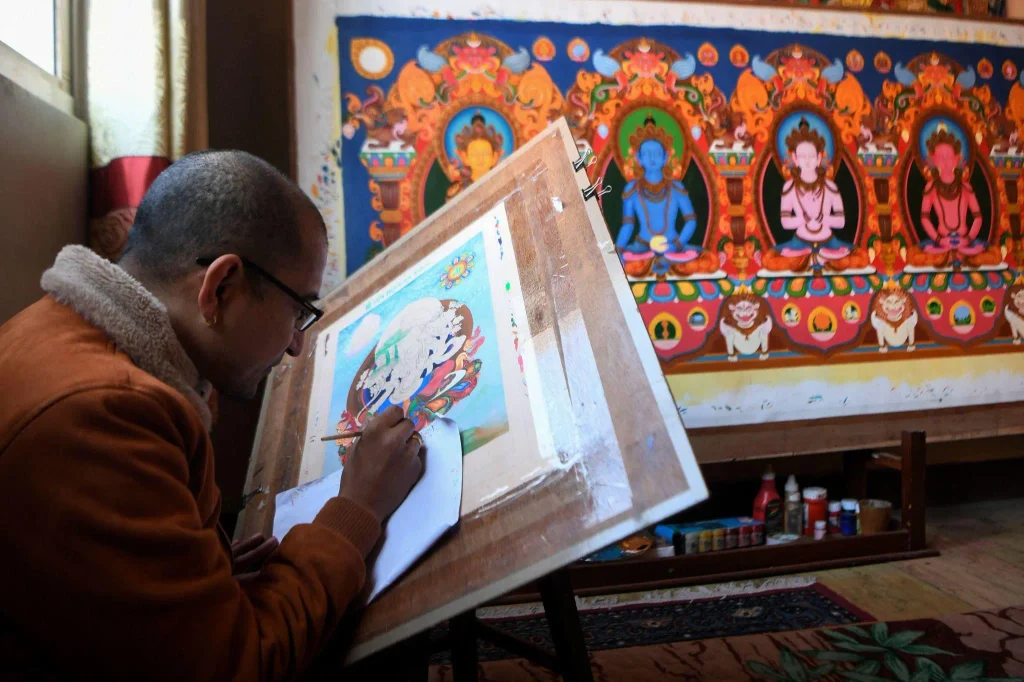
Paubha painting has been associated above all with Chitrakar families, known in Nepal Bhasa as Pun, a Newar occupational group whose hereditary work included religious painting, ritual masks, and festival imagery. Painting in the valley has never been exclusive to one group, and the attribution of specific historic works to specific communities is often uncertain. Writing about Newar art demands that precision: the Newars are not a single undifferentiated community, and practice differs between Kathmandu, Patan and Bhaktapur, and between Buddhist and Hindu households.
Some parts of the practice are restricted. The final act of painting the eyes, called mikhā chāyekegu, functions as a consecration that turns a painted image into a usable ritual object. Details of how particular consecrations are performed belong to the lineages that hold them, and visitors should not expect to observe or request them.
Sacred Geometry: Why the Figures Look the Way They Do
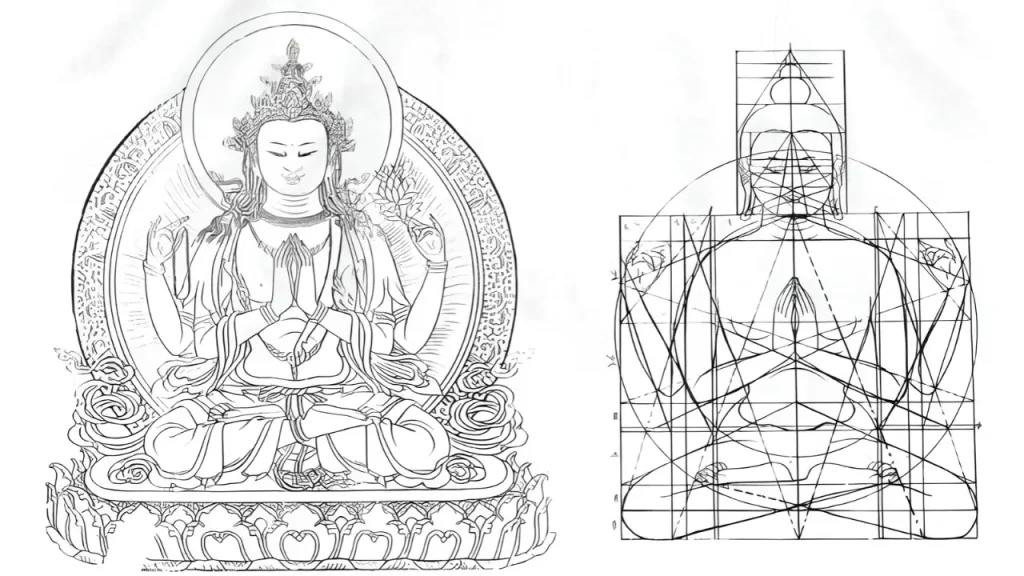
A paubha deity is not drawn freehand from imagination. Figures are set out on a construction grid before a single color is applied, and the grid fixes proportion: the width of the face against the height of the body, the position of the eyes, the span of the shoulders, the placement of each arm in a multi-armed form.
Those proportional systems descend from the Indic shilpashastra tradition, a body of Sanskrit technical literature on image-making that circulated across South Asia and the Himalaya. Measurement works in relative units rather than absolute ones. A body is divided into head-lengths, and finer divisions subdivide those. Change the overall size and every internal relationship scales with it, which is why a paubha figure reads as correct whether it is 30 centimeters tall or three meters.
Honesty is required here. Published scholarship on Newar iconometric practice specifically, as distinct from Indian or Tibetan canons, is thin. Lok Chitrakar has pointed directly at this gap, attributing paubha’s uneven development to a shortage of academic research, books and documentation. Precise canonical measurements vary between texts and between lineages, and we have not found a current authoritative source that fixes a single Newar canon. Anyone quoting exact unit counts for paubha should be asked where they got them.
The Mandala as Architecture
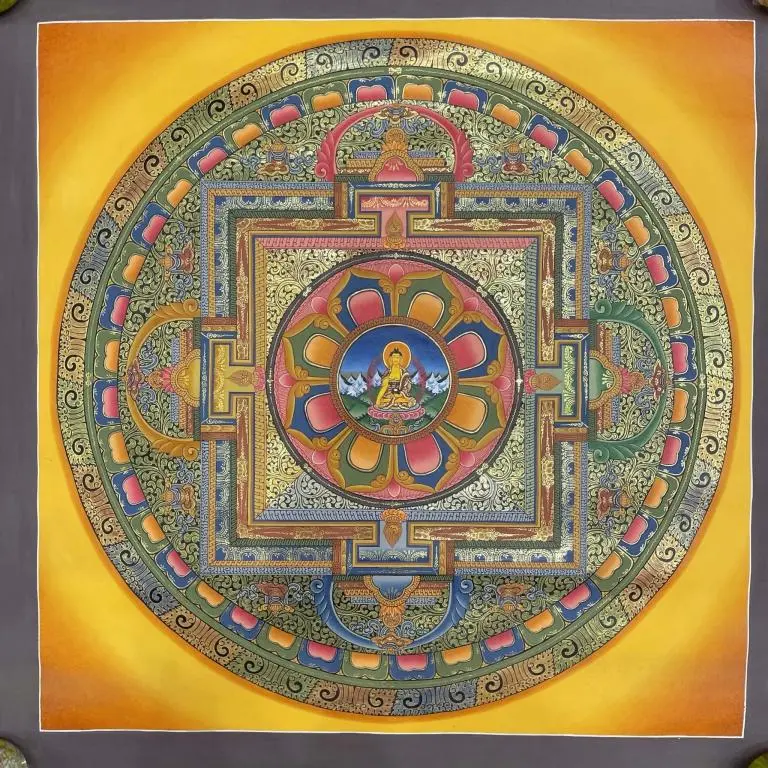
Mandalas take geometry further. A mandala is laid out as a plan: a square palace with four gates, set inside concentric circles, viewed from above and unfolded onto a flat surface. Each ring and each gate has a doctrinal meaning. Drawing one correctly is closer to drafting a building than to sketching a picture, and errors in the plan are errors in the liturgy, not merely in the art.
The earliest firmly dated paubha generally cited is a Vasudhara Mandala painted in 1365 CE, corresponding to Nepal Sambat 485. Earlier undated works exist and some museums date individual pieces considerably earlier on stylistic grounds, so “earliest” depends on whether you accept stylistic dating. Treat the 1365 mandala as the earliest secure date rather than the earliest painting.
Pigment Chemistry: What the Colors Actually Are
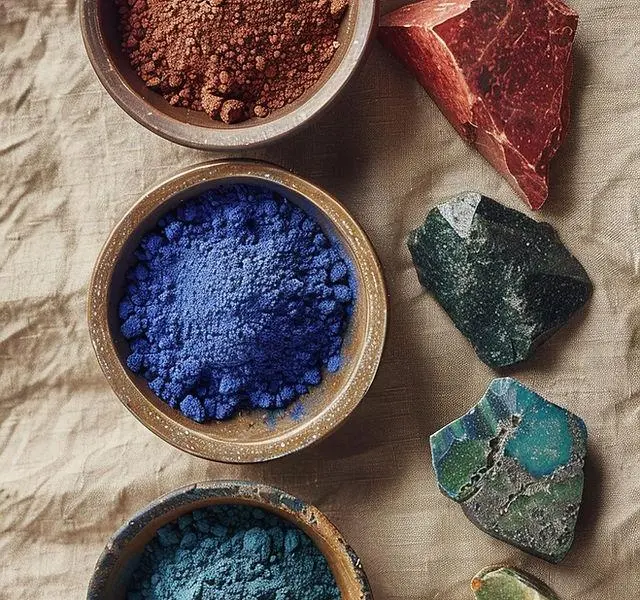
Traditional preparation begins with the support. Cotton cloth is coated with a mixture of animal glue and white clay, then burnished smooth with a stone until the weave no longer shows. That ground gives the fine line work its surface. Pigments are mineral and plant derived, bound in glue, with gold and silver applied for ornament, haloes and detail.
Scientific analysis of paubha specifically is rare in the published literature. The best proxy is work on related Himalayan painting. A 2022 study in the journal Heritage by Joanne Dyer and colleagues at the British Museum examined an 18th century Tibetan thangka using fiber optic reflectance spectroscopy, infrared reflectography, FTIR and Raman analysis. Their identifications give a concrete picture of the regional palette:
| Color | Material identified | Type |
|---|---|---|
| Blue | Azurite, mixed with kaolinite to vary shade | Mineral (copper carbonate) |
| Green | Malachite | Mineral (copper carbonate) |
| Deep red | Cinnabar / vermilion | Mineral (mercury sulfide) |
| Orange and pale flesh | Minium (red lead) | Mineral (lead oxide) |
| Deep red lake | Indian lac, probable | Insect derived |
| Outlines, hair, foliage | Indigo | Plant derived |
| Grey and brown flesh | Iron oxide, specific type undetermined | Mineral |
| Black | Carbon based | Soot with glue |
| White and ground | Magnesite | Mineral (magnesium carbonate) |
| Binder | Proteinaceous, probably animal glue | Organic |
Two cautions. That painting is Tibetan, not Newar, and the authors make no claims about Newar technique. Materials also traveled: the same minerals moved along the same trade routes, and a pigment’s presence tells you about supply networks as much as about workshop identity. Only analysis of the specific object settles what is in it.
The blues deserve a note, because popular accounts collapse them. Azurite and lapis lazuli are different minerals producing different blues, and ultramarine made from lapis was historically the expensive one, sourced through long-distance trade from Central Asia. Which blue appears in a given painting is a laboratory question, not a visual one.
Why Mineral Pigments Behave Differently
Mineral pigments are ground, not dissolved. Particle size controls color: coarsely ground azurite reads deep and saturated, finely ground azurite reads pale and chalky, from exactly the same mineral. A painter adjusts tone by grinding rather than by mixing in white, which is one reason traditional palettes achieve their particular depth. Grinding is slow, physically demanding work, and it is among the first steps dropped when commercial pressure speeds production.
Modern synthetic pigments are cheaper, faster, more uniform and often more lightfast. Painters who use them are making a reasonable economic choice, not committing a betrayal. Collectors who insist on mineral pigment should expect to pay for the hours it represents.
A Tradition That Traveled
Newar artists were not confined to the valley. Visitors noted their skill from early centuries, and their work reached Tibet and China. The clearest documented case is Anige, also written Araniko, a Newar artist who lived from 1244 to 1306. In 1261 the Tibetan master Pakpa brought him to the Yuan court along with 24 other Himalayan artisans, a delegation of 25. Anige and Rinchen Gyeltsen designed and supervised construction of the White Stupa in Beijing between 1270 and 1279, and Anige rose to become director of all artisan classes at the Yuan court.
Scholarship is careful about attribution even here. The Rubin Museum’s Project Himalayan Art essay by Isabelle Charleux notes that Anige’s personal role is hard to gauge, and that none of the artworks attributed to him can be securely linked to his own hand. Fame in the record and documented authorship are not the same thing.
Closer to home, murals in two 15th century monasteries in the former kingdom of Mustang illustrate Newar work far outside the valley, a reminder that trans-Himalayan trade carried artists as well as salt and grain. Our piece on Mustang’s caravan routes traces those corridors.
Where the Tradition Stands Now
Paubha painting is being practiced, taught and sold today. Lok Chitrakar has described a revival over recent decades, driven partly by international interest in the art market, after a long period of neglect. Market demand is a double-edged support: it funds full-time practice, and it also rewards speed, repetition and whatever sells.
Chitrakar has also criticized state policy, saying the government recognizes painting as a form of industry rather than as education or art. That framing has consequences for whether training is institutionally funded or left to individual families. His comments date from 2016, and we have not verified the current policy position, so read them as a snapshot rather than a present-day assessment.
What would strengthen the record is straightforward and unglamorous: technical analysis of dated paubhas held in Nepali and foreign collections, published documentation of workshop practice recorded with the painters themselves, and accessible publication of iconometric manuals. None of that requires calling the tradition lost.
Seeing Paubha Respectfully
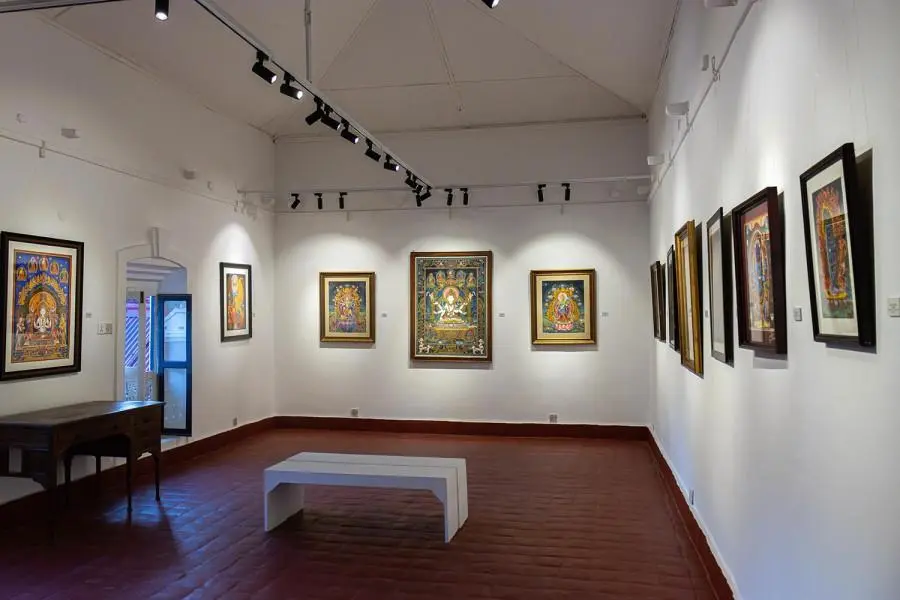
Paubhas in active shrines are ritual objects in use. Photography may be restricted, and some images are displayed only at particular times of year. Museums and reputable galleries in Patan and Kathmandu are the appropriate places to study them closely. If you want to buy, ask the seller who painted the work, where, and with what materials, and expect a real answer from a reputable dealer. Our guide to souvenirs from Nepal covers what questions to ask, and our notes on attending a Newar jatra respectfully apply equally in a shrine courtyard.
Frequently Asked Questions
What is the difference between a paubha and a thangka?
Paubha is the Newar tradition of the Kathmandu Valley and serves both Hindu and Buddhist patrons. Thangka is the Tibetan tradition and is Buddhist. Styles, compositions and conventions differ, though the two have influenced each other for centuries and share many materials.
How long does a paubha take to paint?
Weeks to years, depending on size, complexity, the number of figures, and how much gold work is involved. We have not found a reliable published average, so be skeptical of any single figure quoted as standard.
What is the oldest surviving paubha?
A Vasudhara Mandala dated 1365 CE, Nepal Sambat 485, is generally cited as the earliest firmly dated example. Some museums date individual works earlier on stylistic grounds, which is a less secure basis.
Are traditional mineral pigments still used?
Yes, by painters who choose to, though synthetic pigments are common in commercial production. Mineral preparation is slow and expensive. The only way to know what a specific painting contains is technical analysis.
Who are the Chitrakars?
Chitrakar, called Pun in Nepal Bhasa, is a Newar occupational group whose hereditary work included religious painting, ritual masks and festival imagery. Several well-known modern Nepali painters came from Chitrakar families, including Tej Bahadur Chitrakar.
Can I watch a paubha being painted?
Some studios in Patan and Bhaktapur welcome visitors, and that is the right way to see the work. Ritual stages such as the painting of the eyes are not public performances, and should not be requested.
Is paubha actually dying out?
No. Practitioners are working and teaching, and interest has grown. What is genuinely fragile is the surrounding knowledge base: documentation, published technical research and formal training pathways.
Where can I see historic paubhas in Nepal?
Museum collections in the Kathmandu Valley hold significant examples, and major works are also held abroad in institutions including the Rubin Museum and the Los Angeles County Museum of Art. Collection access and display rotations change, so check before planning a visit around a specific object.
Keep Exploring
Newar craft traditions run far beyond painting. Follow them into the potters’ workshops of Bhaktapur or into the valley’s festival life through the Lakheys of the Kathmandu Valley. Save this guide, share it with someone who is about to buy their first painting in Thamel, and follow NepalVue for more on Nepal’s living craft traditions.


