



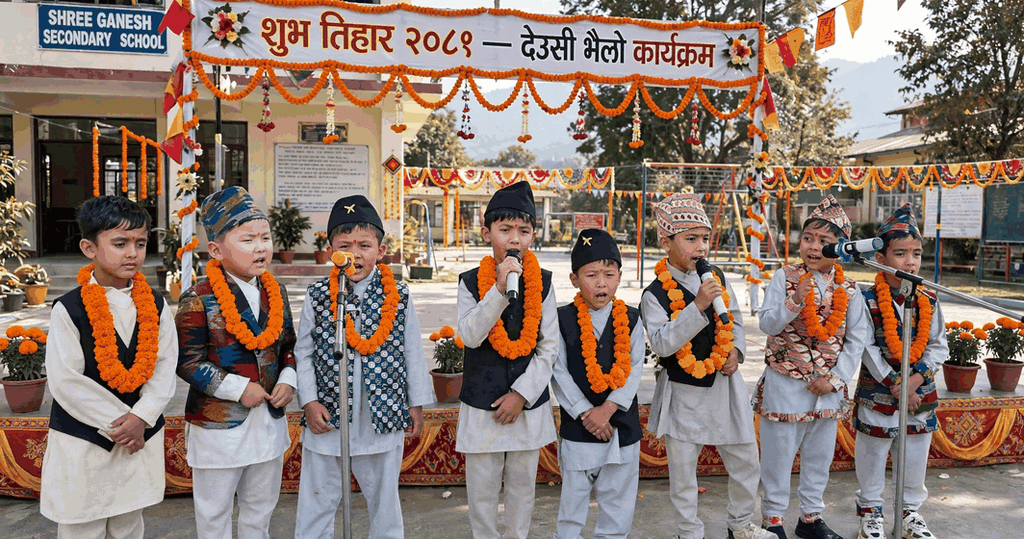
You hear them before you see them. A drum, a pair of madal beats carrying down a lane in Patan, then a clatter of voices answering a single leader: “Deusi re.” A group of fifteen teenagers rounds the corner, oil lamps flickering in the doorways behind them, and stops at the house next to yours. Someone inside opens the gate, and the singing starts properly. Deusi and Bhailo during Tihar are the most visible, most joyful and most misunderstood part of Nepal’s festival of lights. This guide explains what is happening, which nights it happens on, and where the line sits between welcome participation and intrusion.
The Short Version of Tihar, So the Rest Makes Sense
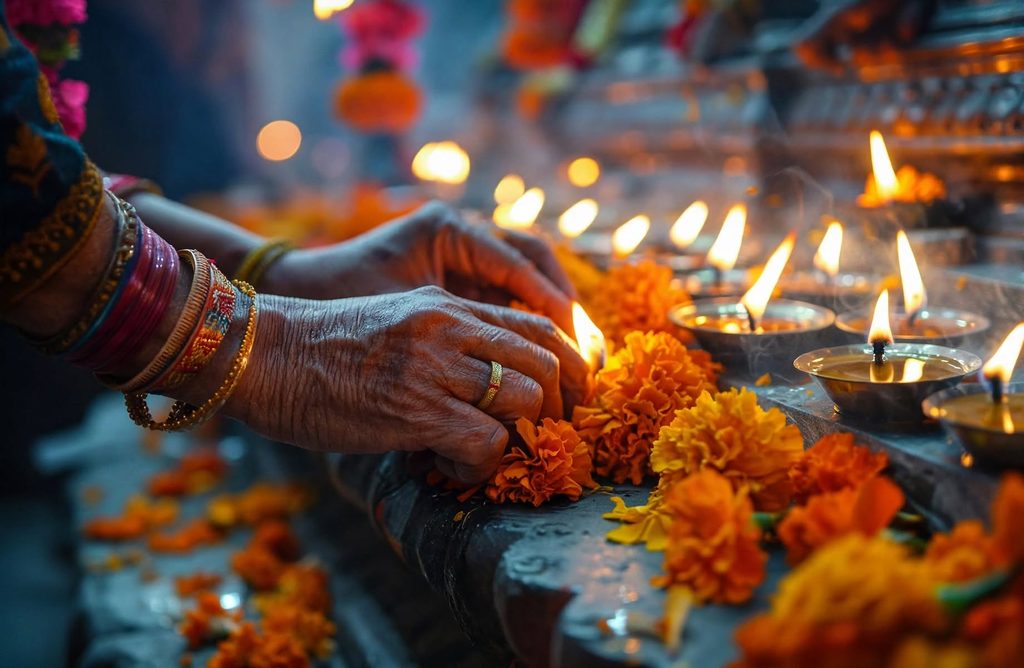
Tihar in 2026 runs from November 7 to November 11. Five days, each honoring a different relationship: crows, dogs, cows, the self or oxen depending on community, and finally brothers and sisters at Bhai Tika on November 11. Laxmi Puja, the night homes are lit for the goddess of wealth, falls on November 8. If you want the full structure, our Tihar festival guide covers all five days and our piece on Laxmi Puja rituals covers that evening in detail.
Day arrangements shift slightly with the lunar calendar each year. In 2083 BS, most Nepali patros place Kukur Tihar and Laxmi Puja together on November 8, with Gai Tihar following on its own day. Check a current calendar before fixing plans around any single date.


What Deusi and Bhailo Actually Are
Both are house to house song traditions performed during Tihar. Groups go door to door, sing blessings for the household, receive money and food in return, and move on. That is the mechanism. What sits underneath it is older and more interesting.
Bhailo
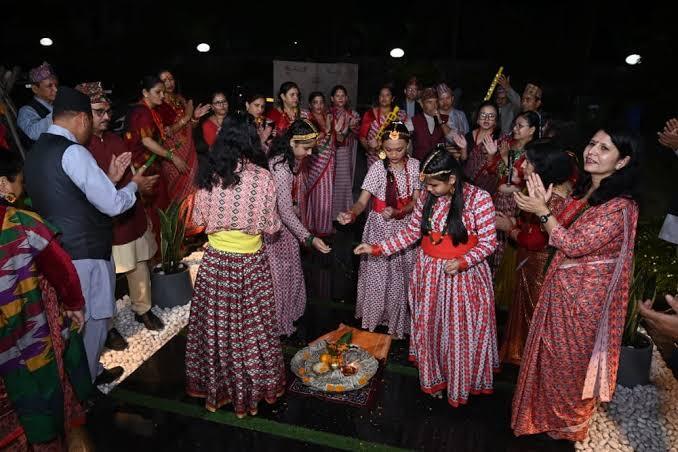
Bhailo is sung on Laxmi Puja night, when homes are already lit with lamps and marigold garlands. Traditionally it was performed by girls and women, and the whole group sings together rather than in call and response. Lyrics address the goddess and the household, asking for prosperity in the coming year.
Deusi
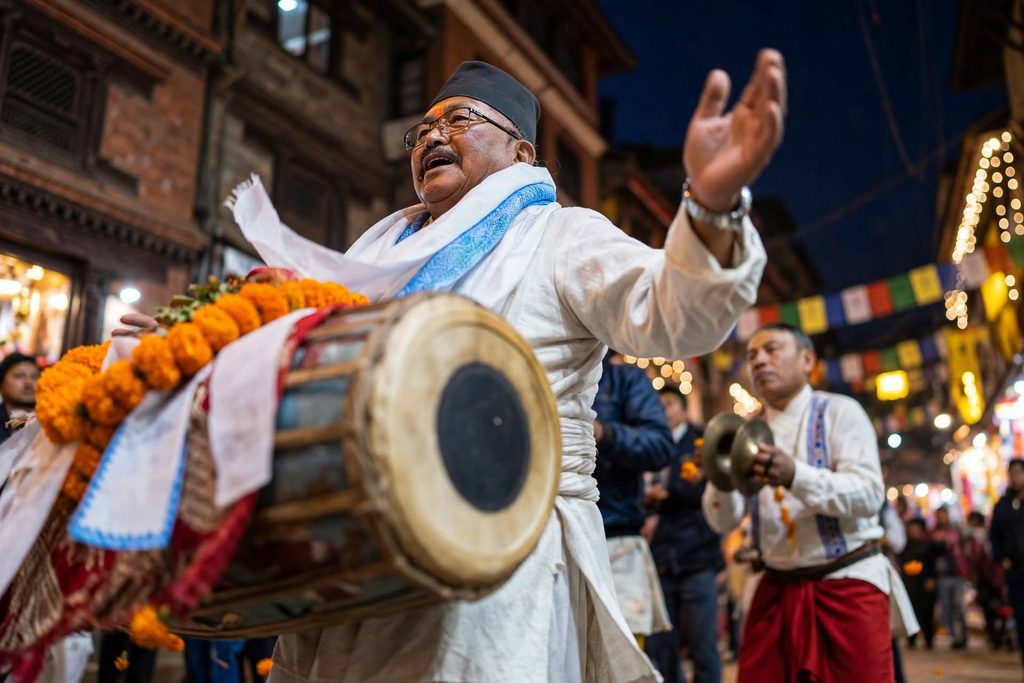
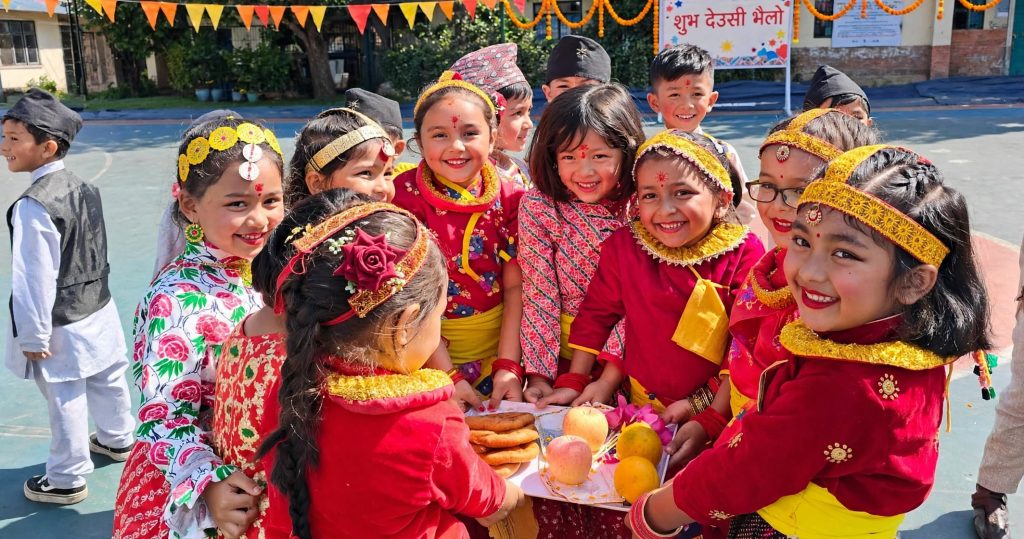
Deusi begins the following night and continues through the remaining days in many places. Traditionally performed by boys and men, it uses a call and response structure: a leader sings a line, everyone else answers with “Deusi re.” Verses bless the house, tell the story of the group’s journey to reach the door, and often work in teasing humor about the householder.
Origin stories vary, and no single version is settled history. One widely repeated account ties the tradition to King Bali, who granted temple attendants the right to go door to door asking for gifts on Laxmi Puja night, with instructions that they not be insulted. Some linguists connect the refrain “Deusi re” to that earlier phrase. Treat these as living traditions with contested origins rather than fixed facts.
How rigid are the gender rules now?
Much less than they were. Mixed groups are the norm in cities, and many groups perform both bhailo and deusi songs on whichever night they are out. Rural practice in parts of the hills stays closer to the older pattern. Do not correct anyone about it.
Who Performs, and Where the Money Goes
Here is the part most travel writing skips. Deusi and bhailo have quietly become one of Nepal’s largest informal fundraising mechanisms.
Neighborhood youth clubs, school groups, college societies, women’s savings groups and local NGOs all organize deusi teams during Tihar. Money collected over a few nights funds concrete things: a community building repair, sports equipment, a temple restoration, scholarships, ambulance costs, disaster relief. Some groups announce in advance what they are raising for and publish accounts afterward. Others keep it informal, and the money goes to a group dinner or picnic.
Children’s groups are different again. Small groups of kids going door to door on their own street keep what they collect, and that is entirely normal and expected.
The practical consequence for a traveler: giving money is not charity in an awkward sense. It is participation in an expected exchange. Refusing a group at the door is unusual, though nobody will make a scene about it.
What to Give
There is no fixed rate, and asking a Nepali friend for the current norm is better than following any number in an article. As general orientation, households commonly give a modest note to a children’s group and rather more to an organized adult group that has performed a full set. Foreigners are sometimes expected to give a little more, which is worth deciding about in advance rather than fumbling at the gate.
Money is given by hand to the group leader, often with both hands or the right hand, never thrown or tossed. Food counts too. Sel roti, fruit, sweets and roti are all normal to hand over alongside or instead of cash. Our guide to sel roti explains why that particular bread turns up at every door during Tihar.
| Bhailo | Deusi | |
|---|---|---|
| Night in 2026 | Laxmi Puja, November 8 | From November 10, continuing in many places |
| Traditional performers | Girls and women | Boys and men |
| Song structure | Group sings in unison | Leader sings, group answers “Deusi re” |
| Typical length per house | Ten to twenty minutes | Ten to thirty minutes |
| Given in return | Money, sel roti, fruit, sweets | Money, food, sometimes a meal |
| Common organizers today | Children’s groups, women’s groups | Youth clubs, schools, community fundraising teams |
Can a Visitor Join a Group?
Yes, with a genuine invitation, and no otherwise.
Joining works when a host family, a guide, a homestay owner or a Nepali friend brings you along with their own group. In that situation you are somebody’s guest, the group knows you are coming, and your presence is explained at each door. Plenty of travelers have spent a memorable Tihar evening this way, clapping badly and learning the refrain by the fourth house.
Joining does not work when you attach yourself to a group on the street because it looks fun. A deusi team at a stranger’s gate is doing something with a social function: they are representing their neighborhood, asking for money, and being watched by the household. An unannounced foreigner in the middle of that changes the encounter for everyone.
If you are invited, a few practical notes
- Learn the refrain. “Deusi re” is the only line you strictly need, and joining the response rather than standing silent is the point.
- Dress warmly and modestly. Evenings in the Kathmandu Valley in November drop toward 8 to 10 degrees Celsius, and you will be outdoors for hours.
- Bring your own small contribution if the group is raising funds. Ask the organizer what they are collecting for.
- Take off your shoes if you are invited inside a home, and expect to be fed at some houses.
- Do not lead. Follow the group’s pace, stop when they stop, and let the leader speak to householders.
What to Leave Alone
Some things are not for visitors, and a few are genuinely intrusive. Worth being direct about them.
Organizing your own group
A group of tourists going door to door collecting money is not participation. It reads as a parody of the tradition at best, and as foreigners soliciting cash from Nepali households at worst. Do not do it, however well meant.
Filming at doorways
Photography of a group performing in a public lane is generally fine. Pointing a camera through an open gate into someone’s lit courtyard, or filming the moment money changes hands, is not. Ask the group leader before filming them, and never film inside a household without the household’s permission. Puja spaces and the Laxmi Puja altar specifically should not be photographed without an explicit invitation.
Pressing for a performance
Asking a group to sing again for your video, or to pose, turns a ritual exchange into a performance for a foreign audience. Watch what happens naturally instead.
Alcohol
Drinking is common in some deusi groups and entirely absent in others, particularly school and children’s groups. Do not bring alcohol to a group unless the organizer has made clear it is welcome.
Noise, Hours and the Rules Nobody Mentions
Deusi and bhailo generate real noise complaints. Amplified sound systems, loudspeakers on pickup trucks and groups working until 2am became common enough that authorities began stepping in. In recent years the Home Ministry and district administrations have repeatedly set cutoff times, usually 9pm or 10pm, and asked police to enforce them. Announcements are typically made shortly before Tihar each year and vary by district, so there is no permanent rule to quote.
For a traveler this matters in two ways. If you are staying in a residential neighborhood during Tihar, expect noise in the evenings and plan sleep accordingly. If you are out with a group, respect whatever cutoff the local administration has announced that year.
Where You Are Most Likely to See It
Deusi and bhailo happen everywhere in Nepal that Tihar is observed, which is most of the country, though not uniformly. Residential lanes give you more than tourist streets. In the Kathmandu Valley, the older neighborhoods of Patan, Bhaktapur and Kirtipur have dense housing, narrow lanes and strong neighborhood organization, which is exactly the combination that produces groups moving house to house. Thamel will give you commercial versions aimed at tourists.
Pokhara’s lakeside is similar: the residential wards away from the tourist strip are where it actually happens. In hill towns and villages, the scale is smaller and the groups more likely to be children or a single neighborhood team, and you are far more likely to be invited in.
Among Newar households the same five days are Swanti, with Mha Puja on November 10 marking the Nepal Sambat new year, so the rhythm of the evenings differs from a Bahun or Chhetri neighborhood nearby. Our Newari culture guide gives more context on that calendar.
Frequently Asked Questions
What is the difference between Deusi and Bhailo?
Bhailo is sung on Laxmi Puja night, traditionally by girls and women, with the group singing in unison. Deusi starts the following night, traditionally performed by boys and men, and uses a call and response pattern with the refrain “Deusi re.” Today mixed groups often perform both.
Do I have to give money if a group comes to my hotel or homestay?
Groups usually approach the household rather than individual guests, and your host will handle it. If you are asked directly, a modest contribution is normal and welcome. Declining politely is also acceptable and will not cause offense.
How much should I give?
There is no fixed amount, and it varies widely by group, neighborhood and what they are raising for. Ask your host or guide what is normal in that area rather than relying on a figure from an article. Giving food alongside money is common.
Can women travelers join a deusi group?
Yes. Mixed groups are standard in cities, and women perform in many groups today. As with any visitor, the invitation should come from someone in the group rather than being arranged by you.
Is it safe to be out at night during Tihar?
Generally yes, and the streets are busier and better lit than usual. Ordinary precautions apply. Traffic is heavier in the evenings, drinking increases in some areas, and roads outside city centers can be poorly lit, so travel back with your group or by arranged vehicle.
Can I record video of deusi and bhailo?
Ask the group leader first. Filming a performance in a public lane with permission is normally fine. Filming inside a home, into a courtyard, at a puja altar, or at the moment money is handed over is not appropriate without clear consent.
Does everyone in Nepal do deusi and bhailo?
No. Practice is strongest among hill Hindu and Newar communities and widespread in cities, but many Himalayan Buddhist communities observe Tihar lightly or center their year on Lhosar instead. In parts of the Terai, Chhath is the larger observance. Traditions vary by community and region.
Are there official time limits on deusi and bhailo?
Often, yes. Nepali authorities have repeatedly announced evening cutoffs, commonly 9pm or 10pm, in recent years. Announcements come shortly before Tihar and differ by district, so check local news during festival week rather than assuming a fixed rule.
Before You Go
If Tihar falls during your trip, read our Dashain guide too, since the two festivals sit weeks apart and shape transport and closures across October and November. Background on the tradition’s contested origins is well covered by Onlinekhabar.
Save this guide, share it with anyone traveling to Nepal in November, and follow NepalVue for more on experiencing Nepali festivals without getting in their way.


