



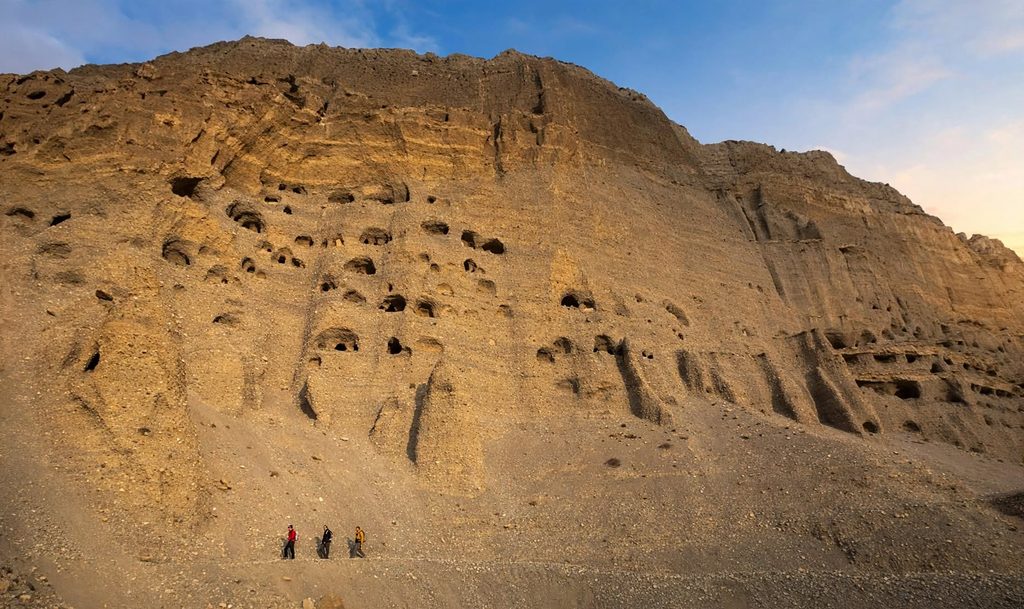
Around 10,000 man-made caves are cut into the cliffs of Upper Mustang, in the valleys above the Kali Gandaki in northern Nepal. Nobody knows who dug most of them. Only a handful have been excavated by archaeologists, the finds inside span more than two thousand years of use, and the structures holding them up are soft sedimentary rock. Chhoser, a village north of Lo Manthang, holds some of the most accessible examples. What follows covers what the sky caves of Mustang actually are, what research has established, and where the record runs out.
What the caves are
Walk up the Kali Gandaki above Kagbeni and the cliffs begin to look perforated. Openings run in rows and clusters, some at ground level, many tens of meters up a vertical face with no visible way in.
Access is the first puzzle. Several cave groups sit well above any surviving path or ledge. Erosion has removed whatever once led to them, which means the entrances now hanging in open rock were reachable when they were cut and are not reachable now.


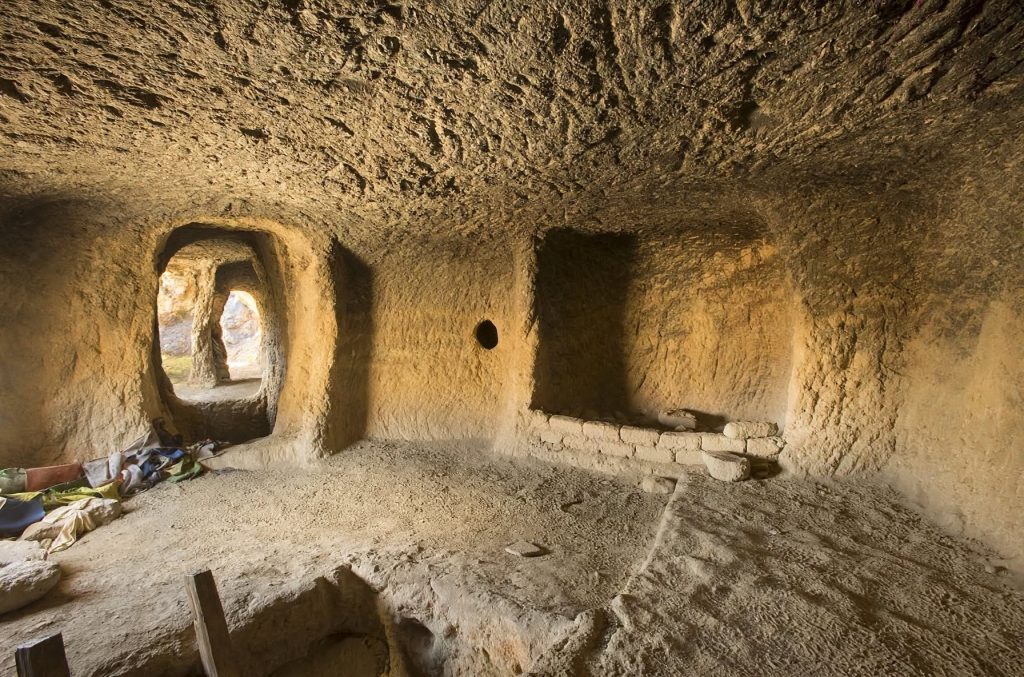
Interior arrangements vary widely. Some are single chambers. Others run to multiple storeys connected by internal shafts and hand-and-foot holds. Charang cave contains 33 chambers. Chukumau has three storeys, Marchung and Luri four each, and the Ghami caves rise to eight, according to a survey of Upper Mustang heritage by the Nepali archaeologist Prakash Darnal.
Function varied too, and probably changed over time at the same site. Research and survey work has identified caves used for burial, for storage, for meditation and religious retreat, for defensive refuge, and in some cases as ordinary dwellings.
Chhoser specifically
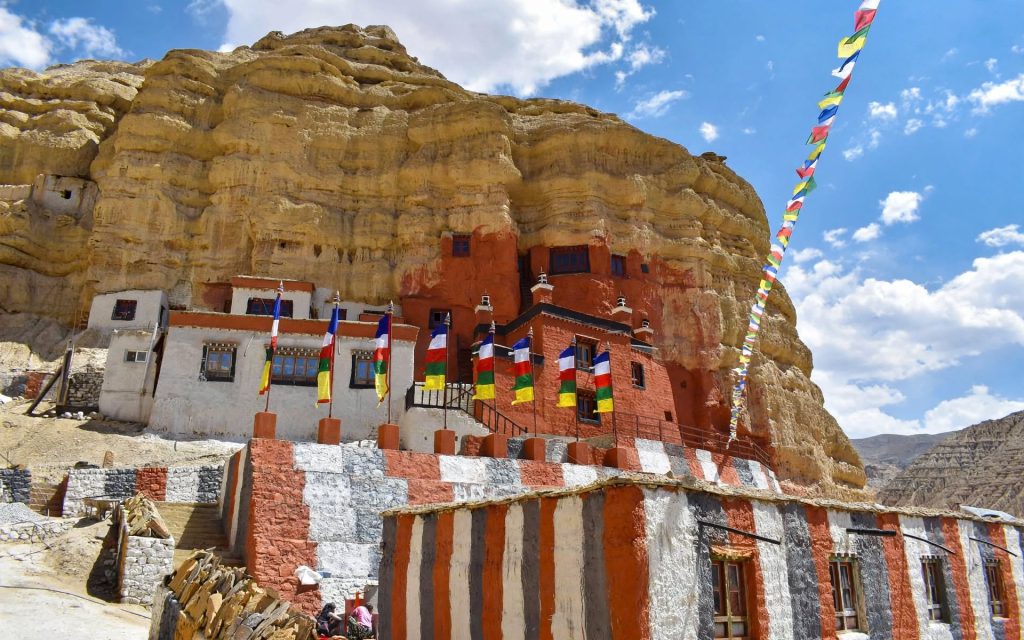
Chhoser sits roughly 10 to 12 kilometers north of Lo Manthang, close to the border with Tibet. Its best-known site is a multi-storey cave complex locally called Jhong, reached on foot from the village and open to visitors.
Darnal’s survey of the Choser area names several sites: a cave known as Mandala, the Phodaling complex also called Goije Phu, and Chukumau Dhakpu. Phodaling carries around 70 painted images, including one panel of 56 figures.
A caution worth stating early. Guiding literature and trekking websites routinely date the Chhoser caves to around 800 BCE. That specific figure does not appear in the archaeological sources reviewed for this article, and no published excavation report for the Chhoser complex establishing it was found. Treat the number as locally repeated rather than demonstrated.
What excavation has actually shown
Archaeological work in Mustang has been episodic, concentrated at a few sites, and spread across three decades.
During the mid-1990s a joint Nepali team worked with archaeologists from the University of Cologne. Several dozen bodies recovered then were dated to at least 2,000 years old.
Finds near Lo Manthang in 2007 and 2008 produced Buddhist paintings and manuscripts of the 12th to 14th centuries, with art from the 2007 site dated to the 13th century. Skeletal remains recovered in 2008 were around 600 years old.
In 2010 a team working near Samdzong recovered the remains of 27 individuals, dated between the 3rd and 8th centuries CE.
Samdzong, and why it matters
Samdzong has produced the most informative assemblage so far. Metallic artefacts from the site, published under a date range of 450 to 650 CE, include a gold funerary mask, bronze mirrors and brass bracelets.
Composition analysis of that material is what makes it significant. Objects of this type connect Upper Mustang to exchange networks reaching well beyond the Himalaya, and textile finds from the same context have been argued to indicate contact with Silk Road trade further south than had been assumed.
Put plainly: these were not isolated cliff dwellers. A community in an extremely dry, high valley was obtaining worked metal and imported cloth, and burying both with its dead.
Human remains from some Mustang burial contexts carry cut marks on the bones. Interpretation has centered on defleshing as a mortuary practice rather than consumption, and researchers have been careful about how far that reading can be pushed.
| Context | Date range | What was found | When investigated |
|---|---|---|---|
| Mid-1990s burials | At least 2,000 years old | Several dozen bodies | Mid-1990s, Nepal and University of Cologne |
| Samdzong | 3rd to 8th centuries CE; metalwork published at 450-650 CE | 27 individuals, gold funerary mask, bronze mirrors, brass bracelets, textiles | 2010 |
| Near Lo Manthang | 12th to 14th centuries | Manuscripts, Buddhist paintings, sculpture | 2007 and 2008 |
| Near Lo Manthang skeletal finds | About 600 years old | Skeletons | 2008 |
Read the table as a scatter of data points rather than a sequence. Four investigations across roughly thirty years, at a small number of locations, out of about 10,000 caves. Any statement about Mustang’s caves as a whole is an extrapolation from a very thin sample.
Who built them, and why nobody can say
Honest answer: the identity of the people who cut most of these caves is not established.
Several things make the question hard. Most caves have never been systematically recorded, let alone excavated. Occupation at many sites appears to have been repeated and intermittent across long periods, so later use overwrites earlier evidence. Dry conditions preserve organic material unusually well, which is a gift, and the lack of stratified excavation at most sites means that material usually has no secure context.
Local tradition, Bon and Buddhist textual sources, and the archaeological record do not map neatly onto each other. Manuscripts recovered from these caves mix Buddhist and Bon writings, which is itself a finding about the religious history of the region rather than a tidy answer about origins.
The surrounding culture is Tibetan in language, religion and architecture, and Lo Manthang was the capital of an independent kingdom. Continuity of that kind is real, and it does not by itself date a cave cut into a cliff.
What is actually damaging the sites
“Collapsing” is a word applied loosely to these caves. The documented threats are more specific, and most of them are not geological.
Darnal’s survey records concrete damage across Upper Mustang’s heritage. Water seepage from rain and snowmelt has damaged murals at Jhyampa monastery, with broken rafters and joists. Dampness and cracking have damaged paintings at Thubchen, where careless restoration also destroyed part of the lower paintings. Shaka Phu cave is now inaccessible, and its associated kabung is badly damaged. Tashe kabung is severely damaged on its eastern side, and the Gonpa Kang kabung is ruined.
Road building is the threat Darnal treats most seriously. Lung Kurki was filled with mud, dust and stone during road construction in 2007. Chortens at Kangni, Charang, Sumda and the entrance to Lo Manthang are listed as vulnerable, and the survey warns that vehicle movement and the vibration it causes may cause irreplaceable loss.
Building pressure compounds it. Houses near the Lo Manthang wall rose from two in 1995 to sixteen by 2004, and new cemented structures sit badly against earth and stone originals.
Note what is not in that list. Earthquake damage, looting and changing rainfall patterns are frequently asserted in general coverage of Mustang, and Darnal’s survey does not name them among its documented threats. They may still be real. They are not established by the source.
The documentation gap
Popular articles sometimes describe 3D mapping or laser survey of the Mustang caves. No published programme systematically mapping these caves in three dimensions was found while researching this piece.
Darnal’s own recommendation points the other way: he calls for full documentation of Lo Manthang through survey, drawings, mapping and inventory, and for a conservation master plan. That is a call for work still to be done, not a description of work completed.
The practical consequence is uncomfortable. If a cave face fails, there is in most cases no record of what was inside it.
Visiting, and doing it without adding to the problem
Upper Mustang is a restricted area. Foreign visitors need a restricted-area permit in addition to the Annapurna Conservation Area permit, must travel with a licensed guide, and cannot trek solo. Permit costs and rules change, so confirm current requirements before planning.
Road access has transformed the journey. Much of the route that was once a multi-day walk is now drivable, which is the same development Darnal flags as a conservation risk. Our Upper Mustang overland itinerary covers the practicalities, with wider regional context in our Mustang travel guide and the approach through Jomsom and Kagbeni.
Inside the caves, the useful rules are dull. Do not touch painted surfaces, since skin oils and abrasion do cumulative damage. Do not remove anything, including pottery fragments. Follow your guide on which chambers are open, because some sites are religiously restricted and some are structurally unsafe. Nepal has other cave sites that are easier to visit and carry less conservation risk, including Siddha Gufa and the cave network around Pokhara.
What would change the picture
Three things would move this from mystery to history.
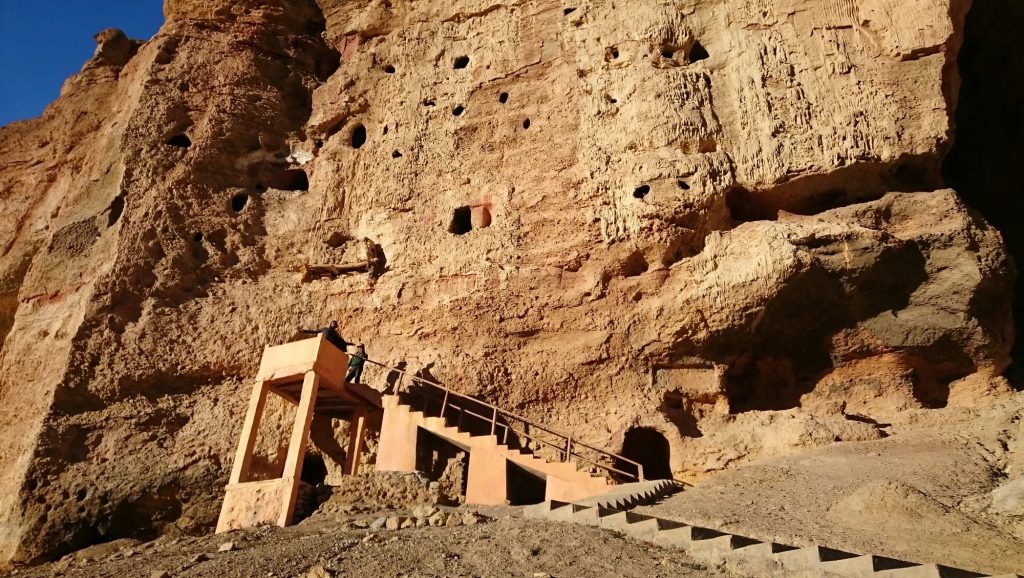
Systematic survey comes first: a recorded inventory of cave locations, forms and condition, which does not currently exist at scale. Targeted excavation with secure stratigraphy would follow, at a small number of representative sites rather than at whatever is easiest to reach. Radiocarbon programmes across multiple sites would then let researchers say whether the caves represent one episode of construction or many.
None of that is cheap, and all of it competes for the same limited archaeology budget as Nepal’s better-known sites. Meanwhile the road network expands.
Frequently asked questions
How many caves are there in Mustang?
About 10,000 man-made caves are recorded across the district, cut into valley sides in Upper Mustang near the Kali Gandaki. Only a small number have been archaeologically investigated.
How old are the Chhoser caves?
Not established. Guiding literature commonly cites around 800 BCE, but no published excavation report for the Chhoser complex supporting that date was found. Dated material from other Mustang sites ranges from at least 2,000 years old to the 14th century CE.
Who built them?
Unknown for most of the caves. Occupation appears to have been repeated across long periods, most sites have never been excavated, and later use obscures earlier evidence. Anyone offering a confident single answer is going beyond the record.
What has actually been found inside?
Human burials, including partially mummified remains; Buddhist paintings, sculpture and manuscripts from the 12th to 14th centuries; and at Samdzong a gold funerary mask, bronze mirrors, brass bracelets and textiles, with the metalwork published at 450 to 650 CE.
Why are some caves unreachable?
Erosion has removed the ledges and paths that once led to them. Entrances now sitting high on bare rock faces were accessible when the caves were cut.
Are the caves collapsing?
Specific documented damage across Upper Mustang’s heritage includes water seepage, cracking, inaccessible and ruined structures, and harm from road construction and vehicle vibration. Framing the whole cave system as collapsing overstates what has been recorded site by site.
Can visitors go inside?
Some sites are open, including the multi-storey complex at Chhoser. Upper Mustang is a restricted area requiring a special permit and a licensed guide, and solo trekking is not allowed. Access to individual caves depends on local permission and safety.
Have the caves been 3D mapped?
No systematic published 3D mapping programme for the Mustang caves was found. Nepali heritage scholarship has called for exactly this kind of documentation, which indicates it remains an unmet need rather than completed work.
Further reading
The conservation survey drawn on throughout is Prakash Darnal’s “Significant Heritages of Upper Mustang and Issue of Conservation” in the Dhaulagiri Journal of Sociology and Anthropology. The Samdzong metalwork is published as “Of gold masks, bronze mirrors and brass bracelets” in the Journal of Archaeological Science: Reports.
NepalVue covers Nepal’s past as an open question rather than a finished story. Save this one for your Mustang planning, share it with anyone repeating the 800 BCE line, and follow NepalVue for more from the trans-Himalayan north.


