



Twenty-one Nepali porters walked onto a force platform in a laboratory carrying up to 127 percent of their own body mass. Researchers expected to find a trick. They did not find one. Published work on high-altitude porters in Nepal shows that the loads routinely carried along Himalayan trails are among the heaviest documented anywhere, and that the people carrying them achieve this through sheer physiological cost rather than some clever energy-saving mechanism. Understanding what the science actually found matters, because it bears directly on how porters should be loaded, paid and protected.
The method: namlo and doko
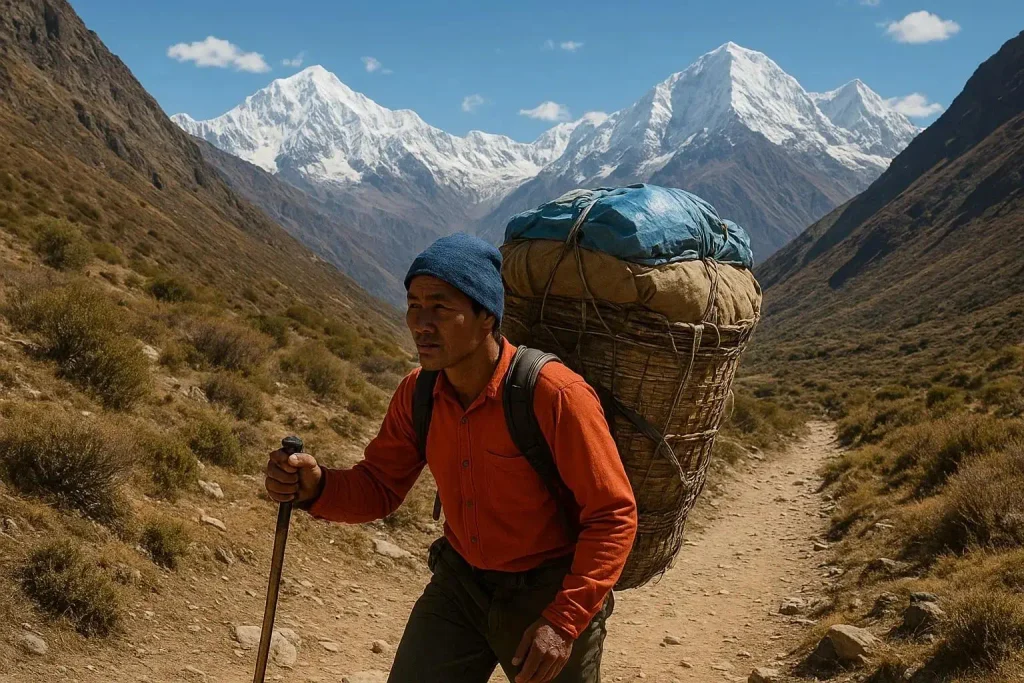
Across the Nepali hills, loads travel on the back but hang from the head. A woven strap called a namlo passes across the upper forehead and supports a conical bamboo basket, the doko, or a bundled stack of goods. Weight transfers down the cervical spine and the trunk rather than through shoulder straps.
Porters use a T-shaped walking stick, the tokma, as a prop. At rest stops they wedge it under the load, taking the weight without setting the basket down and without having to lift it again from the ground. Lifting a 70 kilogram basket off the trail is far more expensive than never putting it down.


Practices vary by region and community. Head-strap carrying is widespread in the middle hills among many groups, while in parts of the high Himalaya shoulder-and-tumpline combinations and yak transport are more common. Treating one method as “the Nepali way” misses that variation.
What the laboratory work found
A 2016 study in the Journal of Experimental Biology by Guillaume Bastien, Patrick Willems, Bénédicte Schepens and Norman Heglund set out to test a specific hypothesis. Earlier work by Heglund and colleagues had shown that women in Kenya carrying loads on their heads recovered a large share of mechanical energy from step to step, effectively carrying moderate loads for free. Would Nepali porters do the same, at much heavier loads?
They did not. Across 1,620 analyzed strides at loads from zero to 120 percent of body mass and speeds from 0.5 to 1.7 meters per second, the porters performed about the same total mechanical work as European control subjects. No pendulum-style saving appeared.
One difference did show up. At slow speeds with heavy loads, the porters were more efficient, meaning they converted metabolic energy into mechanical work at a better rate than the controls. Efficiency, not mechanics, is where the advantage sits.
| Measure | Finding | Source |
|---|---|---|
| Loads tested in laboratory | 0 to 127% of body mass | Bastien et al., J Exp Biol, 2016 |
| Typical field load, adult male porters | About 89% of body mass | Bastien et al., 2016 (introduction) |
| Typical field load, adult female porters | About 70% of body mass | Bastien et al., 2016 (introduction) |
| Loads recorded at start of trek | 146% of body mass, standard deviation 30% | Malville, 1999, cited in Bastien et al. |
| Maximum African head-carrying loads studied | Roughly half the porters’ loads | Bastien et al., 2016 |
| Energy saved per step, Kenyan head carriers | Up to 80% recovery at loads around 20% of body mass | Heglund et al., earlier work |
Walk slow, stop often
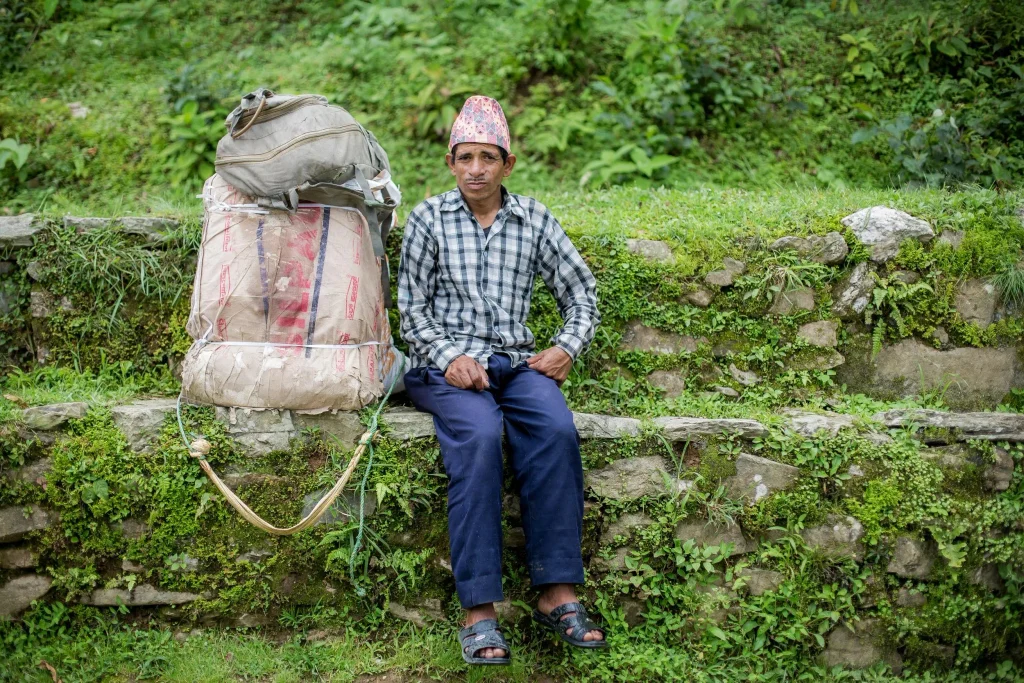
Field observation from the same research group explains how porters make the economics work on real terrain. Speeds hold at roughly 3 to 4 kilometers per hour and do not increase when porters are behind schedule. Instead, they walk later into the evening.
Rest patterns are more surprising. On the steepest sections, porters may walk for something like fifteen seconds and then rest for forty-five. Norman Heglund’s interpretation is that this keeps them below the threshold where anaerobic metabolism takes over, since anaerobic work builds a debt that has to be repaid with much longer recovery.
Heglund also pointed out a terrain constraint that defeats energy-saving gait. On Himalayan trails, as he put it, porters never take two steps at the same level. Pendulum mechanics need a reasonably even surface. Stone staircases and root-laced switchbacks do not offer one.
Altitude adds a second problem
Above roughly 3,000 meters, falling barometric pressure reduces the oxygen available per breath. Maximal aerobic capacity declines, and the decline steepens with elevation. A load that sits comfortably within aerobic range at 1,500 meters can push the same person into anaerobic effort at 4,500 meters.
Porters working the high trails are not immune to altitude illness. Acute mountain sickness, high-altitude pulmonary edema and high-altitude cerebral edema affect residents of lower hill districts who travel up for seasonal work, and these workers often ascend faster than the trekkers they serve. Many are hired in Kathmandu or the lowlands, not in high villages.
Genetic adaptations documented among long-resident Himalayan populations, including Sherpa communities, do not transfer to a porter recruited from a middle-hill district at 900 meters. Assuming that “Nepali” means “acclimatized” is a mistake that has cost lives.
The long-term cost to the body
Head-supported carriage loads the cervical spine in compression. Research published in the Journal of the Nepal Medical Association examined cervical spondylosis among Nepali porters, and degenerative neck changes are a recognized occupational concern in this workforce.
Related work on heavy load carrying in Nepal, including a study of sand miners in Kaski district, has documented high rates of musculoskeletal symptoms among people who carry loads daily. Precise attribution is difficult. Porters are rarely followed over years, and few studies separate carrying from other physical labor, nutrition and access to care.
What can be said fairly: the biomechanical loading is extreme, degenerative change is reported, and the evidence base is thinner than the scale of the workforce warrants.
Who the porters are
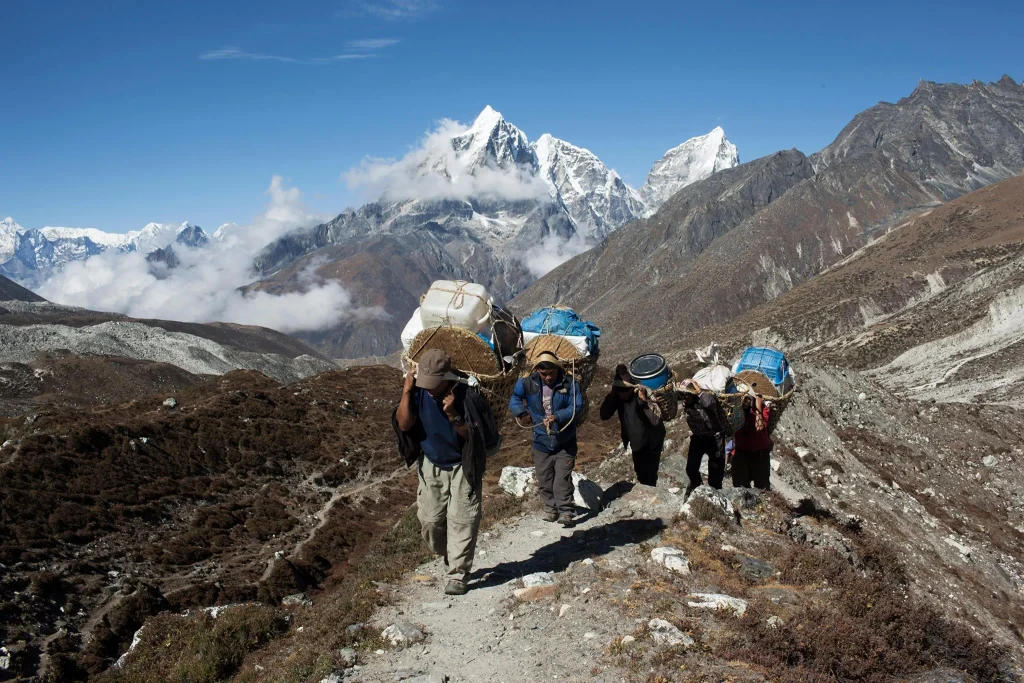
Porter work in Nepal splits into two broad markets that outsiders often merge. Trekking porters carry client gear on commercial routes, usually hired through agencies in Kathmandu or Pokhara, paid a daily rate, and working a season that peaks in spring and autumn. Freelance load carriers move cement, rice, roofing iron and beer to road-less villages, paid by weight, and they work year-round.
Second group carries the heaviest loads and attracts the least attention. Most biomechanics research has been done with porters of this kind on the Jiri to Namche corridor and similar supply routes. Recruitment draws heavily on households in middle-hill districts where farm income alone does not cover the year, which is why so many porters are migrants within their own country.
Weight limits and why they exist
Responsible trekking operators and porter welfare organizations converge on a working guideline of around 20 to 25 kilograms of client gear per porter on commercial treks, with some policies setting 20 kilograms at altitude and allowing a little more at lower elevations. These figures are industry and advocacy standards rather than a single enforced national statute, and they exclude the porter’s own clothing, food and bedding.
Commercial trekking loads and the loads measured in the biomechanics studies are different things. Research subjects were often freelance commercial porters moving goods to market villages, where pay is by weight and the incentive runs in exactly the wrong direction. A porter paid per kilogram will carry more than is good for him.
Here is the practical point for trekkers. Your duffel is not the whole load. Ask your agency what the porter is carrying in total, including gear for a second client, and ask what equipment the porter has been issued.
What good practice looks like
- Weight ceiling: agreed in writing before departure, covering client gear only.
- Clothing and footwear: adequate boots, insulated jacket, gloves, sunglasses and headwear appropriate to the maximum altitude of the route.
- Shelter and food: accommodation and meals of the same standard of safety as the rest of the team, not an unheated storeroom.
- Insurance: cover that includes helicopter evacuation, not just accident compensation. A single rescue flight can cost thousands of dollars.
- Illness protocol: a written rule that a sick porter descends accompanied, with pay continuing, rather than being sent down alone.
- Pay: daily rates agreed directly, with tipping treated as a bonus rather than a wage substitute.
Agencies that meet these standards will tell you so without being pushed. Vague answers are an answer. The International Porter Protection Group publishes guidelines that most responsible operators now reference, and the Nepal Tourism Board maintains registration information for licensed agencies.
Respect without romance
Porters are workers in a labor market, not a photogenic Himalayan tradition. Pay, weight and insurance are the terms that matter. Admiring someone’s endurance while quietly benefiting from an unregulated load is not admiration.
Our guide to tipping guides and porters in Nepal sets out current norms. If you are planning a high route, the Everest Base Camp trek guide and the Kanchenjunga trek guide cover the logistics that determine how much weight your team ends up carrying. For conditions that change loads and risk quickly, see our note on fresh snowfall in Nepal’s high mountains.
Frequently asked questions
How much weight does a Nepali porter actually carry?
It depends on the job. Research recorded average field loads of about 89 percent of body mass for adult male porters and about 70 percent for adult female porters, with some trek-start loads measured at 146 percent of body mass. Responsible commercial trekking policies cap client gear at roughly 20 to 25 kilograms per porter.
Why do porters carry loads with a head strap instead of a backpack?
The namlo transfers weight down the spine rather than onto the shoulders, and it suits tall, narrow loads carried on steep trails. Research has not shown that it saves mechanical energy compared with other methods at these load levels.
Are Nepali porters more efficient than other people?
At slow speeds with heavy loads, measured efficiency was higher than in European control subjects. Total mechanical work was about the same. Training, technique and lifelong conditioning appear to matter more than any special mechanism.
Why do porters stop so often?
Frequent short rests keep effort below the anaerobic threshold. Researchers observed sequences of roughly fifteen seconds of walking followed by about forty-five seconds of rest on the hardest sections, which avoids building an oxygen debt that would require far longer recovery.
Do porters get altitude sickness?
Yes. Many porters come from lower hill districts and ascend quickly for seasonal work, so they face the same risks as trekkers. Being Nepali does not confer acclimatization, and high-altitude adaptation documented in long-resident mountain communities does not apply to every worker on the trail.
Is carrying heavy loads harmful long term?
Degenerative cervical spine changes have been reported in Nepali porters, and musculoskeletal symptoms are common among people who carry heavy loads daily in Nepal. Long-term studies tracking individual porters over years are limited, so the full picture is incomplete.
What should I check before hiring a porter?
Confirm the total weight, the insurance policy including helicopter evacuation, the clothing and footwear provided, the accommodation standard, and the written rule for what happens if the porter falls ill.
Should I carry my own pack instead?
That is a personal choice, but removing the job does not help the worker. Hiring through an operator with transparent weight limits, insurance and fair pay does more good than declining to hire at all.
If this was useful, save it before your next trek and share it with whoever is booking. NepalVue keeps digging into how Nepal’s mountains actually work, for the people who live in them as much as the people who visit.


