



On a winter summit day on Everest, the wind chill temperature sits near minus 64 degrees Celsius and the calculated time for exposed facial skin to freeze drops below a single minute. Those numbers come from a 2021 analysis of real ascents by Szymczak and colleagues in Frontiers in Physiology. They explain why winter climbing on Nepal’s highest peaks is a different discipline from spring climbing, not a harder version of it. Winter ascent physics is the study of how a climber’s body loses heat faster than it can make it, and what clothing, pace and timing can realistically do about that. This article explains the mechanism, the measured evidence, and where the science is still uncertain.
The problem is a budget, not a temperature
Climbers talk about cold as a number on a thermometer. Physiologists talk about it as an accounting problem.
Your body generates heat through metabolism. It loses heat through four main routes: convection, which is air moving across you and carrying warmth away; radiation, which is heat leaving your surface toward a cold sky; evaporation, mostly from sweat; and respiration, which is the cost of warming and humidifying every breath of dry, freezing air. Add the small amount of solar radiation you absorb on a sunny day. Subtract the losses. What remains is net heat storage, usually written as S and measured in watts per square meter of body surface.


When S is positive or near zero, you are stable. When S is strongly negative, your core temperature falls, and the clock starts.
Everything that makes a winter Himalayan ascent dangerous can be traced back to that single equation. Cold air lowers your surface temperature. Wind multiplies convective loss. Thin air reduces the oxygen available for metabolism, so you make less heat. Dry air raises the respiratory cost. The losses go up at the same moment your capacity to replace them goes down.
What the measurements actually show
Two linked studies give the clearest quantitative picture available for Everest, and by extension for Nepal’s other 8,000 meter peaks.
The first, by Szymczak and Błażejczyk, used weather station data recorded on the mountain itself. At the South Col at 7,945 meters, the mean air temperature was around minus 22 degrees Celsius, with a minimum near minus 40. Mean hourly wind at that station was 9 meters per second, with a maximum hourly mean of 26 meters per second and gusts to roughly 44. At the Balcony, at 8,430 meters, the mean was close to minus 23 degrees with a minimum near minus 45.
Those readings turn into heat loss. At the South Col in winter, under cloud and strong wind, modeled total heat loss reached roughly 400 watts per square meter. In summer the same site lost 180 to 215. Convection alone on windy winter days ran four to five times higher than on calm winter days at the same station.
Clothing cannot close the gap in winter
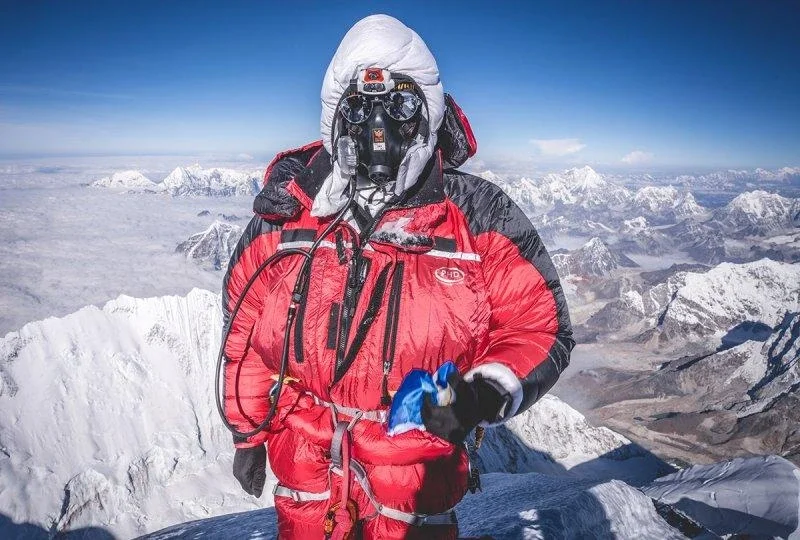
Insulation is measured in clo. One clo is roughly a business suit. A heavy high-altitude down suit sits somewhere between 4.5 and 6.
A 2024 modeling study by Błażejczyk, Havenith and Szymczak in the International Journal of Biometeorology simulated six-day summit attempts without supplemental oxygen, using station data from May 2019 for spring and December 2019 for winter. In spring, 5.5 clo produced net heat storage of roughly plus 20 to plus 40 watts per square meter above 8,000 meters, with air temperature near minus 20 and wind under 11 meters per second. A climber in that state is in balance.
In winter, with air around minus 40 and wind of 12 to 14 meters per second in the sub-summit zone, even 6.0 clo produced net storage of minus 50 to minus 80 watts per square meter. The authors translate that into a body temperature drop of roughly 0.6 to 1 degree Celsius per hour.
Read that again. The best insulation modeled still left a deficit. More clothing is not a solution past a certain point, because bulk restricts movement, adds weight, compresses at the joints and lowers the metabolic efficiency that generates the heat in the first place.
| Condition above 8,000 m | Spring (May 2019 window) | Winter (Dec 2019 window) |
|---|---|---|
| Air temperature | around -20 °C | -35 to -40 °C |
| Wind in sub-summit zone | under 11 m/s | 12 to 14 m/s |
| Clothing modeled | 5.5 clo | 6.0 clo |
| Net heat storage | +20 to +40 W/m² | -50 to -80 W/m² |
| Respiratory heat loss | up to -70 W/m² | up to -121 W/m² |
Source: Błażejczyk, Havenith and Szymczak (2024), modeled values. These are simulations, not measured body temperatures, and the authors say so plainly.
Breathing is a heat cost almost nobody budgets for
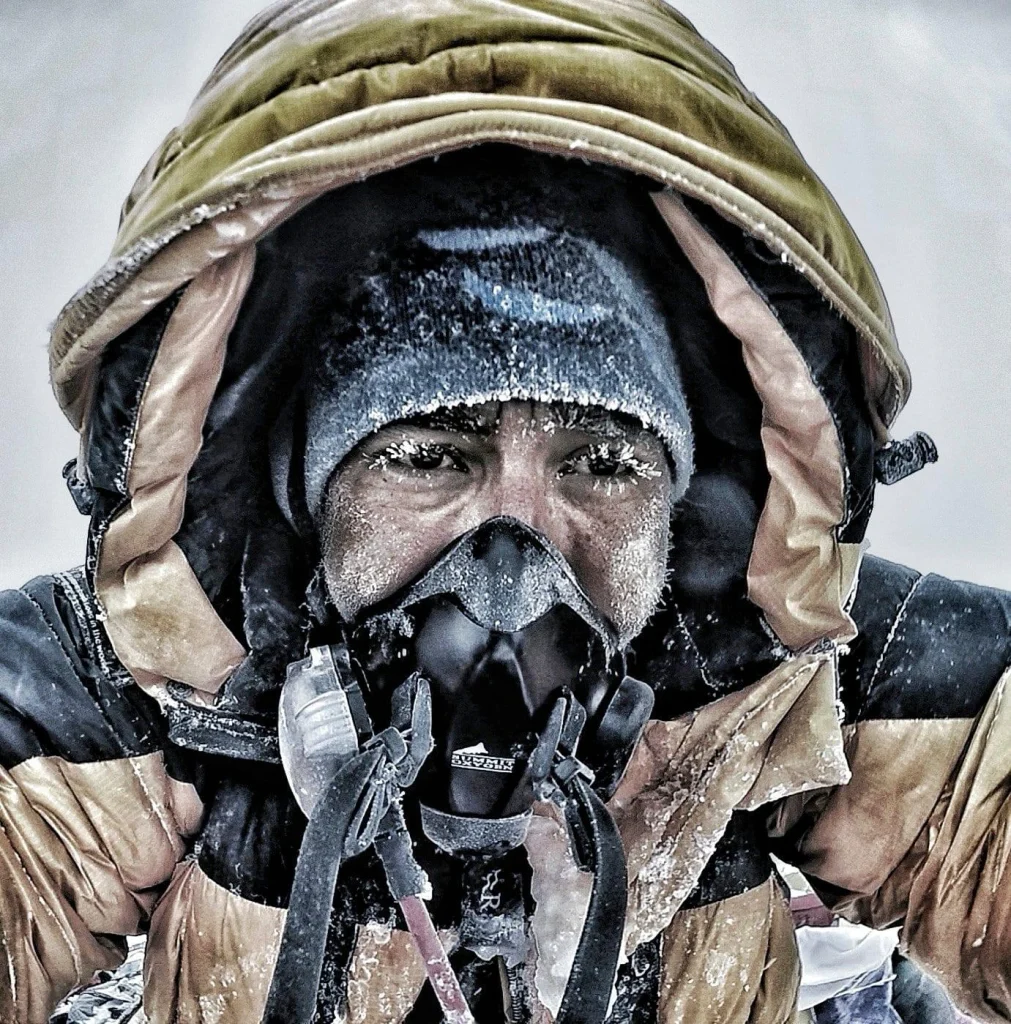
Respiratory heat loss is the quiet item on the list. Every breath arrives at ambient temperature and leaves your body at close to 37 degrees, saturated with water vapor. At altitude you breathe far more air per minute than at sea level, because each breath carries less oxygen.
The modeling above puts respiratory loss above 8,000 meters at up to 70 watts per square meter in spring and up to 121 in winter. That is a significant share of the total deficit, and no jacket addresses it. A neoprene mask or a heat exchanger helps a little. Supplemental oxygen helps more, because it allows a lower ventilation rate for the same oxygen delivery and raises the metabolic heat you can produce.
Frostbite time, and why the indices disagree
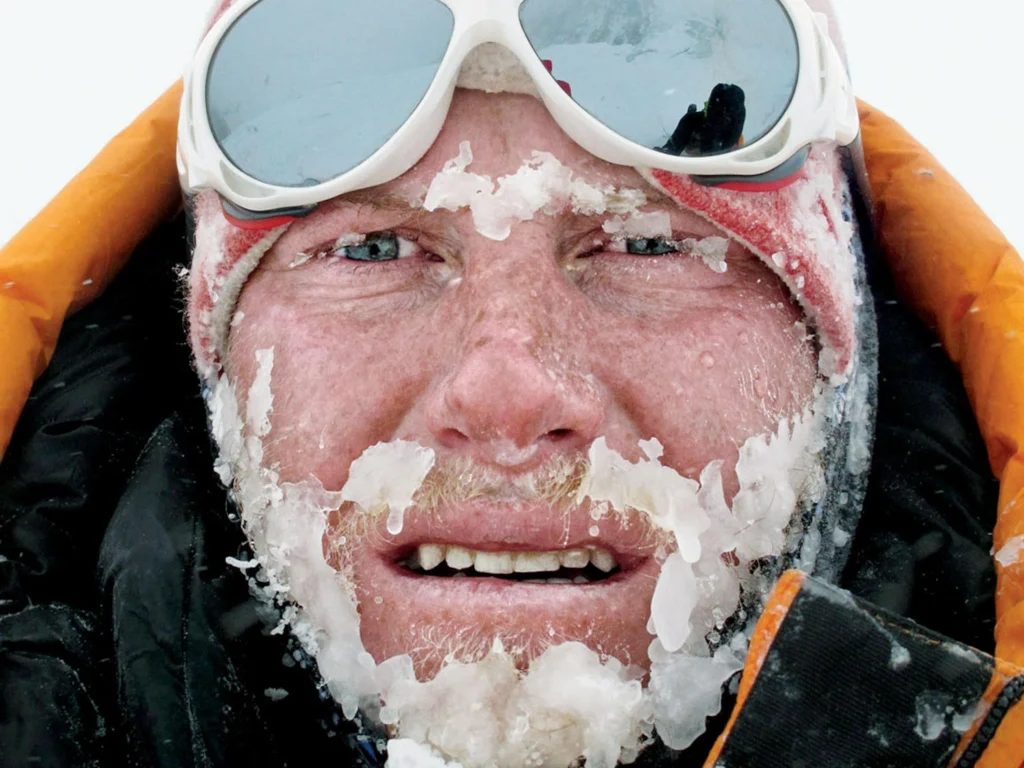
Wind chill temperature and facial frostbite time are the two indices most often quoted in mountaineering coverage. Both were designed for conditions near sea level, and both behave strangely in the death zone.
Szymczak and colleagues calculated these indices for recorded ascents. For non-oxygen ascents outside winter, mean wind chill on the Everest summit was around minus 40 degrees Celsius and facial frostbite time around 9 minutes. For oxygen-supported winter ascents, wind chill averaged near minus 64 and the frostbite index returned negative values, meaning the formula had been pushed outside the range it was built for.
A negative frostbite time is not a physical quantity. It is a warning that the tool has run out of road. The authors note both indices likely overestimate heat loss at extreme altitude, because they assume sea level air density, and that the wind chill formula is only valid below 27 meters per second. Strong winter winds on Nepal’s high peaks routinely exceed that.
Why winter ascents in Nepal are so rare
Nepal holds eight of the world’s fourteen peaks above 8,000 meters. Winter summits on any of them remain exceptional events.
Part of the reason is the jet stream. In winter the subtropical jet descends over the Himalaya, and summit-altitude winds routinely reach speeds that make movement impossible, let alone thermal balance. The 2024 modeling study notes that the mean winter summit wind on Everest is far higher than the relatively calm window its authors chose to simulate. In other words, the conditions modeled were already a best case, and the heat balance was still negative.
Part of it is daylight. Shorter days mean less absorbed solar radiation, which the station analysis found peaked at only 11.1 watts per square meter at the South Col even in sunny summer conditions. Solar gain at these altitudes is almost a rounding error.
And part of it is that a mistake costs more. The same study modeled an unplanned night out without a tent above 8,000 meters. In spring, estimated functional time was about 10.5 hours and survival time about 31.5 hours. In winter, functional time fell to roughly 3 hours and survival time to about 9. Those are model outputs, not field measurements, but the ratio is the point.
What climbers actually do about it
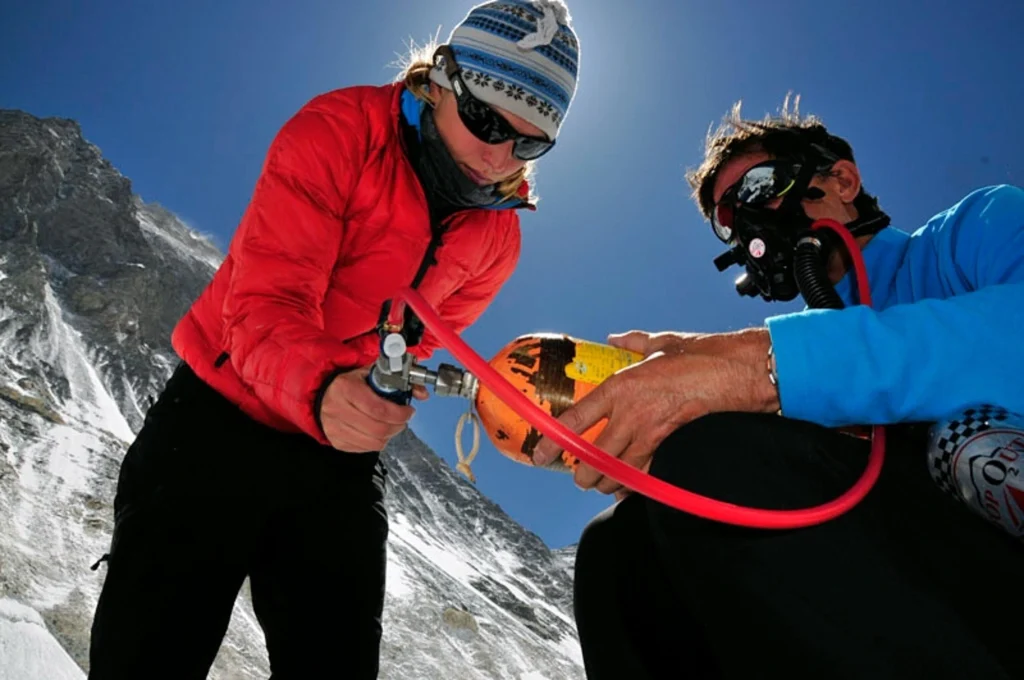
Thermal management in practice is less about gear specification and more about sequencing.
- Pick the wind, not the temperature. The 2024 study suggests targeting winds below 10 to 15 meters per second for spring attempts and below 5 meters per second in winter. Wind dominates the loss term.
- Regulate output to avoid sweating. Damp insulation loses much of its value. Climbers vent and adjust constantly rather than overheating and then freezing.
- Protect the respiratory tract. Masks and buffs reduce a loss that clothing cannot touch.
- Eat and drink on a schedule. Metabolic heat needs fuel, and appetite collapses at altitude. Estimated daily energy expenditure at the higher camps is around 20 megajoules.
- Use adjustable insulation lower down. Below 7,000 meters the recommendation is clothing you can open and close, not maximum loft.
- Treat the turnaround time as a thermal decision. Being late in winter is not an inconvenience. It is a deficit you cannot repay.
Where the science is still unsettled
Honest reporting here means naming the gaps.
Almost all the numbers above come from models and reanalysis data, not from instrumented climbers on summit days. Nobody has recorded core temperature, skin temperature and metabolic rate on a winter 8,000 meter summit push, for obvious reasons. The 2024 simulations did not reduce clothing insulation for wind penetration and body movement, so the authors warn their positive storage values may be optimistic. Shivering, a meaningful heat source, was discussed but not modeled.
There is also an open question about acclimatization and cold tolerance. Whether long-resident high-altitude populations in Nepal, including Sherpa and other Himalayan communities, show measurably different peripheral cold responses is an area of ongoing research rather than settled fact. Claims in either direction should be treated with caution.
Finally, the two source papers do not fully agree with each other on every figure. The station analysis reports net heat storage at the South Col in winter as minus 105 watts per square meter in one table and roughly minus 70 in its text. That kind of internal inconsistency is normal in a developing field, and it is a reason to read the direction of these results rather than the decimal places.
Related reading on NepalVue
For the oxygen side of the same problem, see our explainer on how hypoxia affects the brain at altitude. For how the mountains themselves are changing, see glacial retreat on Nepal’s 8,000 meter peaks. For planning in cold and snow conditions, see our high-altitude snowfall and trekking safety guide, and for the rescue and insurance realities, trekking insurance and helicopter rescue in Nepal.
Frequently asked questions
How cold does it actually get on Everest in winter?
Station data from the Balcony at 8,430 meters recorded a mean near minus 23 degrees Celsius with a minimum near minus 45. Modeled summit conditions in the December window studied were around minus 40. Wind, not the air temperature alone, determines how dangerous those readings are.
Why does wind matter more than temperature?
Convective heat loss scales with air movement. At the South Col, convection on windy winter days was measured at four to five times the value on calm winter days at the same temperature range. A calm minus 40 day is survivable in a way that a windy minus 25 day may not be.
Can better clothing solve the winter problem?
Not entirely. The 2024 modeling found that even 6.0 clo of insulation left a net deficit of 50 to 80 watts per square meter above 8,000 meters in winter. Adding bulk eventually reduces mobility and metabolic efficiency, so insulation has a practical ceiling.
Does supplemental oxygen help with cold, or only with altitude?
It helps with both, indirectly. Oxygen supports a higher metabolic rate, which means more internal heat production, and it allows a lower breathing rate for the same oxygen delivery, which reduces respiratory heat loss. It is not a heater, but it changes both sides of the heat equation.
Is thin air better or worse for staying warm?
Both. Low air density reduces convective heat loss by up to roughly half compared with equivalent sea-level conditions, which helps. It also reduces available oxygen, which cuts the heat your body can generate. The net effect at 8,000 meters in winter is strongly negative.
Why are facial frostbite times sometimes reported as negative?
Because the index was built for conditions near sea level. Pushed into death zone temperatures and wind speeds, the formula returns values outside its intended range. Researchers report those negative numbers as evidence the tool has reached its limit, not as a literal prediction.
Which Nepali peaks have been climbed in winter?
Winter ascents of 8,000 meter peaks remain rare across the whole Himalaya and Karakoram. Everest was first climbed in winter in 1980. For a current and verified list of winter summits on any specific peak, consult the Himalayan Database rather than secondary summaries, since records are periodically revised.
Is winter trekking in Nepal also dangerous in this way?
No. Trekking altitudes are a different physiological environment. At Phortse, at 3,810 meters, modeled total heat loss was around 110 watts per square meter in summer and 130 in winter, well within what ordinary layering handles. Winter trekking risks in Nepal are mainly snow, pass closures and daylight, not thermal collapse.
NepalVue covers Nepal’s mountains, science and communities with the same care we would want applied to our own home. If this explained something useful, save it for your next planning session, pass it to the climbing partner who needs it, and follow NepalVue for more of how this country actually works.


