



Taplejung is worth your attention for a reason that has nothing to do with the view of Kanchenjunga. Across roughly 4,500 hectares of its hillsides, farmers grow a spice under standing forest rather than clearing it, and that single decision shapes water, soil and canopy cover across the district. If you want one practical thing to take from this article, it is this: wild cardamom farming is not a wild harvest at all. It is a cultivated shade crop, and the difference explains both its ecological value and its current trouble.
What the crop actually is
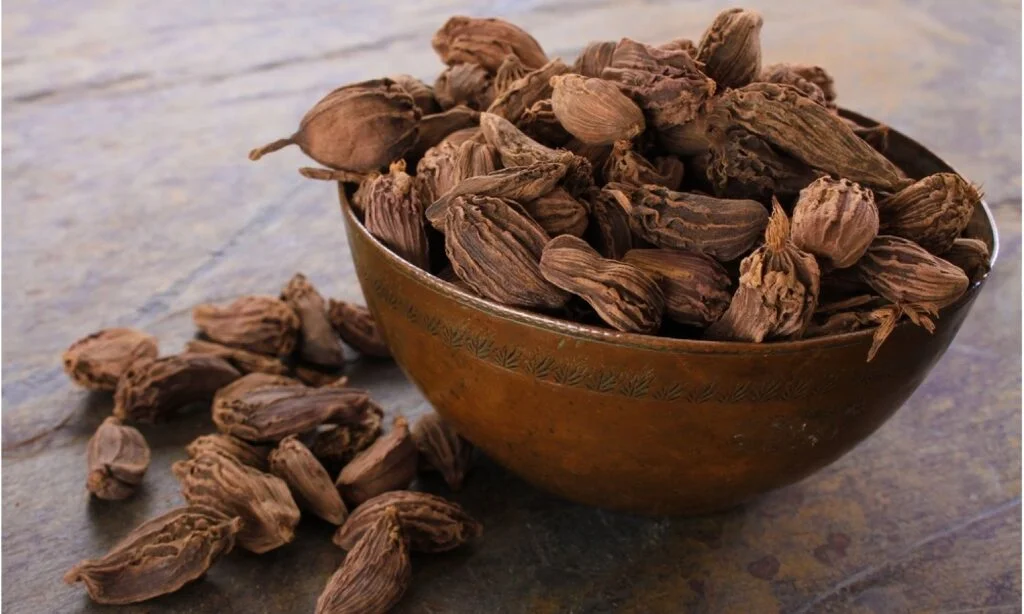
Large cardamom, Amomum subulatum, is a tall perennial in the ginger family. Plants grow to around two meters, send up new shoots from rhizomes each year, and produce capsules at ground level on short flowering stems. Capsules are harvested, dried, and sold whole.
Do not confuse it with green or true cardamom, Elettaria cardamomum, which is a different genus, grown mainly in southern India and Guatemala, and used differently in cooking. Large cardamom is bigger, darker, and carries a smoky note from how it is dried.


Calling it “wild” is a habit of marketing rather than botany. Plants are propagated, planted, weeded and harvested. What is unusual is the setting. Instead of a cleared field, the crop sits under a tree canopy, which is why it functions as agroforestry rather than conventional farming.
The alder question
Nepali alder, Alnus nepalensis, is the shade tree most associated with large cardamom in eastern Nepal and Sikkim. Alder fixes nitrogen through a symbiotic relationship with Frankia bacteria, grows fast on disturbed slopes, and drops leaf litter that feeds the soil.
Cardamom beneath alder therefore gets filtered light, nitrogen input and organic matter without synthetic fertilizer. Slopes keep their root structure and their canopy. For a district with steep terrain and intense monsoon rainfall, that combination matters for landslide risk and for stream flow.
Evidence is not entirely one-directional. ICIMOD’s work with farmers in Taplejung recorded a concern that old alder stands may compete with cardamom for nutrients, and researchers there have looked at alternative fast-growing shade species. Optimal canopy management is still an open question, and the right answer likely differs by site, aspect and stand age.
How much Taplejung produces
| Indicator | Figure | Source and date |
|---|---|---|
| Taplejung area under cardamom | 4,578 ha, up from 4,304 ha the previous year | Agricultural Knowledge Centre, Taplejung, reported January 2026 |
| Taplejung production | 2,291 tonnes, down from 2,539 tonnes | Agricultural Knowledge Centre, Taplejung, January 2026 |
| National area planted | About 18,000 ha | Kathmandu Post, December 2025 |
| Growing households | Over 21,960 across 37 districts | ICIMOD, 2016 |
| Share from four eastern districts | Over 80% of national output | ICIMOD, 2016 |
| Exports, last full fiscal year | 4,301 tonnes worth Rs7.68 billion | Kathmandu Post, December 2025 |
| Share of exports going to India | About 99% | Kathmandu Post, December 2025 |
Read the Taplejung numbers together and the problem becomes visible. Area went up by 274 hectares. Output fell by 248 tonnes. Yield per hectare dropped from roughly 0.59 to roughly 0.50 tonnes, a calculation from the published area and production figures rather than a reported statistic.
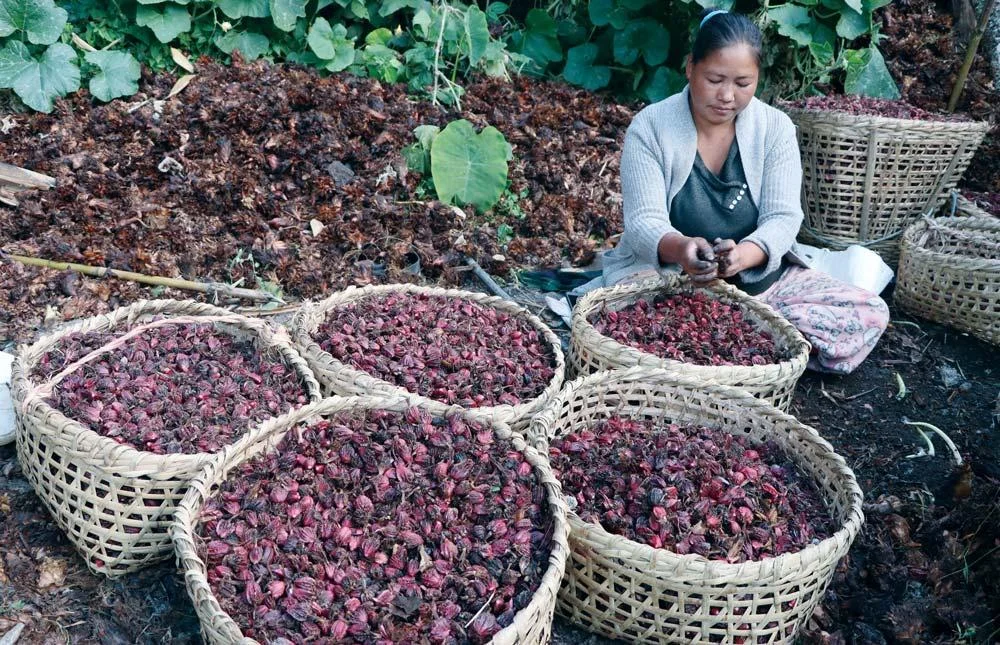
District officials attributed the fall to unfavorable weather, specifically prolonged drought that dried plants and flowers during the growing period. Four main districts, Taplejung, Panchthar, Ilam and Sankhuwasabha, have long accounted for the bulk of national production, with cultivation more recently spreading to Bagmati and Gandaki provinces.
Chirke and furkey
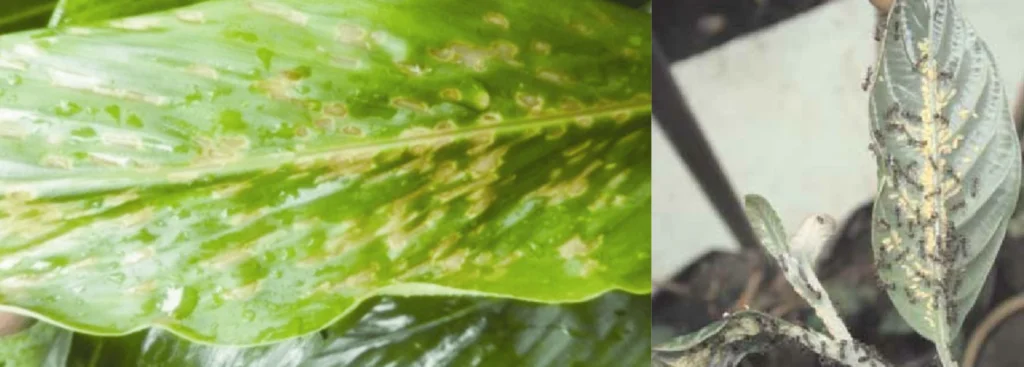
Two viral diseases dominate conversations about declining orchards across the eastern Himalaya, including Sikkim and Darjeeling as well as Nepal.
- Chirke produces pale streaking on the leaves and reduces vigor progressively. Plants decline rather than die suddenly.
- Furkey causes stunted, bushy growth with many thin shoots and sharply reduced capsule production.
Both spread through aphid vectors and through infected planting material. There is no cure for an infected clump. Management rests on removing diseased plants, sourcing clean rhizomes, and controlling vectors, which is difficult when neighboring plots are infected and replanting takes years to reach full yield.
Disease is not the only pressure. Farmers in Taplejung have reported falling water availability, with upstream ponds drying or silting and downstream springs becoming seasonal. Soil condition in long-established orchards is a further concern. Separating the contribution of virus, drought, soil exhaustion and aging plantings is genuinely hard, and researchers have not settled it.
Drying: where the smoke comes from
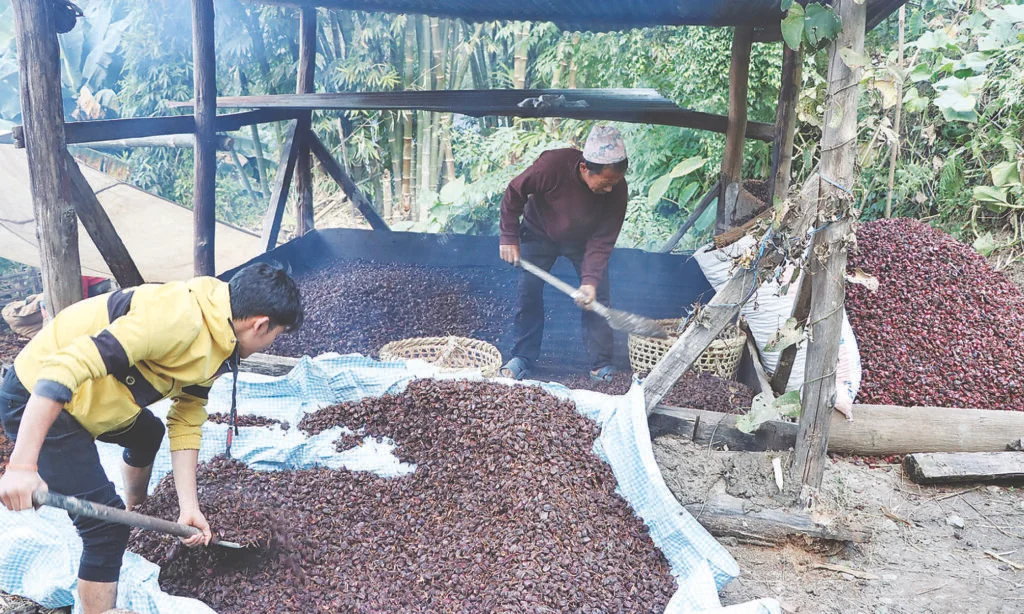
Harvested capsules carry high moisture and must be dried quickly to avoid mold. Traditional curing uses a bhatti, a direct-fire kiln in which capsules sit on a platform above a firewood furnace. Smoke contacts the capsules directly, producing the distinctive smoky flavor that buyers in South Asia expect.
Two costs follow. Direct-fire drying consumes substantial firewood, which puts pressure on the same forests the crop otherwise helps retain. Uneven heat and smoke deposits also affect quality grading, and inconsistent moisture content weakens Nepal’s position in markets outside South Asia that apply stricter residue and quality standards.
Improved dryers that separate the flue gas from the product have been promoted across the eastern Himalaya for years. Adoption has been partial. Capital cost, the smoky flavor profile buyers already pay for, and the practicalities of shared village facilities all slow the switch.
Prices, and why farmers keep planting
Large cardamom prices have run high in recent years. Reported rates around late 2025 placed bold quality near Rs2,600 per kilogram, jumbo jet near Rs2,425 and ordinary near Rs2,350, against roughly Rs2,800 a year earlier. Demand around Ramadan and from Middle Eastern buyers via Indian re-export has supported the market.
That price level explains the expansion in planted area even while yields fall. It also explains the risk. With about 99 percent of exports going to India, Nepali growers are exposed to a single buyer market and to the trade policy of one neighbor. Nepali traders and analysts have been calling for diversification for years, which is harder than it sounds given that most Nepali cardamom reaches other markets only after passing through Indian hands.
Grading and the value chain
Dried capsules are sorted by size and appearance into grades that carry different prices. Bold and jumbo jet grades fetch a premium; ordinary grade sits below them. Sorting happens at the farm or at village collection points, where traders buy and bulk the crop before it moves down to the market towns of Birtamod and Jhapa.
Most growers sell at this first point. Price information is uneven, and a farmer with two hundred kilograms has little leverage against a trader who handles twenty tonnes. Cooperatives have improved that position in some communities, with mixed results elsewhere.
Value added after the farm gate is substantial. Capsules leaving Nepal largely leave unprocessed, so grinding, blending, packaging and branding happen abroad. Repeated analyses of the sector make the same point: Nepal exports a raw commodity and imports the margin back as finished product. Changing that requires processing capacity, consistent quality standards and direct market access, none of which arrive quickly.
What this means for the forest
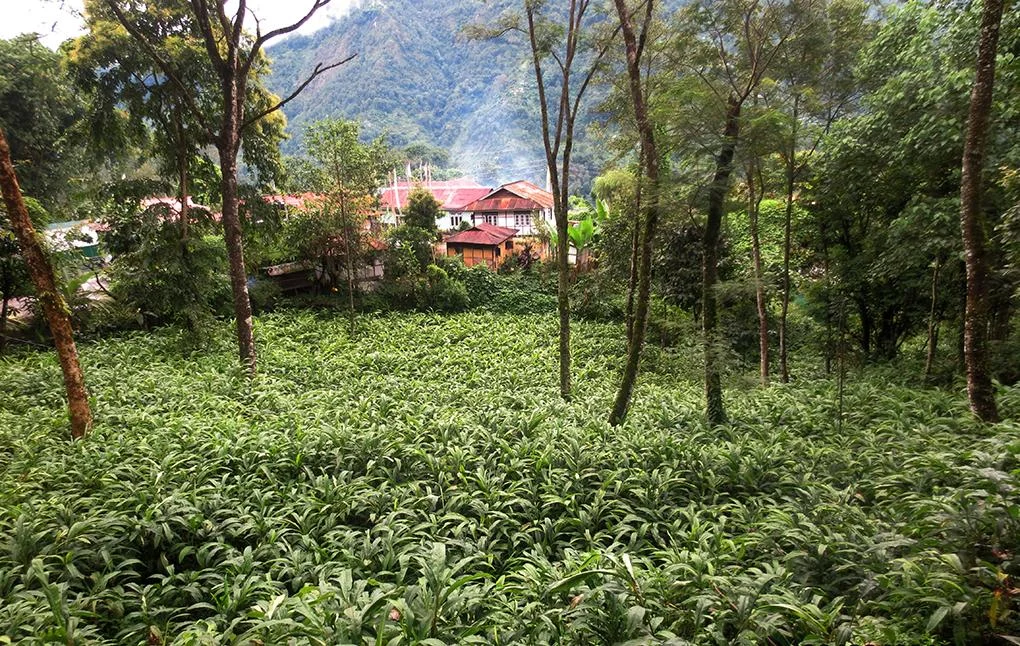
Here is the part that gets lost in the trade statistics. A hillside under cardamom agroforestry keeps a tree canopy, keeps root networks that hold soil through the monsoon, and supports more biodiversity than a maize terrace or a cleared pasture would. Within the eastern Nepal landscape, which includes the buffer areas around Kanchenjunga Conservation Area, that matters.
But the system only holds if the crop remains worth growing. If disease and drought push yields low enough for long enough, the rational response is to switch land use, and the alternatives mostly involve less canopy. Conservation value and farm economics are linked here, not separate issues.
Communities across these districts are not uniform. Limbu, Rai, Sherpa, Tamang, Brahmin and Chhetri households all farm cardamom in eastern Nepal, often with different land holdings, labor arrangements and market access. Policy that treats “cardamom farmers” as one group tends to reach the better connected ones first.
Seeing it for yourself
Cardamom orchards are working land, not an attraction. If you travel through Taplejung, Panchthar or Ilam between roughly September and November you will see harvest and drying underway, and the smell of curing cardamom carries along the road. Ask before entering a plot or photographing people at work.
For the wider region, our eastern Nepal road trip guide covers the route through the hill districts, and the Ilam tea gardens guide explains the other cash crop that defines this landscape. In Taplejung itself, Fungfunge waterfall is an easy detour, and trekkers heading north will want the Kanchenjunga trek guide.
Technical background used here draws on work by ICIMOD on large cardamom production in Taplejung and reporting by the Kathmandu Post on cardamom exports.
Frequently asked questions
Is wild cardamom actually wild?
No. Large cardamom in Taplejung is a cultivated crop, propagated and harvested by farmers. It is called wild because it grows under forest canopy rather than in cleared fields, which is an agroforestry system, not a wild harvest.
How is large cardamom different from green cardamom?
They are different genera. Large cardamom, Amomum subulatum, produces bigger dark capsules with a smoky flavor from direct-fire drying. Green cardamom, Elettaria cardamomum, is smaller, sweeter and grown mainly in southern India and Guatemala.
Why is alder planted with cardamom?
Nepali alder fixes nitrogen, grows quickly on steep disturbed ground, and provides the filtered shade cardamom prefers. Its leaf litter adds organic matter. Some research suggests older alder stands may compete with the crop for nutrients, so management is still debated.
What are chirke and furkey?
Two viral diseases of large cardamom. Chirke causes leaf streaking and gradual decline. Furkey causes stunted bushy growth and heavy yield loss. Both spread by aphids and infected planting material, and neither can be cured once a plant is infected.
Why is production falling while planted area rises?
Taplejung officials cited prolonged drought as the immediate cause of the recent fall. Viral disease, aging plantings, declining water availability and soil condition are also implicated. The relative weight of each factor is not settled.
Where does Nepal’s cardamom go?
About 99 percent of exports go to India, with much of it re-exported onward to Middle Eastern markets. Analysts have repeatedly urged diversification to reduce exposure to a single market.
Does cardamom farming help or harm forests?
Both, in different ways. The cropping system retains tree canopy and soil structure on steep slopes. Traditional direct-fire drying consumes significant firewood, which works against that benefit. Improved dryers reduce fuel use but have been adopted unevenly.
When is the harvest season?
Harvest in eastern Nepal generally runs from around September through November, with drying following immediately. Exact timing varies with elevation and weather.
If this was useful, save it for your trip through eastern Nepal and pass it on to anyone curious about where their spices come from. Follow NepalVue for more on the working landscapes behind Nepal’s mountains.


