



How do you tell a properly licensed trekking guide from someone who simply owns good boots and speaks confident English? That question matters more in 2026 than it did a decade ago, because foreign trekkers on Nepal’s main regulated trails are now expected to trek with a licensed guide arranged through a registered agency. Knowing how to hire a trekking guide in Nepal means understanding what a fair daily rate covers, what belongs in a written agreement, and which sales tactics signal an agency worth walking away from. This guide covers rates, contracts, porter welfare, and the warning signs that experienced trekkers learn to spot early.
Do You Actually Need a Guide?
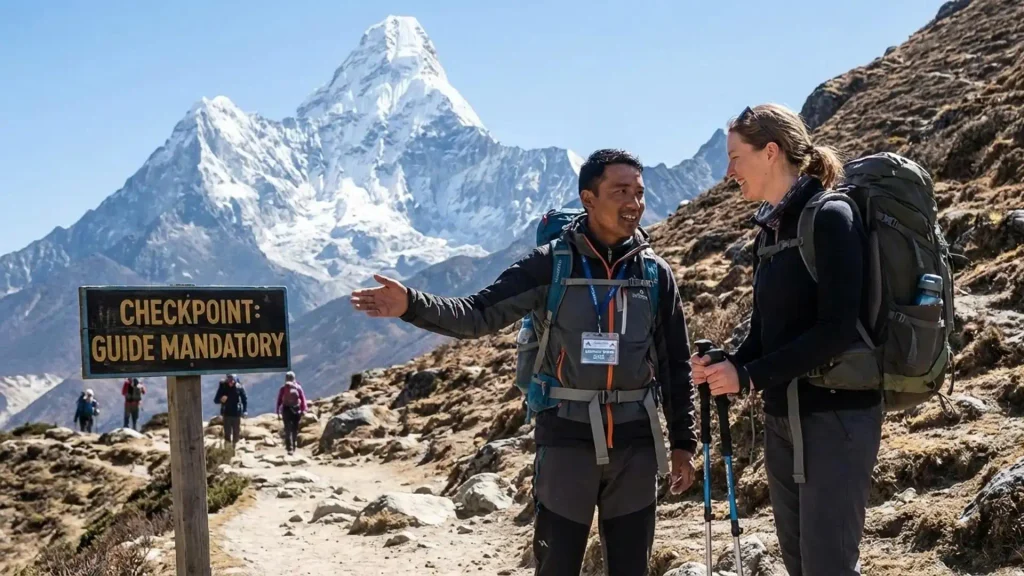
For most foreign visitors on Nepal’s established trekking routes, yes. Since April 2023, Nepal Tourism Board rules have required foreign trekkers on regulated trails to be accompanied by a licensed guide arranged through a government-registered agency. Enforcement is handled largely at permit counters and trail checkposts, and it has held through 2026.
Coverage is broad. Sagarmatha National Park routes, the Annapurna Conservation Area, Langtang, Manaslu and Tsum Valley all fall inside the regulated zone. Restricted areas such as Upper Mustang, Upper Dolpo, Nar-Phu and the Kanchenjunga region carry stricter rules again, with permits issued only through registered agencies.


Day hikes outside protected areas are different. A morning walk on the Kathmandu Valley rim, a circuit of Nagarkot, or an afternoon above Pokhara does not require a guide. Nepali citizens are exempt from the guide requirement entirely.
Rules have shifted more than once in recent years, and local enforcement varies by checkpost. Confirm current requirements for your specific route before you book. Our overview of which trails still allow solo trekking breaks the picture down trail by trail.
Guide, Porter, or Porter-Guide: Three Different Jobs
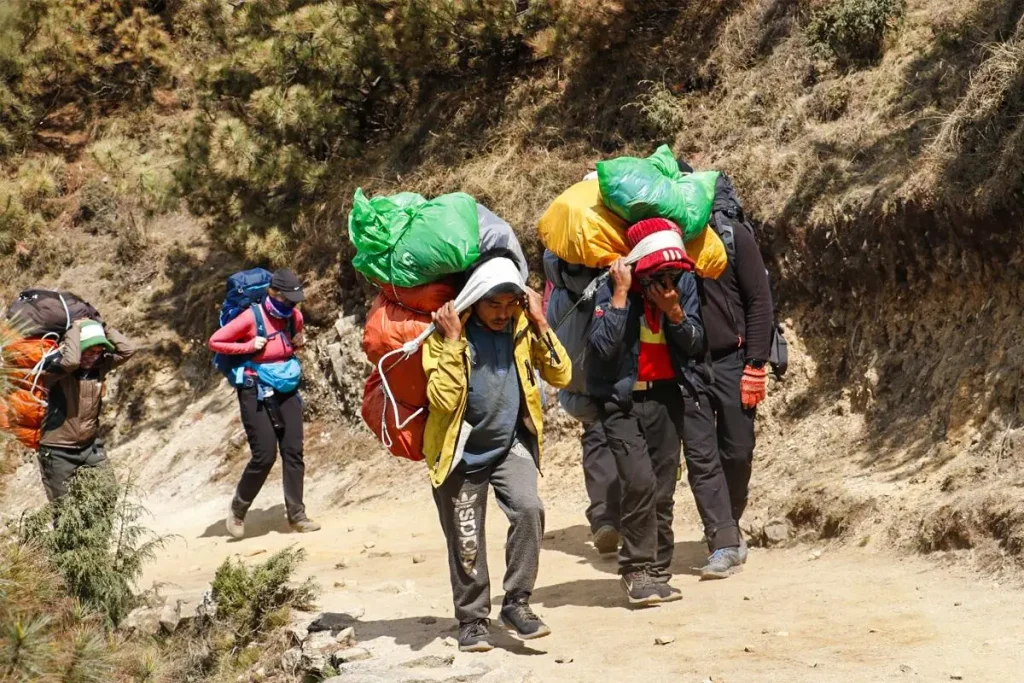
Trekkers often use these words interchangeably. Agencies do not, and the price difference is significant.
A licensed guide carries a Nepal Tourism Board license, has completed formal training, and is expected to hold wilderness first aid certification. Their job is route decisions, altitude management, teahouse bookings, permit handling, cultural interpretation, and emergency coordination. Ask to see the license card and note the number.
A porter carries your load. A good porter is not a guide, may speak limited English, and should not be asked to make altitude calls for you.
A porter-guide carries a lighter load and offers basic route help and conversational English. Popular on shorter routes such as Poon Hill, less appropriate on high passes where a fully licensed guide matters more.
What It Costs in 2026
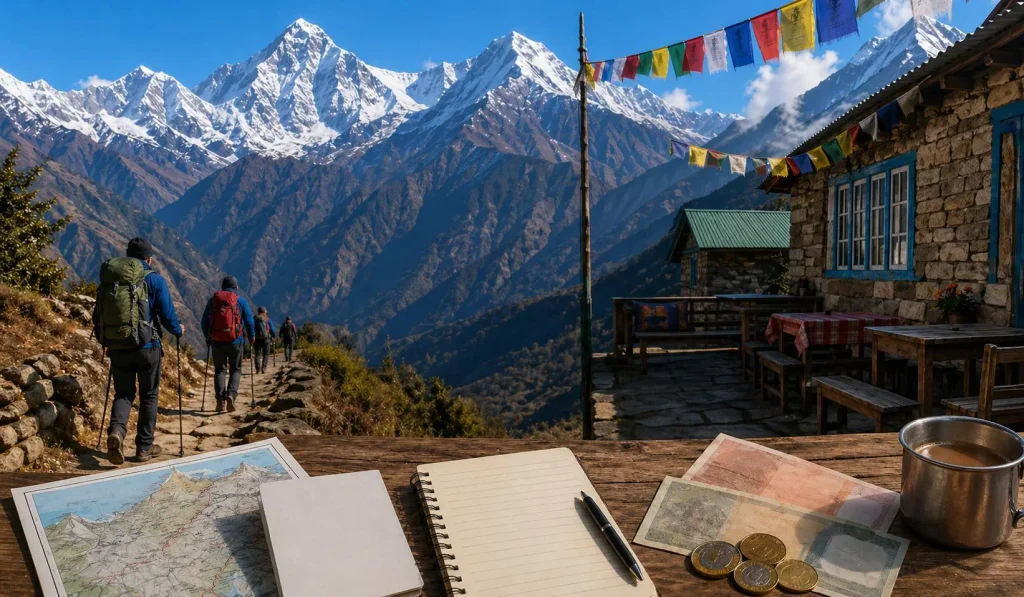
Rates vary by route difficulty, altitude, season, language, and whether you book from abroad or in Kathmandu. Figures below reflect commonly quoted market ranges rather than a fixed official tariff. Treat them as a sanity check, not a price list.
| Role | Typical daily rate (USD) | Notes |
|---|---|---|
| Licensed trekking guide, standard routes | $30 to $50 | Poon Hill, Langtang, Mardi Himal |
| Licensed guide, remote or high-altitude routes | $40 to $70+ | Manaslu, Three Passes, Kanchenjunga |
| Porter | $22 to $28 | Load usually shared between two trekkers |
| Porter-guide | $28 to $40 | Lighter load, basic guiding |
| Multilingual guide (French, German, Spanish, Japanese) | $60 to $100+ | Limited supply, book early |
| Climbing guide, trekking peaks | $80 to $150+ | Separate NMA qualification |
Two numbers deserve context. TAAN set a daily wage floor for porters of NPR 2,400 in 2023, and reported pay commonly sits at or above that level today. Rates quoted below roughly $25 a day for a guide usually exclude their food and lodging, which you then pay on the trail. Ask which model you are being quoted.
For how guide and porter costs fit into a full trip budget, see our line-by-line breakdown of what it costs to trek in Nepal.
What the Daily Rate Should Include
A fair quote for a guide covers their salary, meals, accommodation, transport to and from the trailhead, and insurance. Anything missing from that list becomes your cost later, usually at an awkward moment in a teahouse dining room.
- Salary paid to the guide, not just to the agency
- Food and lodging on trail, clearly stated as included or excluded
- Insurance covering accident and altitude-related emergency, including rescue
- Transport to the trailhead and back, with the mode specified
- Equipment appropriate to the altitude, especially for staff working above 4,000 m
Tips sit outside the rate. Customary practice, not obligation, lands around $5 to $10 per day per client for a guide, scaled down for porters and pooled at the end. Our tipping guide for Nepal covers the etiquette in detail.
Get It in Writing: A Practical Contract Checklist
Verbal agreements are normal in Nepal’s trekking trade and usually honored. They are also where most disputes start. A one-page written agreement, emailed and confirmed, costs nothing and removes ambiguity.
Ask for these items in writing before you pay a deposit:
- Agency name, Department of Tourism registration number, and office address
- Guide’s full name and Nepal Tourism Board license number
- Exact itinerary with overnight stops and acclimatization days
- Total price, currency, what is included, and what is not
- Payment schedule, deposit amount, and refund terms
- Who pays for permits, and whether permit fees are inside the quoted price
- Confirmation that guide and porter insurance is in force, with the insurer named
- Procedure if you descend early, turn back, or need evacuation
- Extra costs if the group size changes or a domestic flight is canceled
- Named contact in Kathmandu reachable 24 hours a day
One clause is worth insisting on: a statement that any helicopter evacuation requires your consent or your insurer’s authorization unless you are unconscious or incapacitated. Given the rescue fraud prosecutions that surfaced in 2026, that sentence protects both sides.
Agency Red Flags
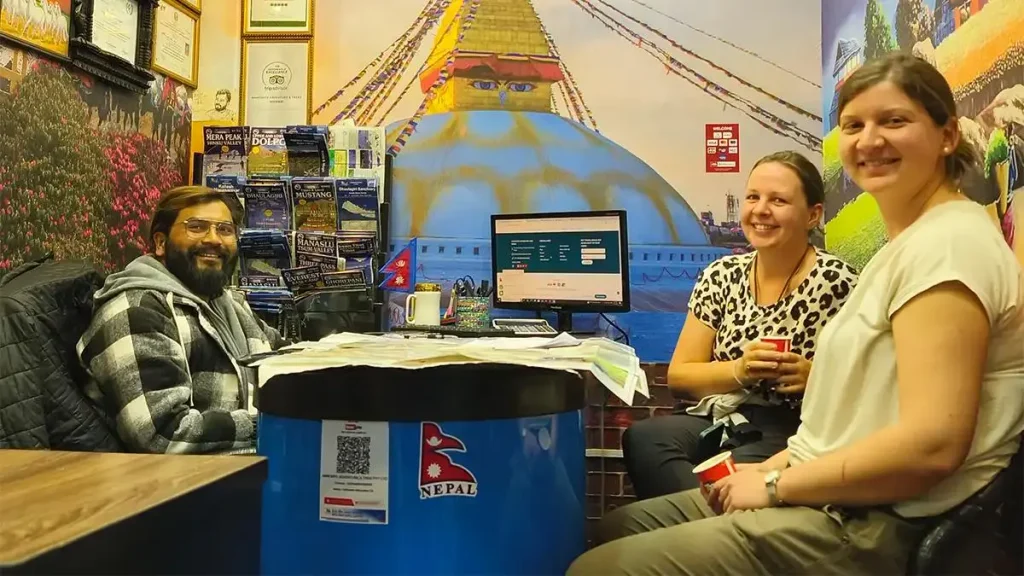
Most Nepali trekking agencies are honest operations run by people who know the mountains well. A minority are not, and the warning signs repeat.
Pressure and secrecy
Be wary of an agency that pushes you to decide today, refuses to name your guide before departure, or cannot produce a registration number. Vague answers about insurance are a serious signal, not an administrative detail.
Prices that cannot work
A quote far below market is not a bargain. Somebody absorbs the gap, and it is usually the porter. Ask directly how much of your payment reaches the staff.
Cash-only demands
Full payment in cash up front, with no receipt and no company bank account, leaves you with no recourse. A deposit by card or bank transfer to a company account is standard practice.
Unlicensed “guides” offered on the street
Informal guiding is cheap and unregulated. Without a license there is no training standard, no insurance, and no accountability if something goes wrong at 4,500 m.
Casual talk about helicopters
An operator who mentions helicopter evacuation as a convenience or a scenic shortcut is describing something your insurer may treat as fraud. Nepal’s Ministry of Culture, Tourism and Civil Aviation announced a zero-tolerance approach to rescue fraud in 2026, after charges were filed against dozens of people in a case involving an alleged multi-million dollar claims network.
Porter Welfare Is Part of Hiring Well
Nepali porters carry loads that would flatten most trekkers, often in weather they are not equipped for. Hiring responsibly is not charity. It is the difference between a working professional and a person put at genuine risk.
The International Porter Protection Group sets widely used welfare standards. Its guidance caps loads at 30 kg, and many responsible operators apply a stricter limit of around 20 kg above 4,000 m. Above that altitude, porters should have a down jacket, proper footwear, and a sleeping bag, and should be insured for altitude-related emergencies on the same basis as guides.
Practical steps that cost you almost nothing:
- Weigh your duffel and keep it honest, not “close enough”
- Ask whether the porter’s insurance is active and who the insurer is
- Check that your porter has boots and a jacket before leaving the trailhead
- Stop when they stop, and do not push a sick porter uphill
Booking From Home vs Hiring in Kathmandu
Booking from abroad costs more and buys certainty. Guides are confirmed, permits are pre-arranged, and someone answers the phone when a flight to Lukla is canceled. Peak season in October and April makes this the safer choice.
Hiring in Kathmandu or Pokhara costs less and gives you a face-to-face read on the agency. Allow two to three working days for permits and paperwork. Visit the office, not a lobby or a cafe, and verify the registration certificate on the wall.
Shoulder seasons give you room to negotiate. Winter and monsoon months bring lower demand, and a strong guide may be available at a better rate. Weather, not price, should still decide your route.
Regional and Route Differences Worth Knowing
Rates and availability are not uniform across Nepal. In the Khumbu, many guides are Sherpa and rates run higher, partly because the altitude and the season are unforgiving. Around Annapurna, the guiding pool is larger and more mixed, including Gurung and Magar guides from the surrounding hills.
Restricted areas work differently again. Upper Mustang, Upper Dolpo and Nar-Phu require permits issued only through registered agencies, and guides working there are usually more experienced and more expensive. Far-eastern routes such as Kanchenjunga combine long approaches with thin infrastructure, so budget for extra days and a guide who has walked the route before.
If this is your first trek in Nepal, our beginner’s guide to trekking in Nepal pairs well with this one.
Frequently Asked Questions
Can I still trek alone in Nepal in 2026?
On most regulated trails, no. Foreign trekkers are required to use a licensed guide arranged through a registered agency. Day hikes outside protected areas remain open to independent walkers.
How do I verify that a guide is really licensed?
Ask to see the Nepal Tourism Board license card and record the number and name. Then confirm the agency’s Department of Tourism registration separately. A guide who is reluctant to show a license is answering your question.
What is a fair daily rate for a guide?
Commonly quoted ranges run about $30 to $50 a day on standard routes and higher on remote or high-altitude treks. Confirm whether the quote includes the guide’s food and lodging.
Do I need to hire a porter as well?
Not always. Many trekkers carry their own pack on shorter routes. On long high-altitude treks, a shared porter between two people reduces fatigue and lowers injury risk.
Is tipping expected, and how much?
Tipping is customary rather than compulsory. Around $5 to $10 per day per client for a guide is a common benchmark, with porters tipped proportionally and paid at the end of the trek.
Should I book before arriving in Nepal?
Book ahead for October, November, March and April. Those months fill quickly, and good guides are committed months in advance. Outside peak season, hiring in Kathmandu is realistic.
What should I do if my guide pressures me toward a helicopter?
Slow down and ask for the medical reason in plain terms. If you are able to walk and descend safely, descent is usually the correct treatment for altitude illness. Contact your insurer before agreeing to any flight unless the situation is a genuine emergency.
Are female guides available?
Yes. Several Nepali agencies are run by and employ women guides, and demand has grown. Request one at the time of booking, because availability is limited in peak season.
Before You Book
Hiring well in Nepal is mostly administrative. Verify the license, read the inclusions, insist on written terms, and ask honest questions about what your staff are paid and insured for. Those four steps remove the majority of problems trekkers report.
Useful official starting points: the Nepal Tourism Board for licensing and trekking regulations, and the Trekking Agencies Association of Nepal for member agencies and industry standards.
Planning a trek this season? Explore more of NepalVue’s trekking and permit guides, save this page for your pre-departure checklist, and share it with anyone booking their first walk in the Himalaya.


