



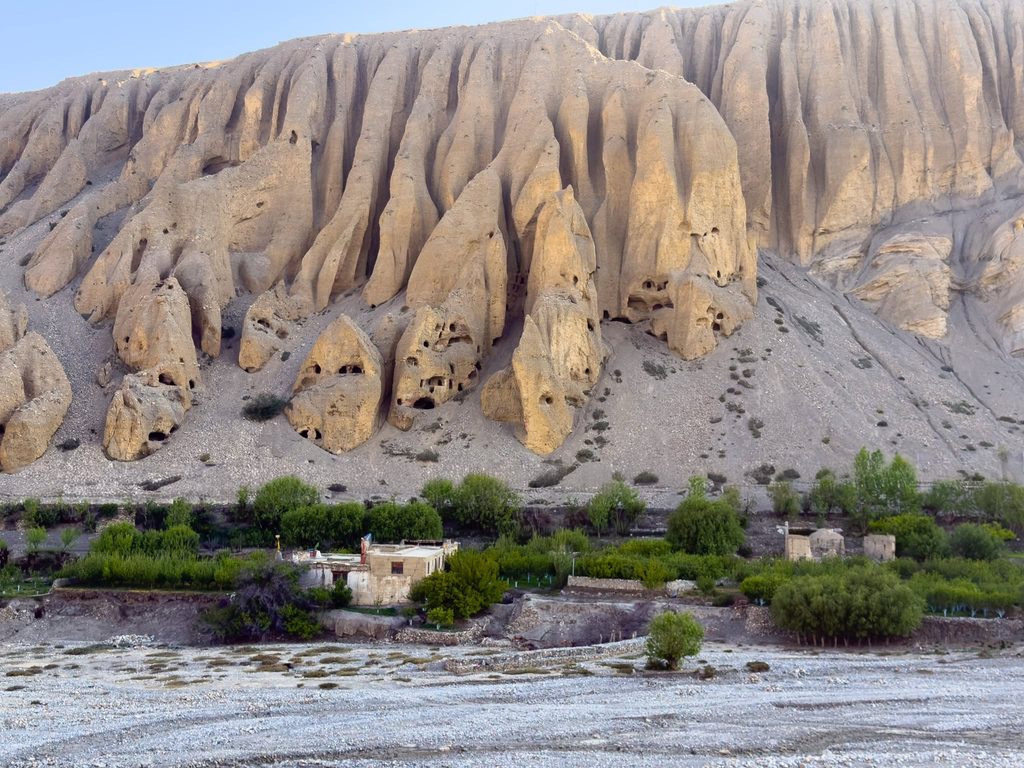
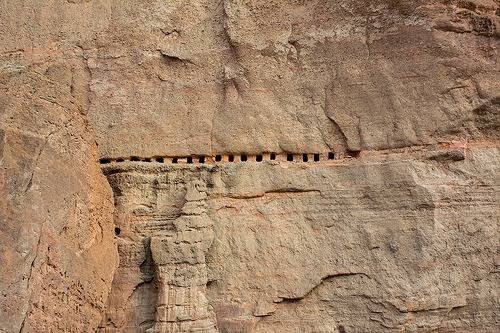
In 2009, a tremor shook loose the face of a cliff above Samdzong, a tiny settlement in Upper Mustang at roughly 4,000 meters. Behind it sat ten shaft tombs that had been sealed for about 1,400 years. What came out of them has changed how archaeologists talk about the Mustang caravan routes that linked the Nepal Himalaya to Tibet and beyond. Glass beads traced to Sasanian Iran. Silk with no local industry behind it. Brass made by a method practiced in the Indian subcontinent. This article explains what the Mustang excavations actually show about long-distance exchange, what remains unproven, and why the popular phrase “Silk Road” fits only loosely.
Why the Kali Gandaki corridor mattered
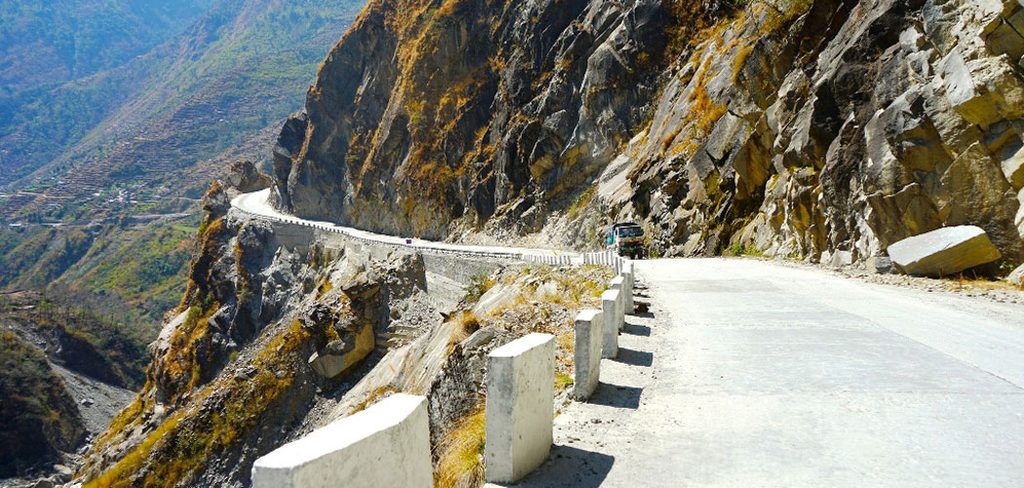
Look at a relief map of Nepal and one feature stands out. Between the Dhaulagiri and Annapurna massifs, the Kali Gandaki river has cut a trench straight through the Himalayan chain. Both flanking mountains rise above 8,000 meters. Their valley floor sits far below, and it keeps going north onto the Tibetan plateau.
That geometry made the corridor one of the few places where loaded animals could cross the range without a technical pass. Grain, dye, metal and later salt moved along it. Caravans using the route did not need to climb above 4,000 meters for most of the journey, which matters enormously for pack animals.


Archaeologists working in Upper Mustang treat the corridor as the explanation for a persistent oddity: an arid, thinly populated valley whose ancient burials contain objects from thousands of kilometers away.
Three phases, roughly three thousand years
Mark Aldenderfer, an anthropologist who has worked in Mustang for decades, groups the known mortuary sites into a sequence. Each phase carries a different signature of contact.
| Phase | Approximate dates | Burial form | Imported material present |
|---|---|---|---|
| Chokhopani | c. 1000 to 450 BCE | Tombs with mortuary-specific ceramics | Copper earrings and anthropomorphic copper sheets resembling Ganges basin Copper Hoard material |
| Mebrak | c. 450 BCE to 100 CE | Collective shaft tombs, bodies on painted wooden platforms | Glass beads of unidentified origin, carnelian beads, textiles, bronze bangles |
| Samdzong | c. 400 to 650 CE (tombs used to c. 860 CE) | Chambers cut into cliff faces | Glass beads linked to Sasanian Iran, South India or Southeast Asia and Sindh; silk; gold and silver mask |
Dates come from Aldenderfer’s 2013 synthesis in the Journal of the International Association for Bon Research and from the Samdzong excavation reports. Ranges vary slightly between publications, and Aldenderfer himself notes inconsistent boundary dates for the Mebrak phase.
One pattern is worth stating carefully. Animal remains appear in Upper Mustang burials only from the Mebrak phase onward. Mebrak tombs contained the mummified heads of thirteen sheep or goats and a disarticulated stallion. At Samdzong, excavators recorded at least 41 animals, including sheep, goat, horse and bovids. Aldenderfer reads the absence before roughly 500 BCE and the sudden presence afterward as borrowing from regions to the west or northwest, rather than a practice invented locally. That is an interpretation, not a measurement.
What the Samdzong metals actually say
A 2019 study by Giulia Massa, Mark Aldenderfer and Marcos Martinón-Torres in Archaeological Research in Asia analyzed the metal objects from the Samdzong tombs. Results are more specific than most popular accounts suggest.
- Copper vessels and beads: close to pure copper, shaped by hammering and annealing.
- Brass bangles and rods: roughly 16 to 23 percent zinc, unleaded, with few impurities. Composition points to cementation using sphalerite ore, a method associated with South Asian production.
- Bronze medallion: an unleaded high-tin bronze, above 21 percent tin, hot-worked and quenched. Stylistically it resembles Central Asian mirrors. Authors consider local manufacture unlikely.
- Gold and silver funerary masks: thin two-layer foils, gold-rich on the front, silver-rich behind. Trace element patterns suggest recycled metal rather than deliberate alloying, and the masks were probably made locally.
Lead isotope data pointed to a broadly single source for most objects, with one copper bead standing apart and sitting closer to Indian material. Taken together, the metalwork suggests a community importing raw material and finished goods from the south and west while producing some funerary items on site.
The silk problem
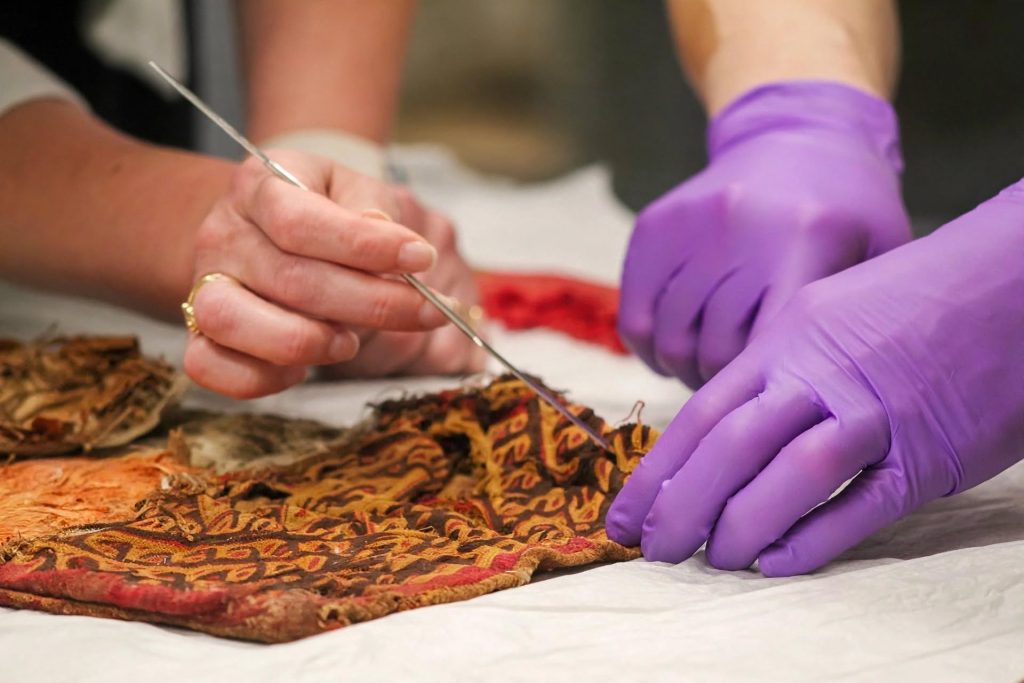
Textile fragments survived in Samdzong tomb 5 because of altitude and extreme dryness. Analysis published in 2016 used scanning electron microscopy, liquid chromatography for dyes and micro-Raman spectrometry for pigments. Margarita Gleba, the lead author, stated plainly that there is no evidence for local silk production.
Silk in a Himalayan tomb is therefore an import. Where it came from is harder. Sericulture was practiced across a wide arc of Asia by the fifth century, and the analysis found components from both local and distant sources, which is consistent with cloth being traded, reworked and reused. Gleba described Upper Mustang as a small but important node within a far larger network.
Note what that claim does not say. It does not establish a direct route from Chang’an to the Kali Gandaki. It establishes that goods circulating in Eurasian exchange systems reached a high Himalayan valley.
Why “Silk Road offshoot” is a loose label
Historians have grown uneasy with the term “Silk Road” generally. It was coined in the nineteenth century by the German geographer Ferdinand von Richthofen, long after the trade it describes. No single road existed. There were overlapping regional networks, most traffic moving short distances between intermediaries, with goods changing hands many times.
Applying the label to Mustang compresses a lot. Evidence supports the following statements:
- Objects whose raw materials or manufacture originated far outside Nepal were deposited in Mustang tombs between roughly 450 BCE and 650 CE.
- Those objects include glass, carnelian, silk and specific metal alloys.
- Samdzong sits on a plausible north to south route between the Indian plains and the Tibetan plateau.
Evidence does not currently support the claim that Mustang was a scheduled stop on a trunk route, or that caravans traveled its full length regularly in any given century. Movement of objects is well documented. Movement of people and the organization of that movement are far less clear.
Salt, grain and the trade people still remember
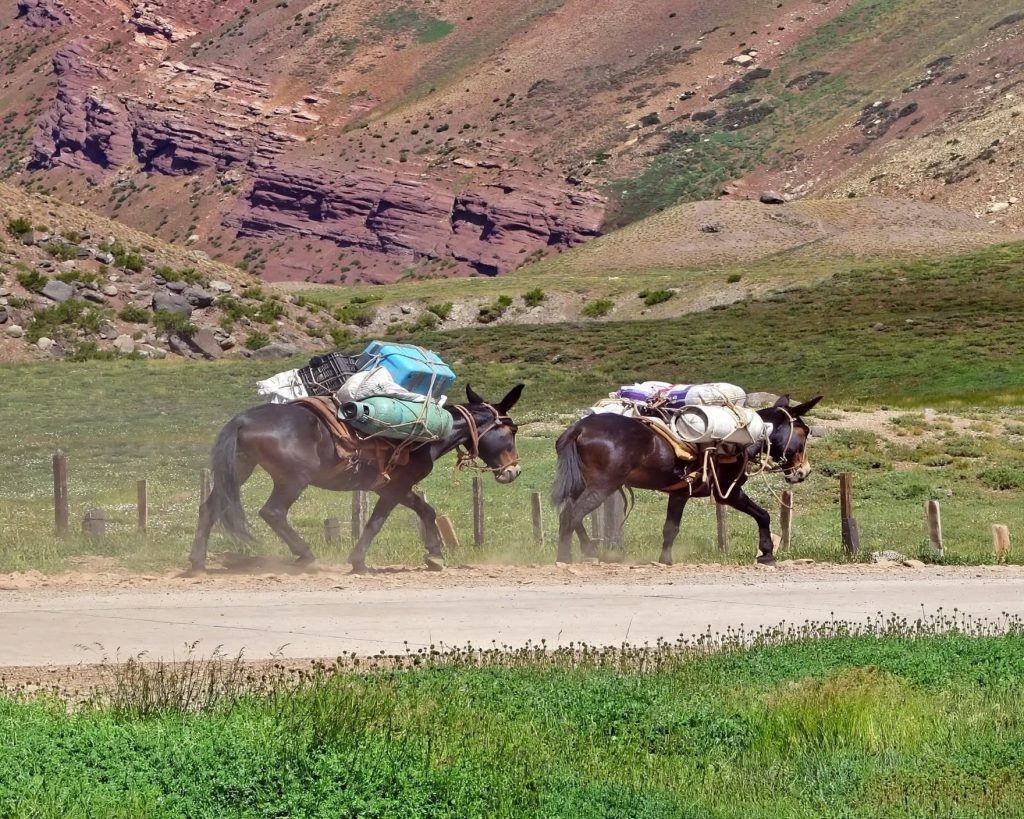
Later trans-Himalayan commerce is much better attested, and it is a different system from the one the tombs record. For centuries, communities along the Kali Gandaki exchanged lowland grain for salt from Tibetan lake beds. Yak, sheep, goats and mules carried the loads. Households in Lo Manthang, Jomsom and the villages between them built their economies around this cycle, moving stock seasonally between winter and summer grazing.
Several forces disrupted it in the twentieth century. Cheap iodized Indian sea salt reached Nepali markets through improved road and rail links. Political change along the northern border altered how and when crossings could happen. Trade did not vanish, but its terms changed completely.
Practices vary between communities. Loba households of Upper Mustang, Thakali communities further south around Jomsom and Marpha, and Gurung and Magar settlements lower in the valley each had different roles in the system. Treating them as one undifferentiated trading culture flattens real differences in language, kinship and religious practice.
The caves, and what we do not know
Upper Mustang’s cliff faces contain a very large number of hand-cut cavities. Popular accounts routinely give the figure of 10,000. Treat that number as an estimate rather than a count, since no complete systematic survey of the district has been published.
Excavations and surveys since the 1990s, including work by German and Nepali teams and later international expeditions near Lo Manthang, have recovered mortuary remains, Buddhist wall paintings, manuscripts mixing Buddhist and Bon material, and pottery. Use appears to have shifted over time, from burial, to shelter, to meditation. Several caves show clear monastic use dating to the second millennium CE.
Who cut the earliest caves, with what tools, and over what period remains unresolved. Anyone who tells you otherwise is ahead of the published evidence.
Access, permits and conservation
Upper Mustang remains a restricted area. Visitors need a restricted-area permit in addition to the Annapurna Conservation Area Project permit, and independent travel without a registered guide is not allowed. Permit fees have changed more than once in recent years, so confirm current rates with the Nepal Tourism Board or a licensed agency before budgeting.
Mustang’s archaeological sites are fragile in an unusual way. Erosion exposes them, then destroys them. Samdzong became accessible precisely because a cliff collapsed, and the same collapse disturbed the deposits. A road now links Jomsom toward the northern border, which has transformed access for residents and increased pressure on sites that were once effectively unreachable.
If you visit, the rule is simple. Do not enter cave openings without a guide and permission, and do not remove anything. Surface pottery is data.
Where to see the material
Objects recovered from Mustang sites are held in several places, including a small museum near Jomsom and institutional collections in Kathmandu. Access varies and displays change. For current information on protected sites and excavation permissions, the Department of Archaeology, Government of Nepal is the authority.
For travelers planning the journey itself, our Upper Mustang overland itinerary covers the route stage by stage, while the Mustang travel guide explains seasons and logistics. Lower in the valley, Jomsom and Kagbeni make a practical base. If your timing allows, the Tiji festival in Lo Manthang is the one fixed point in the Upper Mustang calendar worth planning around.
Frequently asked questions
Was Mustang really part of the Silk Road?
Not in the sense of a named highway. Artifacts from Samdzong show that goods circulating in wider Eurasian exchange networks reached Upper Mustang between roughly 400 and 650 CE. Researchers describe it as a minor node connected to larger systems, not a main artery.
How old are the Mustang cave burials?
Dated mortuary contexts span roughly 1000 BCE to 860 CE across the Chokhopani, Mebrak and Samdzong phases. Buddhist material in other caves is much later, mostly from the twelfth to fourteenth centuries CE.
What was found in the Samdzong tombs?
Excavations between 2011 and 2013 recovered gold and silver funerary masks, copper vessels, brass bangles, a high-tin bronze medallion, glass and carnelian beads, silk fragments, and the remains of more than one hundred individuals along with at least 41 animals.
Who built the sky caves?
No one knows. Published research has not identified the builders of the earliest cavities or established a full construction chronology. Later use for shelter, burial and meditation is better documented than origin.
Is the 10,000 caves figure accurate?
It is a widely repeated estimate, not a survey total. No comprehensive published count exists for the district.
Can visitors enter the caves?
Some accessible caves can be visited with a guide, and a few near Chhoser are set up for visitors. Many are unstable, legally protected, or both. Entering without permission risks damage to the site and to you.
Do I need a special permit for Upper Mustang?
Yes. Upper Mustang is a restricted area requiring a restricted-area permit plus an ACAP permit, arranged through a registered trekking agency. Independent trekking without a guide is not permitted.
Does the salt trade still happen?
Not in its historic form. Cheap iodized salt from India displaced Tibetan lake salt in Nepali markets during the twentieth century, and border and road changes reshaped the rest. Cross-border trade continues, but as modern commerce rather than seasonal caravan exchange.
Mustang rewards slow reading as much as slow travel. If this was useful, save it for your trip planning, pass it to whoever you are traveling with, and keep exploring Nepal with NepalVue.


