



National Flag Day of Nepal is observed every year on Poush 1 in the Nepali calendar, which corresponds to December 16 in the Gregorian calendar. This day commemorates a historic milestone when Nepal’s national flag was officially adopted and recognized by the United Nations in 1962. The occasion highlights the flag’s deep historical roots, unique design, and powerful symbolism that represents Nepal’s identity on the global stage.
Since 2018 (BS 2075), the National Heritage Conservation Foundation Nepal has been formally celebrating National Flag Day to raise awareness about the flag’s cultural, historical, and national importance.
Historical Background of Nepal’s National Flag
Before 1962 (BS 2019), Nepal did not have a constitutionally standardized national flag. Although flags were widely used in government offices, military institutions, and royal ceremonies, they varied in size, shape, and proportions. These flags were recognized in practice but lacked formal constitutional legitimacy.


Constitutional Standardization (1962)
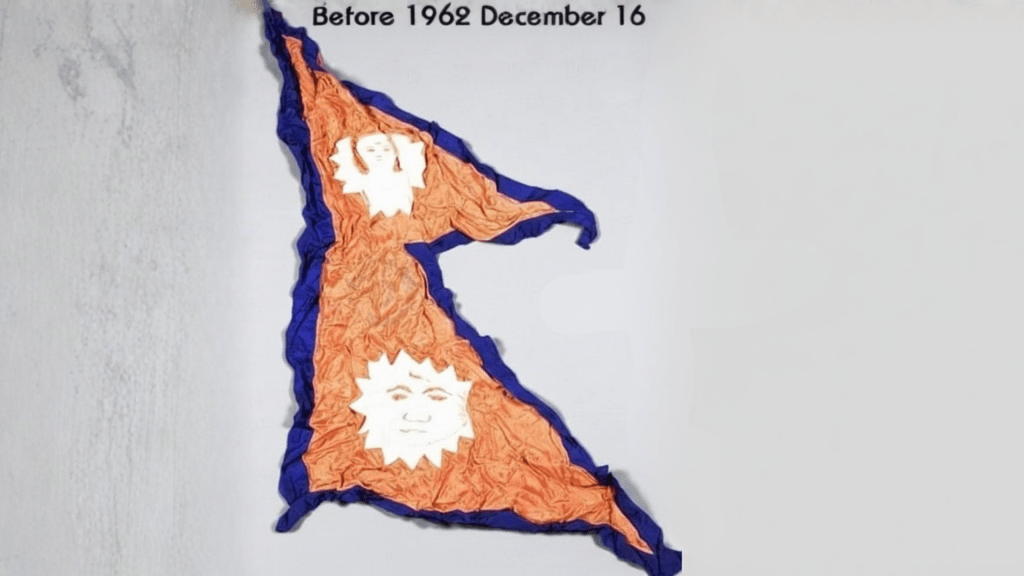
In 1962, during the drafting of Nepal’s new constitution, the Constitution Drafting Committee decided to officially define the national flag within the constitution’s schedule. The goal was to ensure uniformity and preserve the flag’s traditional essence while giving it legal recognition.
Role of Engineer Shankar Nath Rimal

The precise geometric design of Nepal’s national flag was developed by Engineer Shankar Nath Rimal. He applied the Pythagorean theorem to determine the flag’s proportions, using the ratio 3:4:5, often referred to as an eternal or infinite ratio in geometry:This mathematical precision makes Nepal’s flag not only visually unique but also scientifically exact.
Ancient Origins of the Triangular Flag
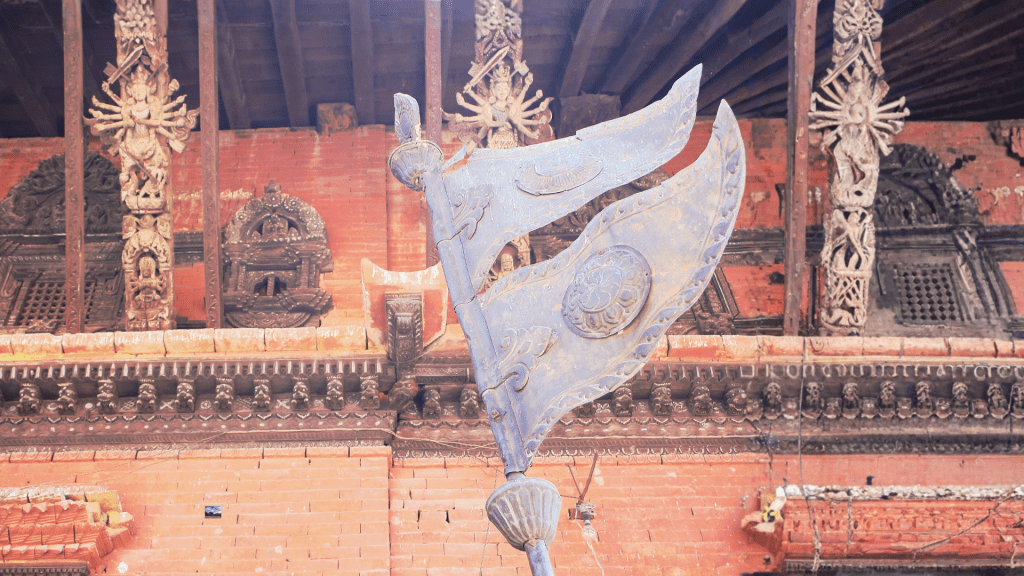
Nepal’s flag design is deeply rooted in history. Archaeological and numismatic evidence shows that the double-pennant triangular flag has existed for over 1,300 years.
- Licchavi-era coins from the reign of King Aṁśuvarmā depict a lion holding a double-pennant flag.
- Manadeva-era coins also show a lion saluting the flag.
- According to cultural historian Hariram Joshi, despite political transformations—from ancient kingdoms to monarchy and modern democracy—Nepal’s traditional flag has been continuously preserved.
These findings confirm that Nepal’s triangular flag is one of the oldest continuously used national flag designs in the world.
Symbolism of the National Flag of Nepal
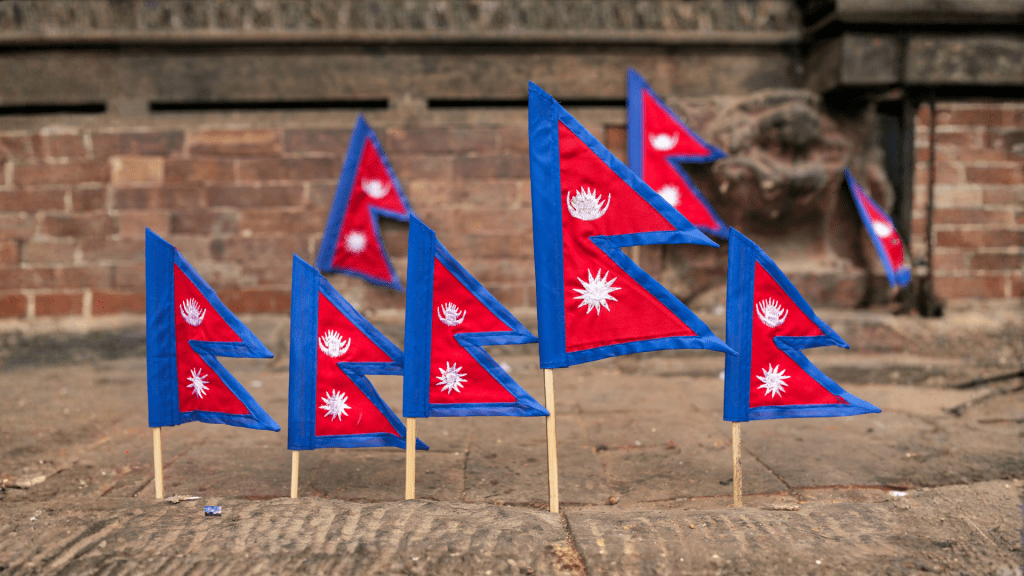
Nepal’s national flag is the only non-rectangular national flag in the world, consisting of two stacked triangles. Its symbolism reflects geography, philosophy, and national unity.
What the Triangles Represent
- Himalayas, Hills, and Terai – Nepal’s three major geographical regions
- Continuity and resilience of the nation
Symbols and Their Meanings
| Element | Symbolism | Meaning |
|---|---|---|
| Moon (upper triangle) | Calmness, wisdom, peace | Peace leads to long-term prosperity |
| Sun (lower triangle) | Energy, labor, transformation | Controlled energy brings progress |
| Overall design | Sattva, Rajas, Tamas; all ethnicities, religions, cultures | Unity in diversity |
According to Hariram Joshi, the moon represents peace and mental balance, while the sun symbolizes action, strength, and transformation, suggesting that true progress comes when energy is guided by wisdom.
Adoption at the United Nations
International sources such as English Wikipedia and Encyclopedia Britannica confirm that Nepal’s current national flag was officially adopted on December 16, 1962, coinciding with the establishment of a new constitutional government. On the same date, the flag was formally registered at the United Nations, giving it international recognition.
The National Flag of Nepal is not just a symbol—it is a living representation of the nation’s history, geography, philosophy, and unity. Observing National Flag Day on Poush 1 (December 16) allows Nepalis and the global community to reflect on the flag’s timeless significance and Nepal’s enduring identity.


