



Most trekkers land in Pokhara with their eyes locked on Annapurna Base Camp, and they walk right past a shorter trail that finishes higher than a lot of the routes they signed up for. The Mardi Himal trek was only promoted as a proper teahouse route around 2012, which makes it one of the youngest established trails in the entire Annapurna region. That youth is exactly why it stays quiet. You climb a single high ridge to 4,500 meters, sleep in lodges perched on the edge of the world, and stare straight into the fluted face of Machapuchhre, all in about five days.
Here is what most guides won’t tell you: this is the trek to pick when you want the big-mountain payoff without the two-week commitment or the conga line of other hikers.
Why the Mardi Himal Trek Is Worth Your Time
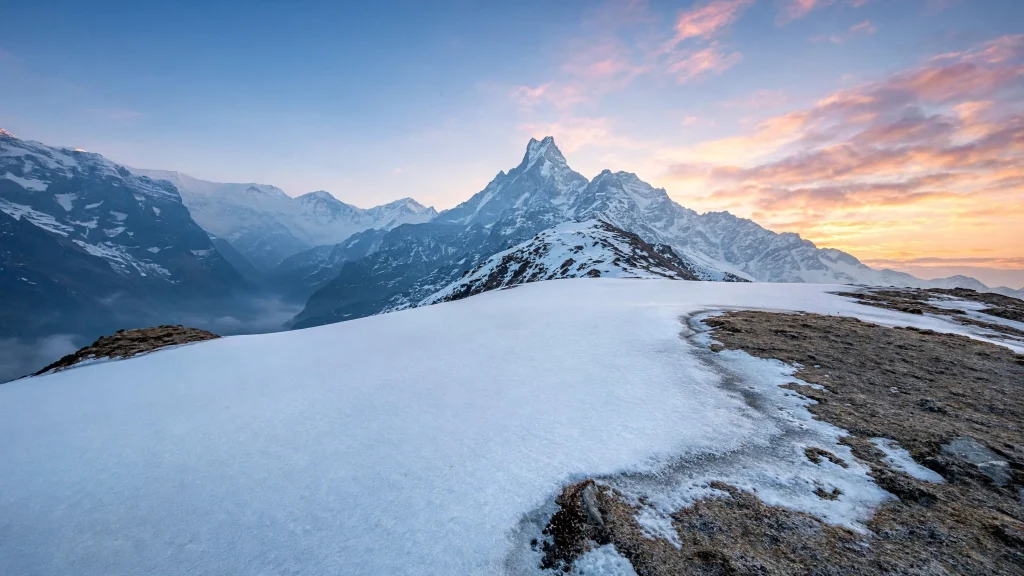
Short does not mean easy on the eyes. The Mardi Himal trail runs along a forested ridge that sits directly beneath Machapuchhre, the sacred fishtail peak that Nepal has never allowed anyone to summit. From the upper camps you also see the Annapurna range, Dhaulagiri far to the west, and Manaslu poking up to the east on clear mornings.


What makes this route special is the terrain change. You start in dense rhododendron and oak forest, dripping with moss and loud with birds. Climb for a day and the trees shrink, then vanish. By High Camp you are on an exposed alpine ridge with nothing between you and the snow but cold air. Few treks in Nepal pack that much variety into so little distance.
The total walking distance from Kande to Siding is roughly 42 kilometers. That is not a lot. Compare it to the Annapurna Circuit at over 160 kilometers and you understand why time-pressed travelers keep choosing this trail.
The Route: Camp by Camp
Trail names here are refreshingly literal. You move up through Forest Camp, Low Camp, and High Camp, and each one marks a clear step in elevation. Here is the classic five-day flow.
Most people start by driving to Kande, at 1,770 meters, about an hour and a half from Pokhara by taxi or local bus. From there you climb to Australian Camp and Deurali, then push on to Forest Camp for the first night. Day two takes you up to Low Camp and often on to High Camp at around 3,580 meters, where the tree line finally gives up and the views crack wide open.
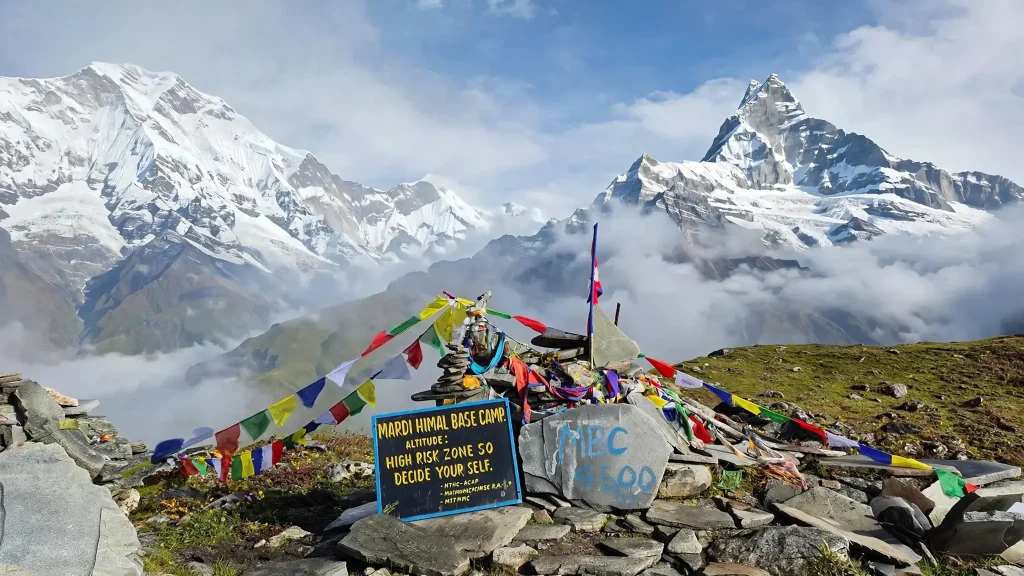
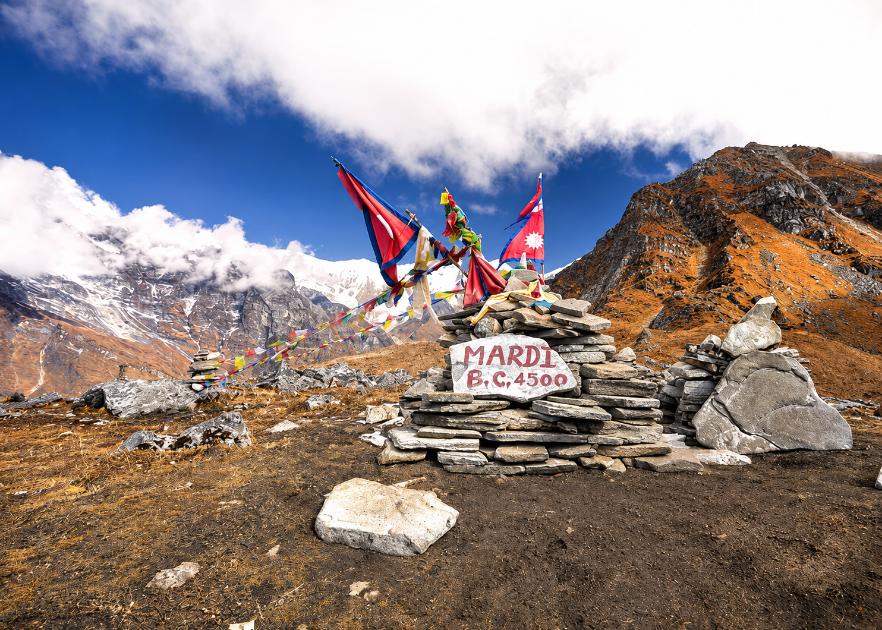
Day three is the big one. You leave High Camp before dawn, walk the exposed ridge past the Lower Viewpoint, and continue to the Upper Viewpoint or Mardi Himal Base Camp at 4,500 meters. That final stretch is where the trek earns its reputation. Then you descend, usually to Siding village at about 1,700 meters, and drive back to Pokhara the next day.
A Typical Day-by-Day Breakdown
- Day 1: Pokhara to Kande (drive), trek to Forest Camp. Around 4 to 5 hours walking.
- Day 2: Forest Camp to High Camp via Low Camp. Around 5 to 6 hours, and the day you gain the most altitude.
- Day 3: High Camp to Mardi Himal Base Camp (4,500 m) and back, then descend toward Badal Danda or Siding. A long day, often 7 to 8 hours.
- Day 4: Descend to Siding village, drive back to Pokhara.
Got only three days and strong legs? You can compress this by pushing bigger daily distances, but you trade away acclimatization time and a lot of the fun. Five days is the sweet spot.
How Hard Is It, Really?
Let me be straight with you. Mardi Himal is moderate, not a stroll, and this is where a lot of first-timers misjudge things. Daily distances are gentle, and the trail is well maintained for most of its length. That part is beginner-friendly.
Then comes the climb above Low Camp. Once you pass it, the trail steepens along narrow ridges, with rocky sections and a few exposed spots that demand steady footing. Your legs and lungs will notice. Reaching 4,500 meters also means real altitude, so a headache or shortness of breath is possible even on a short trek like this one.
Anyone with a reasonable fitness base who can walk 5 to 6 hours a day handles this trek fine. No technical climbing skills are needed, no ropes, no crampons in the regular seasons. Train a little beforehand, walk slowly on the high days, and drink more water than feels necessary.
Permits for the Mardi Himal Trek
You need two documents, and both are easy to sort out in Pokhara or Kathmandu. First is the Annapurna Conservation Area Permit, known as ACAP. As of early 2025, foreign trekkers pay NPR 3,000 for ACAP, while nationals of SAARC countries pay NPR 1,000. The permit money funds conservation and community work across the region, managed by the National Trust for Nature Conservation.
Second is the TIMS card, short for Trekkers’ Information Management System. Independent trekkers generally pay around NPR 2,000 for TIMS, though booking through a licensed agency can bring that down to roughly NPR 1,000. Fees do shift with policy changes, so budget somewhere between NPR 4,000 and 5,500 total and confirm current rates when you arrive.
You can pick up both permits at the Nepal Tourism Board offices in Pokhara or Kathmandu. Bring your passport, a couple of passport photos, and cash in rupees. For the official conservation details, the NTNC Annapurna Conservation Area Project page lays out what the area covers. If you want the full permit walkthrough for other regions too, our Nepal trekking permits guide breaks down every card you might need.
Best Time to Trek
Two windows stand out. Spring, from mid-February through May, brings warmer days and the famous rhododendron bloom that turns the lower forest red and pink. Autumn, from September through mid-December, delivers the clearest skies and the sharpest mountain views of the year.
Winter is doable but cold, and High Camp can get snowed in, with some lodges closing. Monsoon months from June to August bring leeches, slick trails, and clouds that hide the very peaks you came to see. If mountain views matter to you, and on this trek they really do, aim for October or April. Our month-by-month guide to the best time to visit Nepal goes deeper on the seasonal trade-offs.
What It Costs and Where to Base Yourself
Pokhara is your launch pad, and it is a genuinely lovely place to spend a day or two before and after the trek. Lakeside guesthouses run from budget rooms at around NPR 1,000 a night to comfortable mid-range hotels for NPR 3,000 and up. Spend an evening by Phewa Lake and you’ll see why so many trekkers linger. Our Pokhara travel guide covers where to stay and eat.
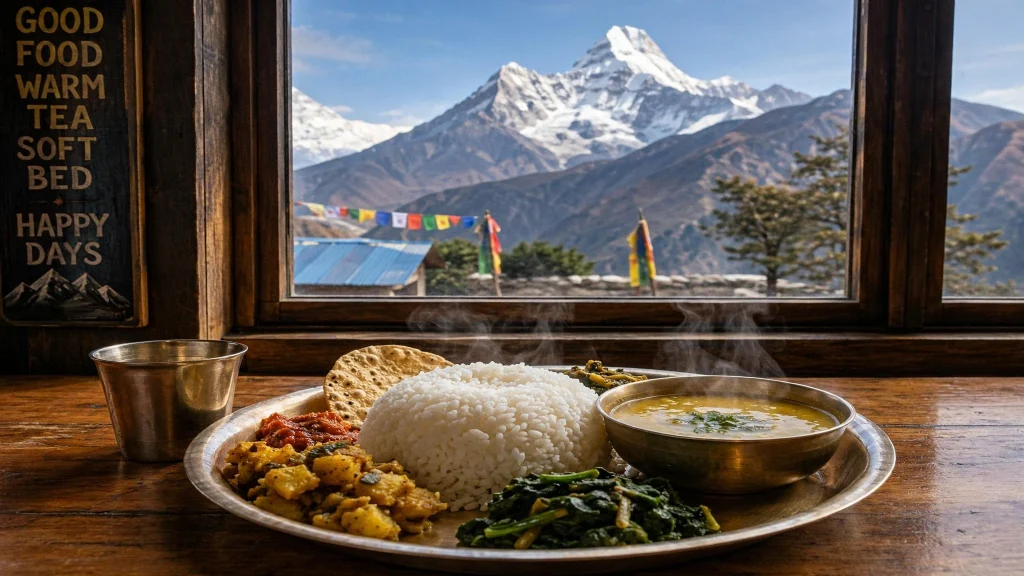
On the trail itself, teahouses are simple. A bed costs very little, sometimes free if you eat your meals there, and a plate of dal bhat runs higher the further up you go because everything is carried in by porter or mule. Expect prices at High Camp to be two or three times what you’d pay in Pokhara. Carry enough cash, because there are no ATMs once you leave the road.
A rough all-in budget for a guided five-day trek, including permits, guide, food, and lodging, tends to land between USD 250 and 450 per person depending on group size and season. Going independent trims that, but a good guide earns their fee on the high, exposed days.
Practical Tips Before You Go
Pack layers. Daytime temperatures in the forest can feel mild, then drop below freezing at High Camp after dark. A warm sleeping bag rated to at least minus 5 Celsius saves a miserable night. Bring a headlamp for the pre-dawn push to the viewpoint, since you want to be walking that ridge as the sun hits the peaks.
Water is worth a word. Buy bottled water and you add plastic to a fragile place and empty your wallet, so carry a bottle and purification tablets or a filter instead. Cell signal is patchy above Low Camp, so tell someone your rough itinerary before you disappear into the hills.
One more thing. Book your return jeep from Siding in advance if you can, or budget for a longer walk out. Siding is small, and transport is not guaranteed to be sitting there waiting for you.
Mardi Himal Trek FAQ
How many days do you need for Mardi Himal?
Five days is the most popular and most comfortable option, covering the drive in, three days of walking up and along the ridge, and the descent and drive out. Fit trekkers with limited time can do it in three to four days by walking longer hours, but you lose acclimatization time and some of the enjoyment.
How high does the trail go?
The highest point is the Mardi Himal Base Camp and Upper Viewpoint at 4,500 meters, or 14,763 feet. High Camp, the usual highest overnight stop, sits at around 3,580 meters.
Is Mardi Himal suitable for beginners?
Yes, with a caveat. The gentle daily distances and well-kept trail make it one of the more approachable high-altitude treks in Nepal. That said, the climb above Low Camp is steep and exposed, and you reach real altitude, so a base level of fitness and slow, careful walking on the high days matter.
What permits do I need for this trek?
You need the Annapurna Conservation Area Permit (ACAP) and a TIMS card. As of early 2025, ACAP was around NPR 3,000 for foreigners and the TIMS card around NPR 2,000, though rates vary, so confirm current prices at the Nepal Tourism Board when you arrive.
How far is the walk in kilometers?
The total walking distance from Kande to Siding is roughly 42 kilometers, or about 26 miles, spread across the trekking days. Exact distance shifts depending on your start point and how far up the ridge you push.
When is the best time to do the Mardi Himal trek?
Spring, from mid-February to May, and autumn, from September to mid-December, are the two prime windows. Autumn gives the clearest mountain views, while spring brings the rhododendron bloom. Winter is cold with possible snow closures, and monsoon brings clouds and leeches.
Do I need a guide?
A guide is not technically required for the trail itself, but Nepal has tightened rules on solo trekking in recent years, and a good guide adds real value on the steep, exposed sections near the top. Independent trekking is possible, though hiring a guide or joining a small group is the safer and often more rewarding choice.
How does Mardi Himal compare to Annapurna Base Camp?
Mardi Himal is shorter, quieter, and climbs a ridge for dramatic close-up views, while Annapurna Base Camp is longer and takes you into a glacial amphitheater surrounded by peaks. Mardi Himal is the better pick if you are short on time and want solitude with a big finish.
Ready to trade the crowds for a quiet ridge and a fishtail sunrise? Mardi Himal delivers more mountain per day than almost any trek in Nepal, and it fits inside a single week. Sort your permits, pick October or April, and go before the rest of the world catches on.


