



What actually happens to a person’s mind after twenty days of walking alone across northern Nepal? Long-distance solo trekking is usually discussed in terms of logistics: permits, food caches, pass crossings. Far less attention goes to the psychological terrain, which on a route like the Great Himalaya Trail is at least as demanding. Research on the psychology of wilderness isolation points to real benefits, real risks, and a picture more nuanced than either the romantic or the alarmist version suggests. Below: what the evidence supports, where altitude complicates matters, and how experienced walkers manage it.3
A Route That Produces the Condition
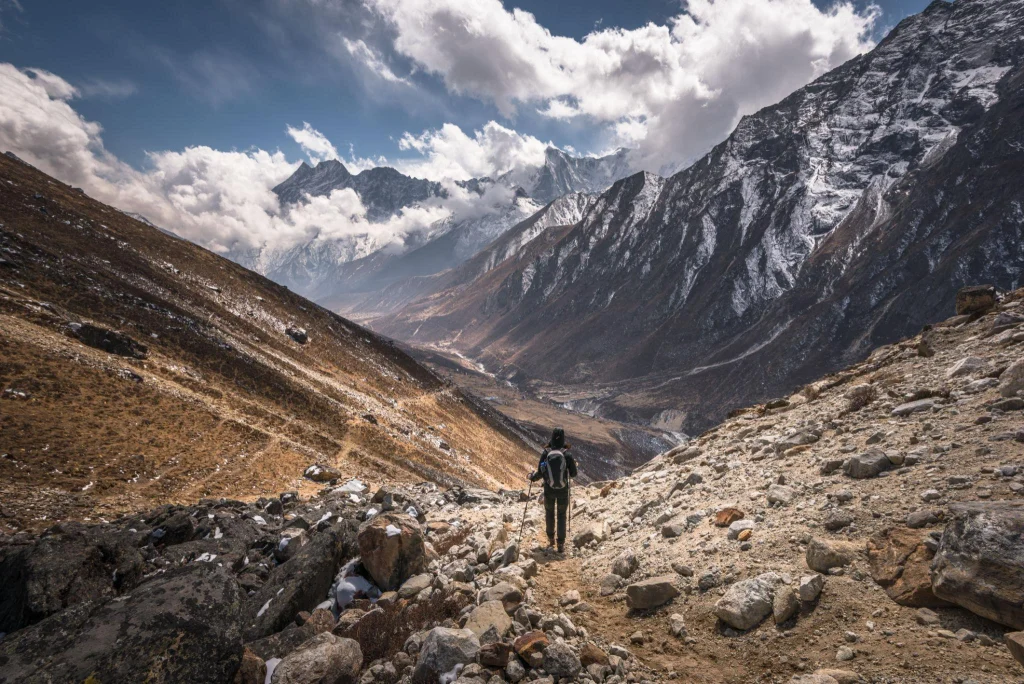
Nepal’s Great Himalaya Trail is not a single marked path but a linked network of routes running the length of the country. Trail documentation describes a high route of roughly 1,700 km taking around 150 days, and a lower cultural route of about 1,500 km through the mid-hills taking around 100 days. Sixteen districts are crossed, from Darchula on the Indian border in the far west to the eastern reaches near Kanchenjunga. Robin Boustead led the first full traverse of the Nepal route in 2008 and 2009.
Figures vary between sources and route variants, so treat them as approximate. What matters psychologically is the structure: long sections in Dolpo, Mugu and Humla pass through areas with no road access, no mobile coverage, and days between settlements.


Most people who walk sections of the GHT do so with at least a guide or porter. A smaller number attempt stretches genuinely alone. That second group experiences something distinct from ordinary trekking solitude.
What Research Says About Solitude Itself
Psychologists draw a hard line between solitude and loneliness. Solitude is the objective state of being alone. Loneliness is the subjective distress of wanting more connection than you have. People can experience one without the other, and the research consistently finds that conflating them produces bad conclusions.
The Deactivation Effect
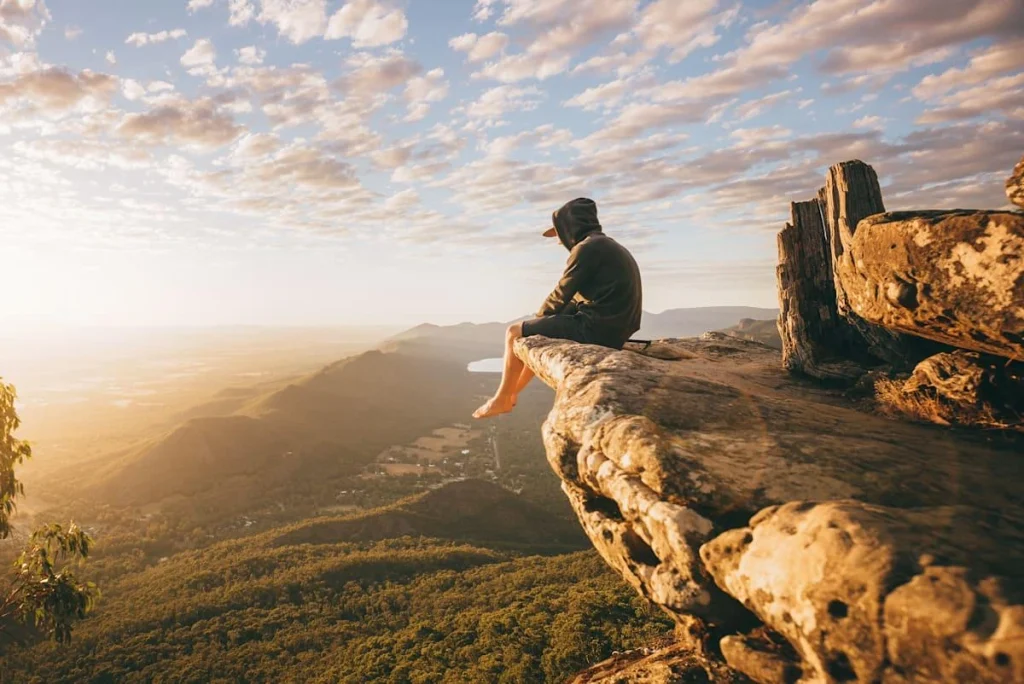
Work by Thuy-vy Nguyen, Richard Ryan and Edward Deci, published in 2018 in Personality and Social Psychology Bulletin, described what they termed a deactivation effect. Across their studies, time spent alone reduced high-arousal states in both directions: excitement and enthusiasm fell, but so did anger and anxiety. Solitude did not simply make people sad. It turned the volume down.
Nguyen’s later review work, including a 2024 open-access review in Social and Personality Psychology Compass, examines how far that effect generalizes and what moderates it. You can read it at Social and Personality Psychology Compass, and the original 2018 paper is available in full from the Self-Determination Theory archive.
Chosen Versus Imposed
Autonomy appears repeatedly as the key moderator. Solitude a person chooses tends to be restorative. Solitude imposed by circumstance tends not to be. That distinction matters enormously on a long trail, because the two can switch places mid-trek.
A walker who chose to go alone in week one may find in week four that a closed pass, an injury, or a village without onward transport has converted choice into confinement. Same physical situation. Different psychological meaning. Trekkers who have described crises on long solo routes often locate the turn at exactly that point.
A caveat worth stating: nearly all of this research was conducted in controlled or everyday settings, not on multi-week high-altitude expeditions. Applying it to the GHT is reasonable extrapolation, not established finding.
Altitude Changes the Equation
Here is the complication that separates Himalayan solitude from a wilderness solo in a temperate forest. Hypoxia affects mood and cognition directly, which means a trekker’s psychological state is not purely psychological.
Research published in Physiological Reports in 2022, examining rapid ascent to 3,000 and 4,050 meters, reported that acute mountain sickness and sleep disturbance influence cognition and mood differently rather than as a single bundled effect. Separating the two matters: poor sleep at altitude is near universal, while AMS is not.
Practical implications follow.
- Periodic breathing during sleep fragments rest at altitude even without illness. Accumulated sleep debt degrades emotional regulation in anyone, anywhere.
- Irritability, low mood and poor decision-making can be early signs of altitude illness rather than character or circumstance.
- A solo trekker has no second observer. Companions usually notice confusion or ataxia before the affected person does.
That last point is the hard safety argument against going fully alone high on the GHT, and it is physiological rather than motivational. Our guide to what high-altitude hypoxia does to the brain covers the mechanism in more depth.
The Timeline Trekkers Report
Long-distance walkers describe a reasonably consistent arc, though it is anecdotal rather than measured. No study has tracked GHT trekkers through a full traverse.
| Phase | Typical timing | Commonly reported experience |
|---|---|---|
| Decompression | Days 1 to 5 | Mental noise from ordinary life persists; restlessness; frequent checking for signal |
| Trough | Roughly weeks 1 to 3 | Strongest urge to quit; boredom; sharpest homesickness |
| Settling | Weeks 3 to 6 | Routine takes over; thinking slows; reported clarity and calm |
| Erosion | Beyond week 6 | Fatigue accumulates; small problems feel large; motivation becomes mechanical |
Treat the table as a summary of what experienced walkers describe, not as validated psychological staging. Individual variation is wide, and prior solo experience appears to compress the early phases considerably.
What Helps
Guides, expedition leaders and long-distance walkers converge on a short list of practices. Most are mundane, which is rather the point.
Structure Before You Need It
A fixed daily rhythm reduces the number of decisions you make while tired. Same wake time, same camp routine, same order of tasks. Decision fatigue compounds fast when nobody else is sharing the load.
Externalize Your Thinking

Writing a daily log serves a function beyond memory. Putting a worry into words forces it into a defined shape, which is harder when a thought simply circles. Many walkers also report talking aloud to themselves without embarrassment after a week or two.
Set Contact Rules in Advance
Satellite messengers have changed solo trekking substantially. Used badly, constant contact prevents the settling phase entirely. Used well, a fixed daily check-in to one person provides a safety net without dissolving the solitude. Decide the schedule before departure rather than improvising it at a low moment.
Define Your Exit Criteria While Clear-Headed
Write down, in advance, the conditions under which you turn around: a specific symptom set, a weather window, a missed resupply. Judgment degrades at altitude and in fatigue. A rule written at sea level does not.
Do Not Go High and Fully Alone
Local guides and porters are not only a legal and logistical matter. Having one person who can observe you is the single most effective mitigation for altitude illness, and they carry route knowledge that no map offers. Solitude on the trail and solo risk exposure are separable. Our guide to trekking insurance and helicopter rescue in Nepal explains what cover you need before entering roadless terrain.
Rules on Trekking Alone in Nepal
Regulation here has been genuinely unsettled. Nepal Tourism Board introduced a requirement in 2023 for free individual trekkers to use a licensed guide in areas covered by its permit system, and enforcement has varied by region and checkpoint since. Restricted-area permits for places including Upper Dolpo, Mustang, Humla and Manaslu have long carried their own conditions, typically requiring a registered agency and a minimum party size, and reports of changes to those conditions have circulated during 2026.
Most online summaries of the current position come from trekking agencies rather than government sources, and they do not agree with one another. We are not going to state a definitive rule here, because we could not verify one against an official notice. Confirm directly with the Nepal Tourism Board or the Department of Immigration before planning a route that depends on the answer. Our article on solo trekking rules in Nepal tracks the background.
When Solitude Becomes a Warning Sign
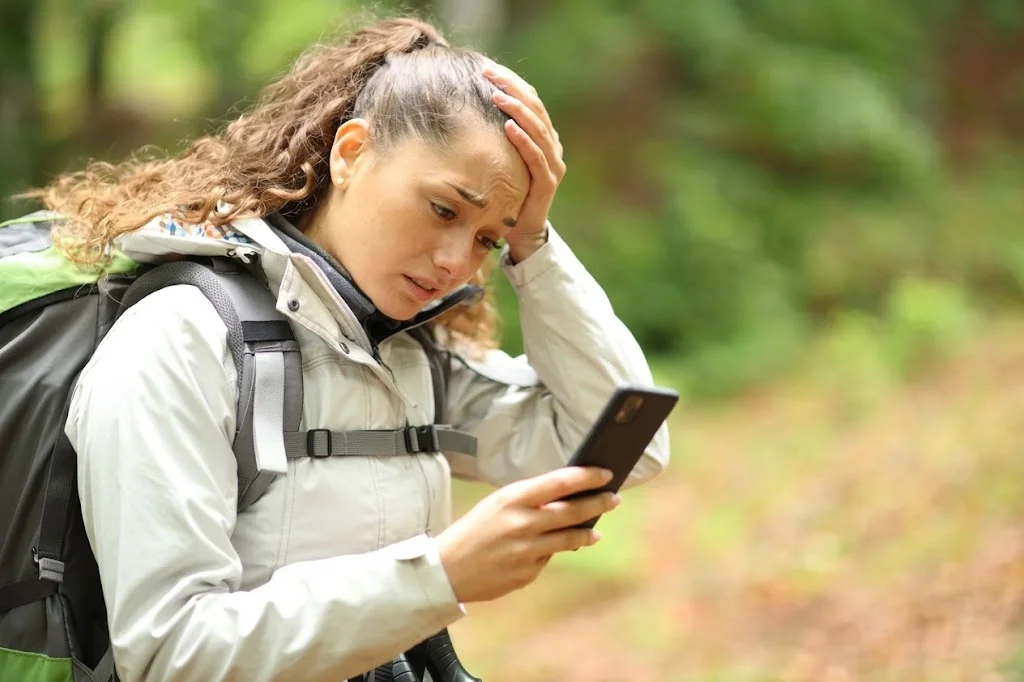
Most difficulty on a long solo trek is ordinary and passes. Some does not.
Signals worth taking seriously include persistent hopelessness rather than fluctuating low mood, loss of interest in the walk itself over several days, confusion or difficulty with simple tasks, and any sense that your perception of events is unreliable. Several of these overlap with altitude illness, which is an argument for descending first and interpreting later.
People with a history of depression or anxiety are not disqualified from long solo routes, and many walk them well. Planning for it openly, including medication continuity and a defined contact person, is simply part of the preparation. If you are weighing a long route and your reasons for going feel more like escape than attraction, that is worth discussing with someone before departure rather than on day thirty in Mugu.
For readers considering a first long route, our guides to what trekking in Nepal actually costs and trekking in Nepal after 50 cover the practical groundwork.
Frequently Asked Questions
Is solo trekking on the Great Himalaya Trail legal?
Rules have changed repeatedly and vary by area. Restricted regions such as Upper Dolpo, Mustang and Humla carry their own permit conditions, and a guide requirement has applied in many permit areas since 2023. Verify with the Nepal Tourism Board or Department of Immigration before committing to a plan.
How long does the Great Himalaya Trail take?
Trail documentation gives roughly 150 days for the high route of about 1,700 km and around 100 days for the lower cultural route of about 1,500 km. Most trekkers walk individual sections rather than the full traverse.
Is being alone in the mountains bad for mental health?
Not inherently. Research distinguishes solitude from loneliness, and finds that chosen solitude tends to reduce high-arousal emotional states in both directions. Imposed solitude is a different matter, and the research base does not cover multi-week high-altitude expeditions directly.
Does altitude affect mood?
Yes. Hypoxia and disturbed sleep both influence mood and cognition, and a 2022 study found that acute mountain sickness and sleep disturbance act on them differently. Mood changes at altitude can be a medical sign, not only a psychological one.
What is the hardest psychological stage of a long trek?
Walkers most often describe the first two to three weeks as the hardest, when the urge to quit peaks. Fatigue later in a long traverse produces a different and slower kind of difficulty.
Should I carry a satellite messenger?
On roadless GHT sections, yes. Beyond emergency use, a fixed daily check-in provides reassurance without constant connectivity. Agree the schedule with one person before you leave.
Can I trek alone but hire a guide for high sections?
Many people do exactly this, and it is a sensible compromise. Solitude on easier stretches and a companion through high passes separates the experience you want from the risk you do not.
What should I do if I feel I am struggling on the trail?
Descend if altitude could be a factor, rest, eat properly and make contact with your check-in person. Treat persistent hopelessness or confusion as a reason to end the section rather than push through it.
Keep Exploring
Walking Nepal’s long trails rewards preparation of the mental kind as much as the physical. If this was useful, save it for your planning, share it with someone considering a long route, and follow NepalVue for more reporting from Nepal’s mountains and the people who live in them.


