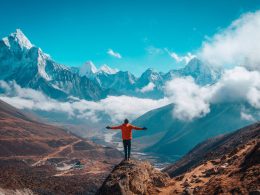



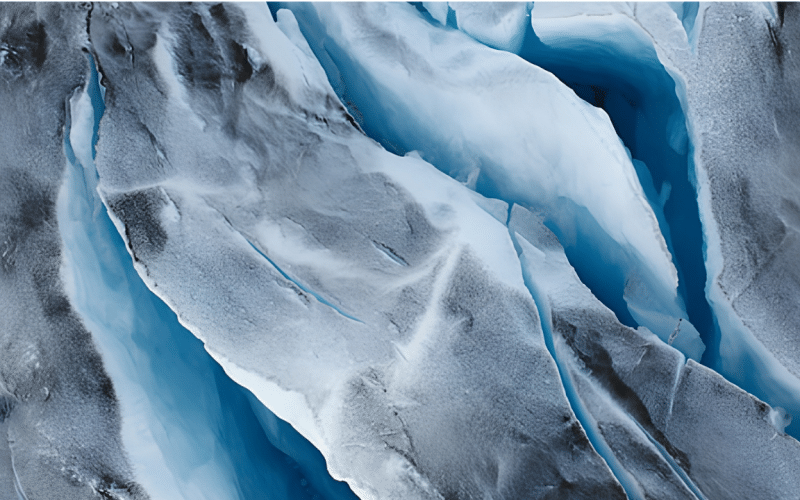
Two years. That is how long it took for meltwater to wipe out a chemical record that had taken decades to build, in a glacier sitting above 4,100 meters. Swiss researchers drilled the same Alpine ice field in 2018 and again in 2020, compared the two cores, and found the soluble pollution signal simply gone. High mountain ice is one of the few archives that stores the atmosphere year by year, and in the Himalaya that archive is now in a race against its own melting. This article explains what Himalayan ice cores actually record, how the drilling is done, what the cores have revealed about monsoon failure and industrial pollution, and why the Nepal side of the range holds far thinner records than most readers assume.
What a glacier stores, and why it counts as a record
Snow falls, compacts into firn, and then into ice. Each year’s snowfall traps whatever the air was carrying at the time: mineral dust, soot, sulfate, nitrate, trace metals, pollen, and the isotopic signature of the water molecules themselves. If the ice stays frozen, those layers stack in order, and a vertical core becomes a timeline.
Researchers read several signals at once. Stable water isotopes, written as delta-oxygen-18, track condensation temperature and moisture source. Insoluble dust tracks dry, windy conditions upwind. Refractory black carbon, the sooty residue of incomplete combustion, is counted particle by particle with a laser instrument called a single-particle soot photometer. Trace metals are measured by mass spectrometry, and lead isotope ratios can separate natural rock dust from smelter and fuel emissions.


One more marker matters enormously: fallout from atmospheric nuclear testing in the 1950s and 1960s. A spike of beta radioactivity gives a fixed calendar date inside the ice, which is how layer counts get checked rather than merely asserted.
Drilling at altitude is a logistics problem first
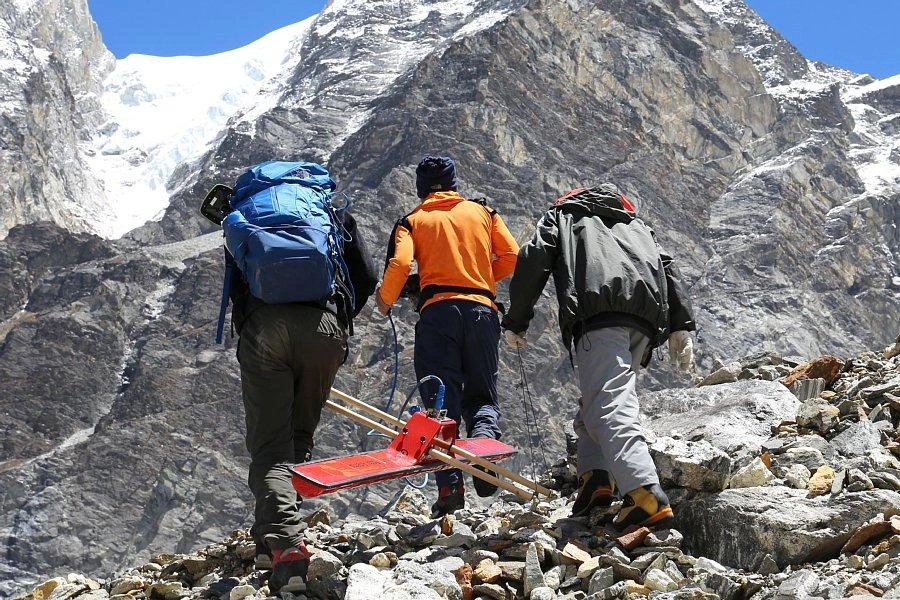
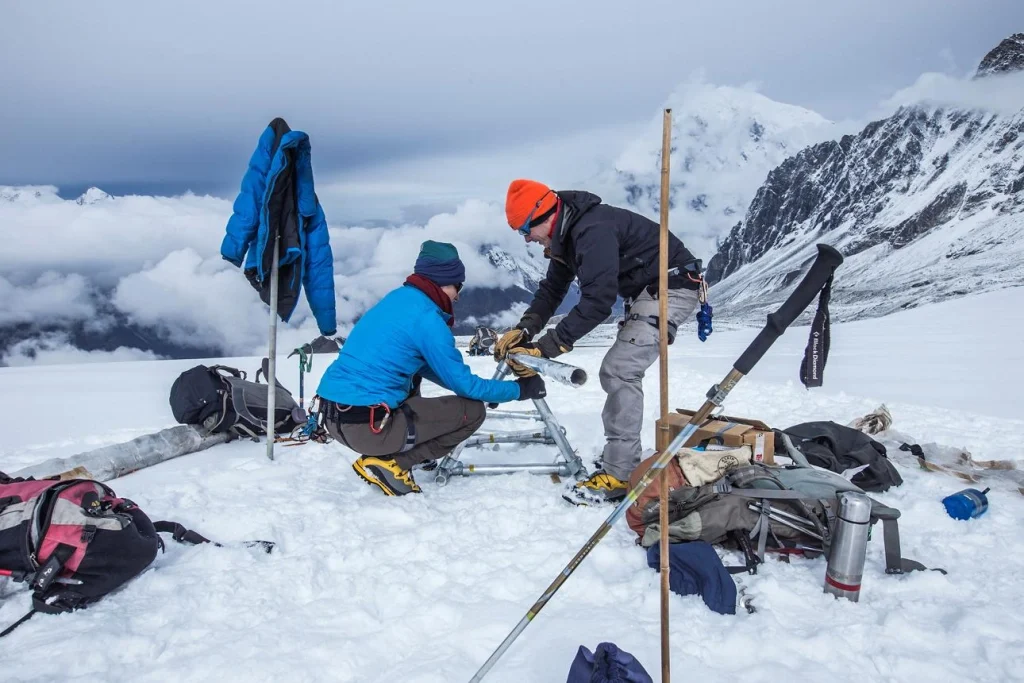
A 2021 account in Annals of Glaciology of the Trambau Glacier operation in Nepal’s Rolwaling region is unusually frank about the mechanics. Eight scientists worked with seven Sherpa guides and 38 porters. A helicopter could carry 240 kg from Kathmandu to Na at 4,600 meters, but only 50 to 100 kg up to the drill site at 5,862 meters, roughly six ice core boxes by volume.
Thin air complicates everything. Air pressure at 6,000 meters runs near 470 hPa, so the team fitted a narrower jet nozzle to the petrol generator, changed spark plugs often, and changed engine oil at least daily. Each drill run recovered about 0.46 m of core at 95 mm diameter, over 177 runs.
Then there is sunlight. Solar heating of the drill barrel melted the ice chips, which refroze and jammed the barrel. Day two of the operation was simply too warm to drill. Effective drilling added up to 41 hours across five days in November 2019.
Cold chain is the last hurdle. Cores were held at minus 13 degrees Celsius in Kathmandu, moved in a refrigerated vehicle, and flown to Japan packed with 10 kg of dry ice per box, imported from India for the purpose.
The cores that built the Himalayan record
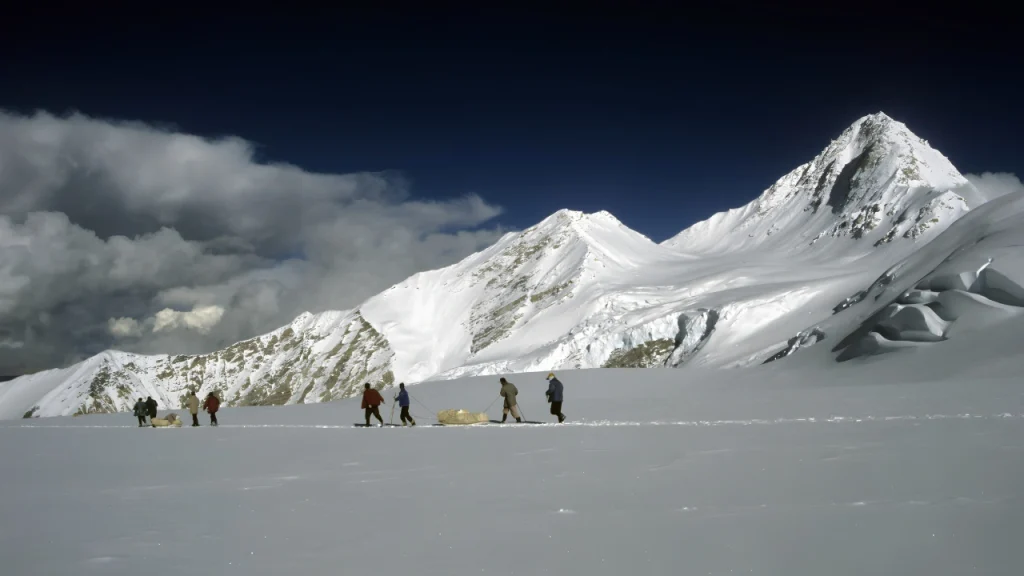
Here is the fact that most coverage gets wrong. Nearly all the headline science comes from two deep cores on the Tibetan side of the range, not from Nepal. Nepal’s own cores are shallow, young, and in several cases damaged by melt.
| Core site | Country | Depth | Record length |
|---|---|---|---|
| Dasuopu (Shishapangma) | China (Tibet) | Up to 167.7 m, to bedrock | About 1,000 years |
| East Rongbuk (Everest north) | China (Tibet) | 108 m to bedrock | Counted to 1534 CE, modeled below |
| South Col, Everest | Nepal | 10 m | Estimated 2,000 years, large uncertainty |
| Mera Peak | Nepal | Shallow | 10 years, 1999 to 2010 |
| Trambau, Rolwaling | Nepal | 81.2 m | Estimated 100 to 130 years, still undated |
| Ganchempo, Langtang | Nepal | Not yet published | Targeting 10 to 20 monsoon seasons |
Dasuopu was drilled in 1997 at 7,200 meters, on a col below Shishapangma. Borehole temperature read minus 16.0 degrees Celsius at 10 m depth and minus 13.8 degrees at the bed, meaning the glacier was frozen to the rock beneath it. Good preservation follows from exactly that.
What the ice has said so far
Monsoon failure, written in dust
Lonnie Thompson and colleagues reported in Science in 2000 that annual layers in the Dasuopu core could be counted back 560 years, with the count verified against the 1963 nuclear fallout horizon at 42.2 m depth. Dust peaks in the core line up with documented South Asian drought. Strongest signal in the whole counted record falls in 1790 to 1796, with a second major monsoon failure in 1876 to 1877.
Below about 145 m the dating stops being counted and starts being extrapolated. Anything the core says about the years before roughly 1440 rests on an assumption of steady accumulation, not on visible layers. Honest readers should treat that deepest millennium as modeled.
Industrial metals at 7,000 meters
A 2020 study in PNAS led by Paolo Gabrielli examined 23 trace metals in ice formed between 1499 and 1992. Toxic metals including cadmium, chromium, molybdenum, nickel, antimony and zinc appear at high elevation from around 1780, which coincides with the onset of the British Industrial Revolution. Peak contamination falls between about 1810 and 1880, when metal fluxes ran two to four times higher than the natural background.
Gabrielli’s own framing is worth keeping: the levels found were higher than what would exist naturally. His team also argued that shifts in atmospheric circulation, specifically a displacement of the winter westerlies, explain much of the pattern, and that point is not universally accepted.
Soot, drought and a genuine scientific argument
Work published in Atmospheric Chemistry and Physics in 2021 reconstructed black carbon in the same Dasuopu core from 1781 to 1992. Mean concentration came out at 1.5 micrograms per liter, with a single sample reaching 63.3 micrograms per liter in 1825, shortly after the eruptions of 1809 and Tambora in 1815 and the dry years that followed. Deposition became both more frequent and larger after about 1877.
Here is where it gets interesting. Trace-element enrichment, the coal and fly-ash fingerprint, correlated negatively with black carbon after 1877. Authors concluded that drought-driven biomass burning, not industry, dominated the soot signal during the high periods. That sits in open tension with the industrial framing of the metals study, and some of the same researchers appear on both papers.
Work on Nepal’s Mera Peak adds another check. A 2014 core there found black carbon accounted for under 16 percent of potential annual melting, with dust and soot together reaching at most 26 percent, and found no deposition trend at all across the decade sampled. Popular writing that treats soot as the main driver of Himalayan melt is running ahead of the measurements. Our piece on how aerosols travel from the Indo-Gangetic Plain covers the delivery side of this story in more detail.
The archive is erasing itself
Meltwater does not simply thin a glacier. Percolating water strips soluble ions out of the layers below, a process called elution, and the timeline dissolves even where the ice remains.
Swiss researchers demonstrated this directly in 2024 in Nature Geoscience. Comparing cores drilled on Corbassière glacier in 2018 and 2020, they found the water isotope record survived while nitrate, sulfate and ammonium records did not. Their sentence is blunt: within two years, the soluble impurity records were destroyed by melting. Note the limit, though. That study is about the Alps and does not address the Himalaya.
For the Himalayan instance, look at Trambau. Borehole temperature there read minus 0.82 degrees Celsius at 10 m, against a mean annual air temperature near minus 8.7 degrees at a nearby stake. Latent heat from refreezing meltwater explains the eight-degree gap. Eighty-eight percent of the core was refrozen ice, and isotopes could not identify annual layers at all, so the core remains undated years after recovery.
A starker version appeared on Naimona’nyi, on the Tibetan Plateau, where four cores drilled in 2006 lacked the 1950s and 1960s nuclear markers entirely. Absence is the finding: the bomb-era surface and everything above it had already gone. Readers following the broader pattern may want our coverage of permafrost degradation in the Everest region and of glacial retreat across Nepal’s 8,000-meter peaks.
Nepal’s thin monitoring base
Across the entire Hindu Kush Himalaya, only 38 glaciers have in-situ measurements, and only seven have been monitored annually for a decade or more. Yala Glacier in Langtang is one of them, and ICIMOD reports it has shrunk by 66 percent and retreated 784 meters since first measured in the 1970s.
On 12 May 2025, ICIMOD and Gosaikunda Rural Municipality held a tribute above 5,000 meters for Yala, attended by glaciologists from Bhutan, China, India and Nepal alongside Buddhist monks and local residents. Plaques carry texts by the Nepali novelist Manjushree Thapa and the Icelandic writer Andri Snaer Magnason, the latter recording a carbon dioxide reading of 426 parts per million. Sharad Prasad Joshi, Nepal’s correspondent to the World Glacier Monitoring Service, was on his 26th visit to the glacier. You can read ICIMOD’s account of the event directly.
Policy has not kept pace with the science. A 2026 paper in the International Journal of Atharva argues that no Nepali policy instrument clearly assigns responsibility for glacier monitoring, and that cryosphere risk screening is not required in hydropower development. Authors count four major glacial lake outburst floods between 2016 and 2025 affecting 625.96 MW of capacity, with damages near NPR 3.08 billion. Venue is a regional journal rather than a flagship, so treat the figures as that team’s numbers.
There is new work underway. In November 2025, a team from Utrecht University, GFZ Potsdam, the University of Rennes, the University of Maine and Tribhuvan University drilled three cores at 5,700 meters on Ganchempo glacier in Langtang, after a first helicopter deployment failed. Results are not yet published. Tribhuvan’s involvement matters, because Nepali institutional authorship in this field has been thin.
What a melting archive costs
Every core lost is a baseline lost. Without a pre-industrial reference, there is no way to say how far current pollution deposition departs from natural background, how often the monsoon failed before instrumental records began, or how unusual the present warming really is at 7,000 meters. Ice is not a sentimental loss here. It is the measurement.
Our explainer on orographic uplift and Nepal’s rainfall microclimates covers the monsoon machinery that these cores are reconstructing.
Frequently asked questions
Has an ice core ever been drilled on Mount Everest itself?
Yes. In 2019, a team on the National Geographic and Rolex Perpetual Planet expedition recovered a 10 m core at 8,020 meters on the South Col, on the Nepal side. Guinness World Records recognized it as the highest-altitude ice core taken.
How far back do Himalayan ice cores go?
The Dasuopu core covers roughly 1,000 years, but only the upper portion, back to about 1440, is dated by counting annual layers. Deeper ages rest on modeling. East Rongbuk is counted back to 1534, with modeled ages below that.
Why are Nepal’s own cores so short?
Accessible glaciers on the Nepal side sit lower and warmer, in what glaciologists call the percolation zone, where summer meltwater soaks downward and refreezes. Layers get smeared, and the record becomes difficult or impossible to date.
What does black carbon in the ice actually tell us?
It records soot deposition, which can come from industry, household fuel, or biomass burning. Attribution between those sources is contested, and absolute concentrations are not comparable between studies because measurement methods differ.
Is soot the main reason Himalayan glaciers are melting?
The evidence does not support that as a simple statement. At Mera Peak, black carbon accounted for under 16 percent of potential annual melting. Rising air temperature remains the dominant driver in the published work.
Can a glacier be re-drilled later if a core is lost?
Not usefully. Once meltwater has eluted the soluble chemistry, that information is gone from the ice permanently. Researchers describe affected sites as irrevocably lost as archives.
Who does ice core work in Nepal?
Fieldwork is usually international and collaborative. Kathmandu University and Tribhuvan University appear as partners in recent cores, and ICIMOD, headquartered in Kathmandu, runs the region’s longest-standing glacier monitoring and training program.
Can visitors see any of this?
Drill sites sit well above trekking routes and are not visitable. Langtang, however, is one of the most accessible glaciated valleys in Nepal, and Yala has been a teaching site for glaciologists for half a century.
Keep following the Himalayan cryosphere
Nepal’s glaciers are being measured, argued over, and lost at the same time. If you want to follow that story properly rather than through headline numbers, explore more of our science coverage on NepalVue, save this guide for reference, and share it with anyone who still thinks a melting glacier is only a water-supply problem.