



Everyone assumes the arrival of the national grid in a Nepali hill village is unambiguously good news. In many places it is also the moment the village powerhouse goes quiet, the turbine stops, and twenty years of community investment becomes scrap metal. Nepal built one of the world’s most extensive community micro-hydro networks, then achieved near-universal grid access, and the second achievement is now dismantling the first. Micro-hydro systems of the middle hills are a case study in what happens when a successful decentralized technology meets a successful centralized one. This article explains how these plants work, what the published numbers actually show, and what is being proposed to keep them running.
How a micro-hydro plant works
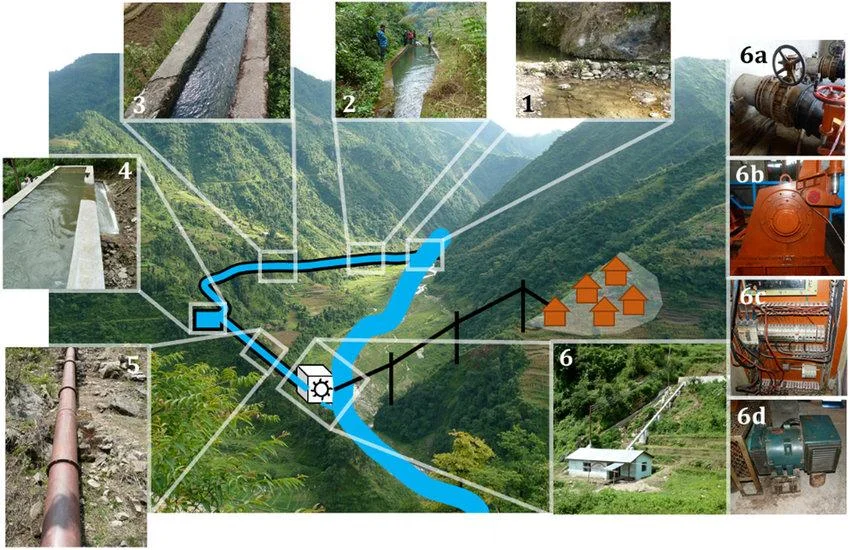
Micro-hydro is run-of-river generation at village scale. No large reservoir is involved, and no valley is flooded.
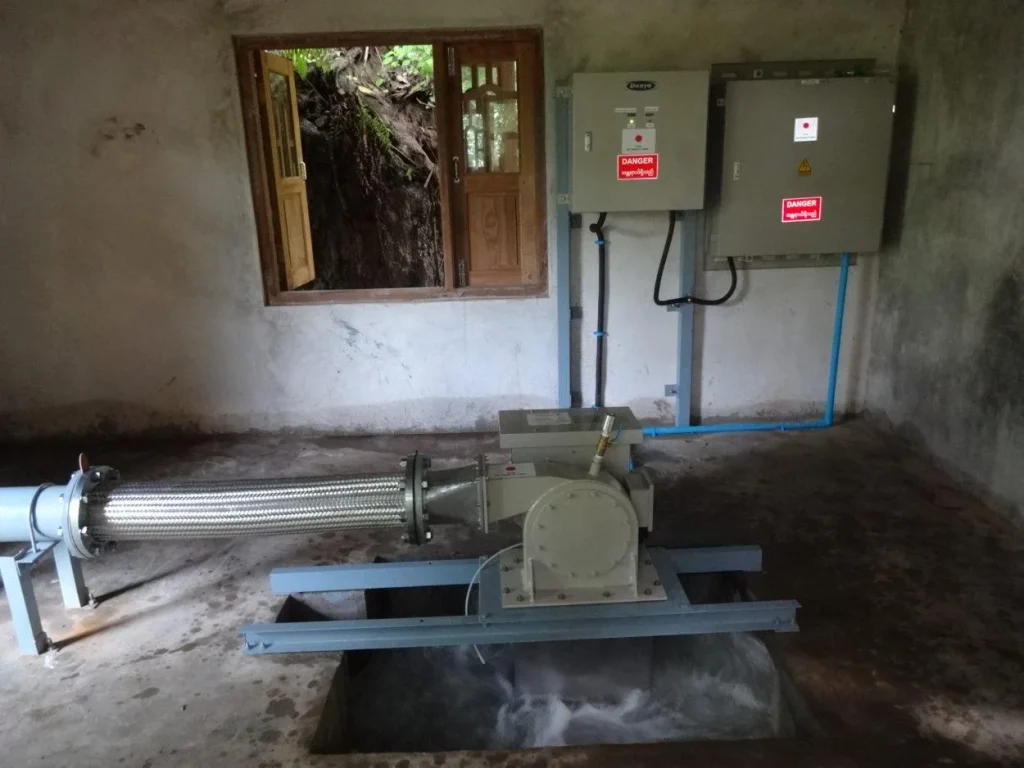
Water is diverted from a stream at an intake, carried along a gently sloping headrace canal to a forebay tank, then dropped down a steel penstock pipe to a powerhouse lower on the slope. Falling water spins a turbine, the turbine drives a generator, and the water returns to the stream. Power output depends on two variables: the head, meaning the vertical drop in meters, and the flow, meaning cubic meters per second. Multiply them, apply an efficiency factor, and you have the plant’s capacity.


Nepal’s middle hills are unusually well suited to this. Steep terrain delivers high head over short horizontal distances, and perennial streams fed by monsoon rainfall and groundwater provide reasonably reliable flow. A village needs only a stream with a few tens of liters per second and 30 to 60 meters of drop to run a plant serving dozens of households.
The size categories
Nepal’s Alternative Energy Promotion Centre (AEPC) uses clear capacity bands.
| Category | Capacity range | Typical role |
|---|---|---|
| Improved water mill electrification (IWME) | Up to 5 kW | Milling plus a small amount of lighting, at sites with 2 m head or more |
| Pico hydro | Up to 10 kW | Lighting for a cluster of houses; locally made Peltric sets go to 5 kW |
| Micro hydro | Above 10 kW to 100 kW | Village mini-grid, lighting plus small end uses |
| Mini hydro | 100 kW to 1 MW | Larger mini-grid; AEPC’s mandate extends to 10 MW |
Capacity bands matter because subsidy eligibility and regulatory treatment follow them. Nepal’s Renewable Energy Subsidy Policy 2078 provides subsidy to community-owned or cooperative-owned mini hydro off-grid projects from 100 kW to 1 MW, and also covers grid-connected mini hydro.
What the numbers show
Published figures vary by source and by year, and it is worth separating them carefully.
AEPC’s own progress report for fiscal year 2081/82 (2024/25) puts cumulative micro and mini hydro capacity at 40,655 kW, roughly 40.7 MW. For that single year, electrification through pico, micro, and mini hydro added 402 kW against a 200 kW target, seven micro-hydro projects were repaired, and nine CDM-registered micro and mini hydro or improved water mill projects were rebuilt or improved. Against AEPC’s total solar capacity of about 49.3 MW and over one million solar home systems, micro-hydro is no longer the centre of Nepal’s rural energy effort.
A 2026 sector review published in New Spotlight by an author at the Renewable Energy and Energy Efficiency Programme reports that the sector at its peak installed more than 3,000 systems totaling about 30 MW, electrifying hundreds of thousands of households. Earlier reporting in Nepali Times in September 2014 cited AEPC figures of about 2,500 plants and roughly 200,000 households, with small-scale hydro capacity passing 48 MW that year and a subsidy of NPR 255,000 per kW.
Those totals do not reconcile cleanly. Different sources count different capacity bands, include or exclude improved water mills, and report installed rather than functioning capacity. Anyone citing a single authoritative national figure for Nepali micro-hydro is simplifying.
The functioning rate is the number that matters
Installed capacity tells you what was built. It does not tell you what still runs. Regional figures compiled in the 2026 sector review are blunt:
- Nationally: at least 90 plants, around 2.7 MW, have already been affected by grid expansion.
- Karnali: more than 120 systems, with about 31 percent non-functional.
- Sudurpaschim: about 72 percent poorly maintained, about 7 percent non-functional.
- Lumbini: 66 systems, about 2.2 MW, serving more than 20,000 households; about 12 percent non-functional and at least 12 affected by grid expansion.
- Koshi: several plants abandoned after grid arrival, mainly because of falling revenue. No count is given.
Those are a mix of measured counts and regional estimates from a sector practitioner, not a national census. Treat the direction of travel as well established and the precise percentages as indicative.
Seasonal flow and sediment: the engineering constraint nobody mentions
Middle hill streams are not steady. Monsoon flows between June and September can be an order of magnitude higher than dry-season flows in March and April, and a plant must be sized for the dry season if it is to supply power year round. Oversizing wastes capital. Undersizing means the village is dark in spring, which is exactly when people decide the system has failed them.
Sediment compounds this. Monsoon streams in the hills carry heavy loads of sand and grit, and that abrasive material erodes turbine runners and nozzles. Settling basins remove the worst of it, but they need regular flushing by an operator who is being paid. Where revenue falls, desilting stops, turbine efficiency drops, and the plant enters a decline that looks like equipment failure but began as an accounting problem.
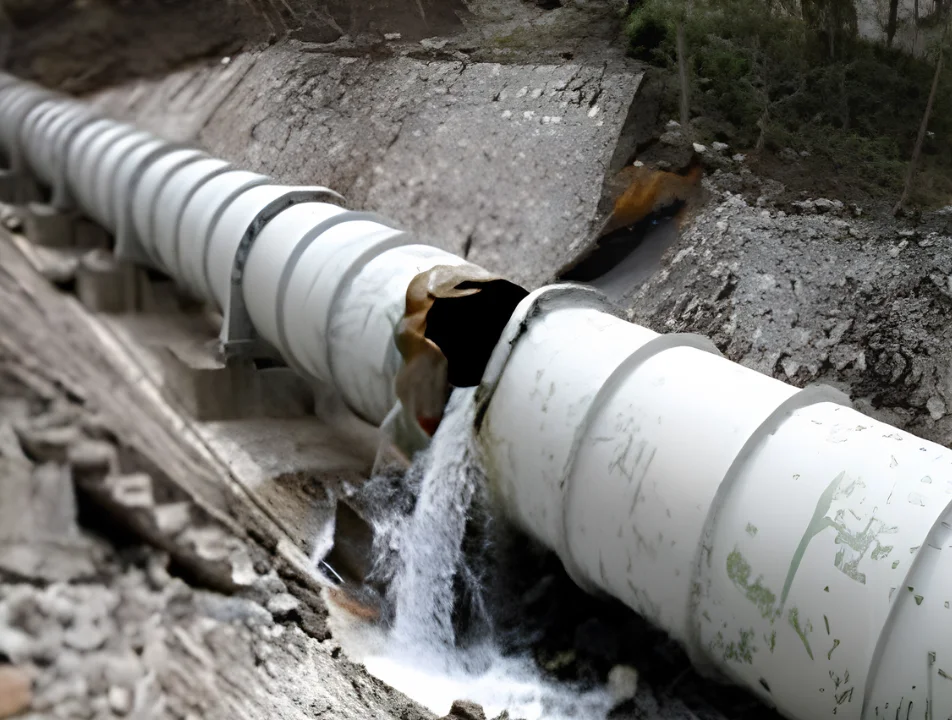
Landslides are the third constraint. Headrace canals run along steep, unstable slopes, and a single monsoon slip can sever a canal and put a plant out of service for months. Repair costs fall on the user committee. In districts where out-migration has thinned the labor available for communal repair work, that burden has become harder to carry.
Why grid arrival kills a village plant
Mechanism is straightforward, and it is economic rather than technical.
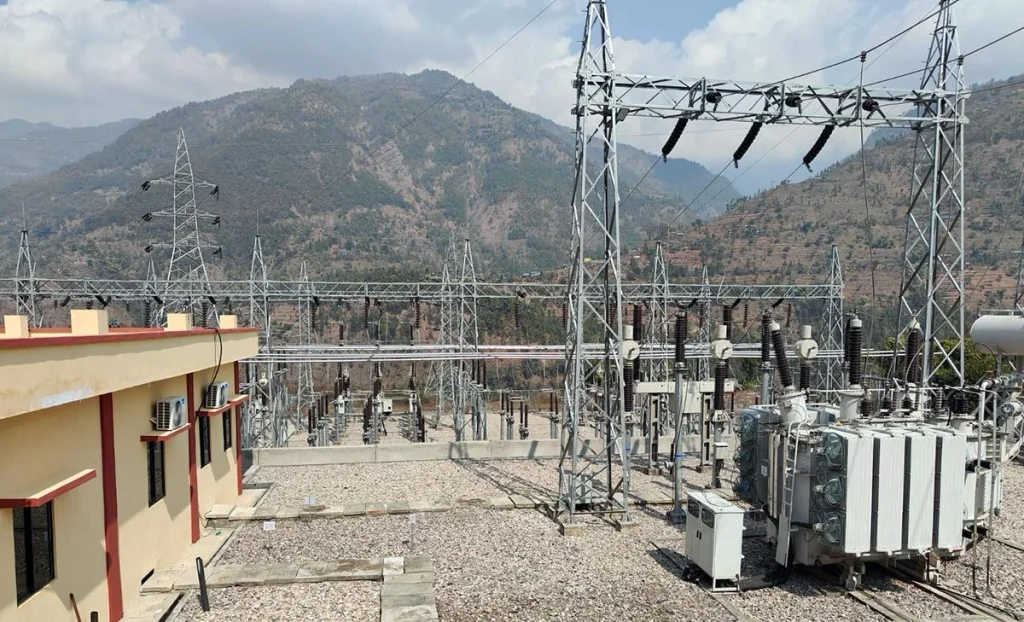
A community micro-hydro plant covers operation, maintenance, and operator salary from the tariff its own customers pay. Tariffs are typically higher per unit than Nepal Electricity Authority rates, because the plant is small, has no economies of scale, and cannot spread costs across a national customer base. When NEA lines arrive, households switch to cheaper and more plentiful grid power. Revenue collapses below the cost of keeping an operator employed, and the plant stops.
Physical condition is often not the problem. Reporting from Dhankuta describes the Leguwa Khola micro-hydro station and the Syaure Bhumi plant running well until transmission lines arrived, after which residents wanted to move to the national system.
Scale of the displacement is set by how successful grid extension has been. By August 2024, the Nepal Electricity Authority reported that around 99 percent of citizens had access to electricity and 539 of 753 local levels were fully electrified. Near-universal access is a genuine development achievement. It also removes the original justification for most off-grid plants.
What is being proposed instead
Three options dominate the current discussion, and they are not mutually exclusive.
Grid interconnection
Rather than competing with NEA, a micro-hydro plant can sell into the grid. Nepal has piloted this. Chanchalghat micro-hydro, cited in the 2026 review, sold about 50,000 units to NEA and bought about 9,000 units over a three-month period while continuing to supply local customers. Interconnection turns a liability into a revenue stream and gives the village a two-way supply that is more reliable than either source alone.
Barriers are institutional rather than technical. Standardized interconnection frameworks, protection and metering standards, and workable power purchase terms for very small generators are still being developed, and the World Bank has called for clearer frameworks in this area.
Productive end use
A plant that only runs lights at night uses a fraction of its capacity. Mills, oil expellers, cold storage, poultry incubators, and small workshops consume power in daylight hours when load is otherwise near zero, which improves revenue per installed kilowatt without any new generation.
Repurposing
Where interconnection is impractical, the civil works still have value. Headrace canals and intakes can serve irrigation, and AEPC reported installing three micro-hydro-operated lift irrigation systems in FY 2024/25. Abandoning the turbine does not require abandoning the infrastructure.
Why any of this matters beyond energy policy
Community micro-hydro in Nepal was never only about electricity. Plants were built and run by user committees, which meant village-level institutions handling accounts, tariffs, maintenance contracts, and dispute resolution. Where those committees still function, they are among the more capable local organizations in the middle hills.
Letting plants fail quietly dissolves that institutional capacity along with the hardware. Keeping them running, in whatever form, keeps it. For readers interested in how village-level economic institutions work elsewhere in Nepal, our piece on community homestay economics covers similar ground, and zero-waste trekking looks at another case where local management determines whether a good idea survives contact with scale.
On the climate side, micro-hydro is low-carbon generation with no reservoir emissions and minimal land take, though run-of-river schemes still alter stream flow between intake and tailrace and can affect aquatic habitat. Our reporting on glacial retreat on Nepal’s 8,000-meter peaks and on rewilding the Terai Arc corridor covers the wider environmental context these systems sit within.
Frequently asked questions
What is the difference between micro hydro and mini hydro in Nepal?
AEPC defines micro hydro as above 10 kW to 100 kW and mini hydro as 100 kW to 1 MW for mini-grid purposes, with AEPC’s wider mandate extending to 10 MW. Pico hydro is up to 10 kW.
How much micro-hydro capacity does Nepal have?
AEPC’s FY 2081/82 (2024/25) progress report gives cumulative micro and mini hydro capacity of 40,655 kW. Other sources cite peak installations of more than 3,000 systems totaling around 30 MW. Definitions differ, so the figures are not directly comparable.
Does micro-hydro need a dam?
No. These are run-of-river systems. Water is diverted at an intake, passed through a turbine, and returned to the stream, with no significant storage reservoir.
Why do micro-hydro plants shut down when the national grid arrives?
Village tariffs are usually higher per unit than NEA rates. When households switch to the grid, plant revenue falls below the cost of operation and maintenance, so the plant stops even when the equipment is sound.
Can a micro-hydro plant sell power to the national grid?
Yes in principle, and pilots exist. Chanchalghat micro-hydro sold roughly 50,000 units to NEA over about three months. Standardized interconnection rules and power purchase terms for very small generators are still being developed.
How many Nepali households have electricity now?
The Nepal Electricity Authority reported in August 2024 that about 99 percent of citizens had access to electricity, with 539 of 753 local levels fully electrified. Access and reliable, sufficient supply are not the same thing.
Is micro-hydro still worth investing in?
For the remaining genuinely remote settlements, yes. For areas the grid has reached, the economic case now rests on interconnection, productive end use, or repurposing the civil works rather than on standalone village supply.
What happens to the canal and penstock if a plant closes?
Civil infrastructure can be reused. AEPC reported three micro-hydro-operated lift irrigation systems installed in FY 2024/25, and headrace canals can often serve irrigation directly.
Before you go
Nepal’s micro-hydro story is not a failure, and framing it as one misreads what happened. A decentralized technology did its job for three decades and is now being overtaken by a centralized system that reaches further. Whether the remaining plants become grid-connected assets or rusting penstocks depends on policy decisions being made right now. Explore more of our reporting on Nepal’s energy and environment, save this guide, and share it with anyone working on rural electrification.


