



How do you protect an animal that researchers cannot reliably find twice in the same place? That is the practical question facing anyone working on the dhole, the Asian wild dog, in Nepal. In Dhorpatan Hunting Reserve, a 2015 study described dholes hunting blue sheep and taking livestock. A 2024 national review listed the same reserve as a site where a recent camera-trap survey detected none at all. Dhole dynamics in this landscape are a case study in how thin wildlife evidence can be, and why that thinness is itself a conservation problem. This article sets out what is documented, what is contested, and what is simply unknown.
What a dhole is, and why it is easy to miss
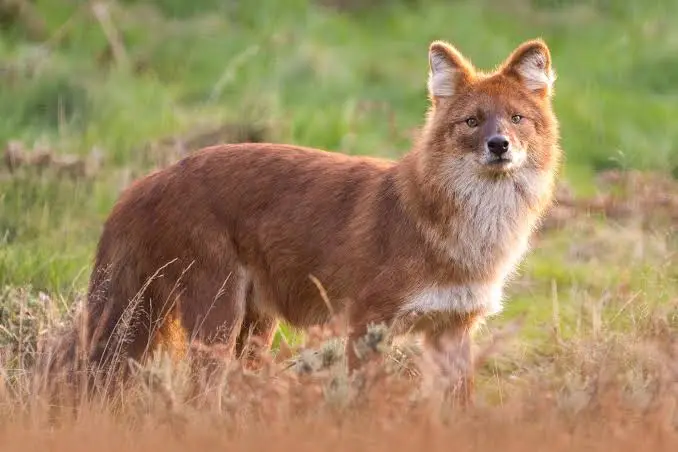
The dhole, Cuon alpinus, is a wild canid roughly the size of a border collie, with a rust-red coat, a dark bushy tail and rounded ears. It is not a close relative of the wolf or the domestic dog. It belongs to its own genus, and its dentition differs: dholes carry fewer molars than other canids, an adaptation associated with a heavily carnivorous diet.
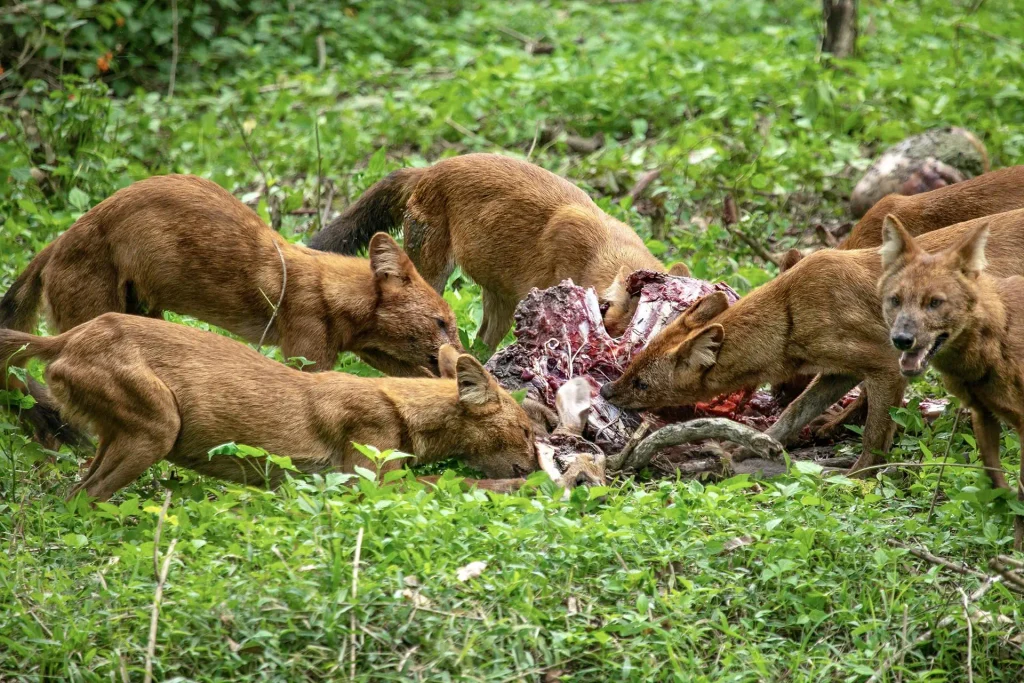
Dholes live and hunt in packs. They communicate with a distinctive whistling call, which is why they are sometimes called whistling hunters. Packs can pursue prey far larger than an individual dhole, including deer and wild sheep.


They are also genuinely hard to survey. Dholes range widely, avoid people, and do not reliably mark territory in ways that make scat or track counts easy to interpret. Most Nepali records in recent years have come from camera traps set up to count tigers or snow leopards, with dholes appearing as incidental captures.
The status picture, and how uncertain it is
Globally the dhole is listed as Endangered on the IUCN Red List. The most recent full assessment dates from 2015, and the Dhole Conservation Fund describes the mature population estimate of roughly 1,000 to 2,000 adults as a reasonable guess rather than a measurement, with a total population somewhere between 4,500 and 10,000. Most surviving populations are in India, Nepal, Bhutan and Thailand.
For Nepal specifically, the ecologist Chandramani Aryal, writing in The Annapurna Express in January 2024, put the national estimate at around 100 animals and noted that confirmed records come from very few locations. He also made a blunt point: the dhole receives far less conservation attention than the tiger, despite arguably being more threatened in Nepal.
Treat all of these figures as order-of-magnitude indicators. None of them rests on a systematic national survey, because no such survey exists.
| Source | Scope | Figure given | Basis |
|---|---|---|---|
| IUCN Red List (2015 assessment) | Global | Endangered; ~1,000-2,000 mature individuals | Expert estimate, described as a guess |
| Aryal, Annapurna Express (2024) | Nepal | ~100 individuals | Compilation of records, not a census |
| Ghimirey et al., Oryx (2024) | Nepal | Endangered on national Red List; recolonization in some areas | Camera traps, literature, interviews |
| Aryal et al., J. Mammalogy (2015) | Dhorpatan | Diet ~80% wild prey; blue sheep 13.9%; livestock 20% | Scat analysis |
Dhorpatan: the reserve and the contradiction
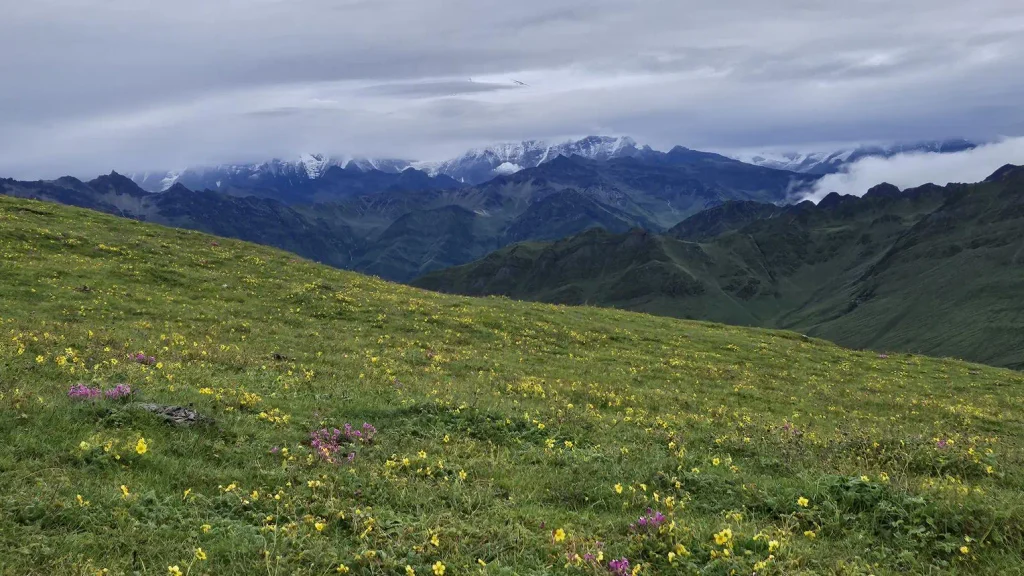
Dhorpatan Hunting Reserve is Nepal’s only hunting reserve. According to the Department of National Parks and Wildlife Conservation, it covers 1,325 square kilometers, was established in 1983 and gazetted in 1987, spans elevations from about 3,000 meters upward, and adjoins Rukum, Myagdi and Baglung districts. It is divided into six blocks for hunting management, and the department issues licenses for sport hunting of species including blue sheep and Himalayan tahr. A DNPWC status survey in 2007 counted 852 blue sheep.
That matters for dholes, because blue sheep are prey.
In 2015, Aryal and co-authors published a study of dhole habitat selection and feeding ecology in Dhorpatan in the Journal of Mammalogy. Using scat analysis, they found that wild prey made up roughly 80 percent of the diet, with blue sheep accounting for 13.9 percent and livestock for 20 percent. Dholes used most habitat types in the reserve but avoided barren ground, juniper and fir-dominated forest, and areas under heavy human pressure. The authors noted that livestock predation had soured local attitudes toward the species.
Then came the 2024 review in Oryx by Ghimirey and colleagues. Their assessment of Dhorpatan is more guarded. Dholes were historically present there, with no clear evidence of local extirpation. A recent camera-trap survey in the reserve detected no dholes, though the authors believe the species is still present. Reports of livestock depredation inside the reserve, they write, need further validation.
How to read that disagreement honestly
Two credible studies, nine years apart, point in different directions. There are several ordinary explanations, and no way at present to choose between them.
- Detection failure. Camera traps placed for other species, at the wrong elevation or season, can miss a wide-ranging pack entirely. Absence of detection is not detection of absence.
- Genuine decline. Dhole numbers may have fallen in the reserve through persecution, disease or prey depletion.
- Range shift. Packs may have moved to adjoining forest outside the survey area.
- Method mismatch. Scat-based diet studies and camera-trap occupancy studies measure different things and can disagree without either being wrong.
A peer-reviewed methods paper published in PeerJ in 2022 addressed precisely this difficulty, examining approaches for estimating dhole populations. That such a paper was needed tells you how unresolved the basic counting problem remains.

The threats, where they are documented
Ghimirey and colleagues list the pressures on dholes in Nepal, and the list is specific rather than generic.
Livestock conflict comes first. Dholes take livestock, herding households respond, and poisoned bait carcasses have killed dholes in the past. Retaliatory killings have been reported from Bardia National Park and Kanchenjunga Conservation Area. The authors make an uncomfortable prediction: if dhole numbers recover, conflict will rise with them.
Hunting of wild ungulates reduces the prey base. Hydropower and road construction fragment mid-hill forest. Lowland deforestation continues at the highest rate in the country. And disease transmission from free-ranging domestic dogs, particularly rabies and canine distemper, is a documented risk to wild canids.
Why dholes collapsed across much of Nepal in the 1970s and 1980s remains unresolved. Forest loss, poaching and prey decline are all implicated. The exact cause is not established.
The herding communities in the middle
Dhorpatan is a working landscape. Households from communities including Magar, Kham Magar and Tibetan-origin groups graze sheep, goats and yaks across the reserve’s pastures, and transhumant herding remains central to the local economy. Practices and attitudes vary between settlements and should not be generalized across the whole reserve.
Any conversation about dhole conservation in Dhorpatan that does not start with livestock loss is not a serious conversation. The 2015 study found livestock at 20 percent of the dhole diet there. For a household running a few dozen head, that is not an abstraction.
Compensation schemes exist in Nepal for wildlife damage, but coverage and administration differ by protected area and by species. It is worth checking the current provisions with DNPWC directly rather than relying on older summaries, since rules have changed more than once.9
What would actually move the evidence forward
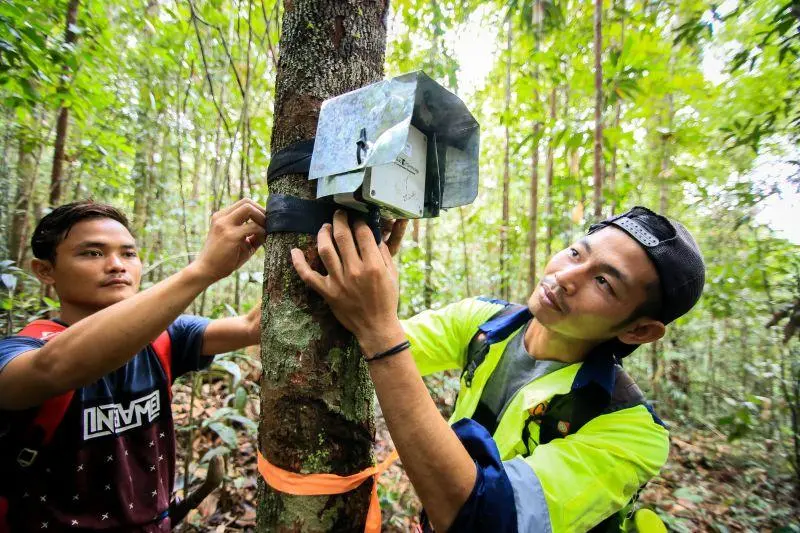
Researchers working on the species tend to converge on a short list.
- Dedicated camera-trap surveys designed for dholes, not repurposed from tiger or snow leopard grids.
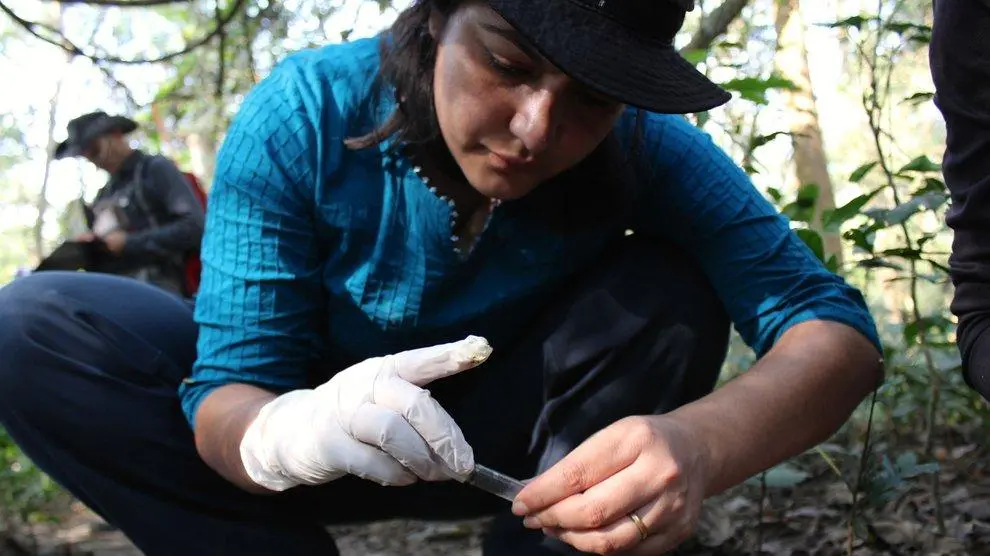
- Genetic sampling from scat, which can distinguish individuals and estimate pack structure where cameras cannot.
- Validation of reported livestock depredation, so conflict policy is built on confirmed cases.
- Vaccination and population management for free-ranging domestic dogs around protected areas.
- Explicit legal protection. Aryal notes that Nepal’s National Parks and Wildlife Conservation Act protects the common leopard but not the dhole.
None of this is exotic. It is standard carnivore ecology, applied to a species that has not received it.
Can visitors see a dhole in Dhorpatan?
Realistically, no. Sightings are rare even for researchers running camera grids for months. Dhorpatan is a demanding, remote trekking destination reached from Baglung or Myagdi, and visitors go for the landscape, the pastures and the birdlife rather than for a near-certain carnivore encounter.
If you do see what you believe is a dhole anywhere in Nepal, a dated photograph with a location is genuinely useful. Incidental records from trekkers and herders have contributed to the recent record base.
Related reading on NepalVue
For the wider picture of the country’s fauna, see our guide to wildlife in Nepal and our guide to Nepal’s tiger parks. For the reserve itself as a destination, see Dhorpatan: the Himalayan journey. For how conservation funding actually flows in Nepal, see where Nepal’s trekking permit fees go, and for a different account of forest rights and livelihoods, the Raute and forest rights.
Frequently asked questions
Is the dhole the same as a wolf or a jackal?
No. The dhole belongs to its own genus, Cuon, and differs from wolves and jackals in dentition and social behavior. It is a distinct species, not a regional variety of another canid.
How many dholes are left in Nepal?
There is no census. The most commonly cited figure is around 100 animals, given by ecologist Chandramani Aryal in 2024, based on compiled records rather than a survey. The true number could be meaningfully higher or lower.
Are dholes dangerous to people?
There is no established pattern of dholes attacking people in Nepal. The documented conflict is over livestock, not human safety.
Why is Dhorpatan a hunting reserve rather than a national park?
It is Nepal’s only reserve managed to allow regulated sport hunting, administered in six blocks with licenses issued by DNPWC. Blue sheep and Himalayan tahr are the main licensed species. The model is intended to generate revenue and local benefit alongside conservation, and it remains debated.
Do dholes compete with snow leopards or leopards?
Dietary and spatial overlap with other carnivores is plausible and has been studied elsewhere in Asia, but there is no robust Nepal-specific evidence on competition in Dhorpatan. Treat claims about it as hypotheses.
What do dholes eat in Nepal’s mountains?
The Dhorpatan scat study found roughly 80 percent wild prey overall, with blue sheep at 13.9 percent and livestock at 20 percent. Diet composition in other Nepali sites has not been studied to the same depth.
Are dholes recovering in Nepal?
The 2024 Oryx paper describes signs of recovery in some areas after decades of near absence, with confirmed camera-trap records from the Annapurna Conservation Area and the Tinjure-Milke-Jaljale forests. The authors frame this cautiously, and warn that recovery will bring more conflict.
How can travelers help?
Report verified sightings with date and location to the relevant protected area office, avoid feeding or encouraging free-ranging dogs near park boundaries, and support community-run conservation programs. The single most useful contribution is accurate location data.
NepalVue reports on Nepal’s wildlife with the evidence shown, including where that evidence runs out. Explore more of the country with us, save this guide for later, and follow NepalVue if you want the version with the uncertainty left in.


