



Call Bon “Nepal’s pre-Buddhist religion” and you have already lost the thread. Scholars abandoned that framing decades ago, and the communities who practice it never used it. What survives in Mustang is not a relic that Buddhism failed to erase. It is an organized religious system with its own scriptures, its own monastic lineages, and its own living village priesthood, shaped in dialogue with Tibetan Buddhism rather than left behind by it. This article explains what the Bon masters of Mustang actually practice, where the real sites are, what the iconography means, and why the single most important Bon settlement in Nepal is now fighting floodwater.
Getting the terms right
Per Kvaerne’s three-way distinction is now standard in Tibetan studies, and Charles Ramble uses it in his essay for the Rubin Museum’s Project Himalayan Art. Bon can mean the pre-Buddhist religion of Tibet, about which little is securely known. It can mean local cults that outsiders once labeled pagan, some of which involve animal sacrifice. Or it can mean Yungdrung Bon, the organized scriptural and monastic system that took shape in the tenth and eleventh centuries, and which rejects those sacrifices and does not claim kinship with them.
3is what Mustang’s priests practice. It shares with Buddhism the structure of sutra, tantra and philosophical commentary, but traces its scriptures to Zhangzhung, a historical polity in western Tibet, rather than to Sanskrit sources from India.


Kvaerne’s own position moved over his career, which is the cleanest way to see how contested this is. In 1972 he described Bon as a peculiar but authentic form of Buddhism. Later he argued it was legitimate and necessary to treat Bon as a distinct religion, a view that matches how Bonpo practitioners describe themselves. David Snellgrove had earlier rejected the idea that Bon is a distorted Buddhism, callin3g it an eclectic tradition that chose to accentuate its own older elements. Bonpos themselves reject any split between pre-Buddhist and post-Buddhist Bon.
Tonpa Shenrab, named as the founder, is said in Bon accounts to have lived 16,000 years ago. No historical sources for him exist. Treat him as a figure of sacred biography, in the way one would treat any founder whose life is known only through scripture.
Where Bon actually is in Mustang
Travel writing routinely garbles the geography here, so it is worth setting out plainly.
| Site | Where it is | What it is |
|---|---|---|
| Klu brag (Lubra, Lubrak) | Lower Mustang, Baragaon enclave, about two hours north of Jomsom | Village of hereditary household priests with a public temple |
| Drangsong collection | Lo Manthang, Upper Mustang | Private manuscript library of the kings’ former Bon chaplains |
| Samling (bSam gling) | Dolpa district, near Bicher | Monastery with a major manuscript collection |
| Pugmo and Puwer temples | Dolpa district | Village temples with resident householder priests |
| Menri, Dolanji | Himachal Pradesh, India | Monastic seat where Lubra’s boys train |
Note what that table shows. The major scholarly survey of Bonpo monasteries, compiled by Dondrup Lhagyal, Phuntso Tsering Sharyul, Tsering Thar, Charles Ramble and Marietta Kind, lists exactly one surveyed Bon monastery in Mustang district, and it is Klu brag, in Lower Mustang. Upper Mustang’s Bon story is a different one: a household library belonging to a royal priestly line that ended, not a working monastery. Readers who want the archaeological backdrop to this landscape will find it in our pieces on the sky caves of Chhoser and on Mustang’s old caravan routes.
Lubra: a village where every household head is a lama
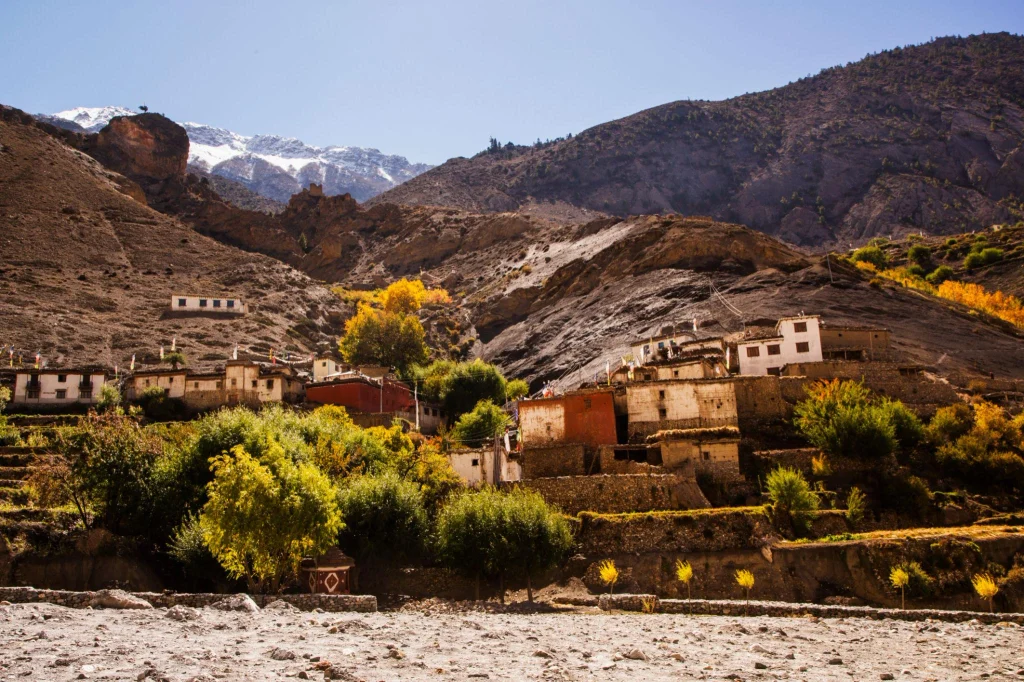
Lubra sits on the south bank of the Panda Khola, one of the nineteen settlements of the old Baragaon enclave. Residents here are Baragaunle, not Loba, a distinction that matters since the Loba are the community of the Kingdom of Lo further north.
Founding is credited to Tashi Gyaltsen, known as Drogon Lubrakpa, of the Ya ngal clan, with land granted by the Thini authorities. Dating varies by source. The Bonpo monastery survey places the founding in the thirteenth century, a German Bon foundation gives the twelfth, and Ramble has described the settlement as eleventh century. Honest summary: twelfth or thirteenth century by most accounts, with an earlier date argued by at least one leading scholar.
Structure of the community is recorded precisely in that survey: ten and a half estates, fourteen households, sixteen hearths. No celibate monks live there. Every male household head is a lama, which makes Lubra a village of hereditary non-celibate priests, and a small number of women take vows as nuns. Boys are sent to Menri in India for formal training.
Reporting by Al Jazeera in June 2026 describes the arrangement as it works today. Lama Tsultrim, then 76, leads the community. Village rules require at least one man from each family to be available for religious duties at the temple. Men prepare the dough and butter offerings called torma, and women brew chyaang. Residents also “feed the yulsa,” the protector deity of the place.
Buildings include Phuntshok Ling, the main public temple, founded by the Tibetan master Karu Druwang Tenzin Rinchen in the mid-nineteenth century, and Gom Phuk, a temple that grew around the founder’s meditation cave and was rebuilt after it collapsed with support from the Danish Embassy. Across the valley at Nyamlon Phu there are about a dozen meditation caves, still used by Bon practitioners from outside Nepal. Those are working retreat sites, and they are not a sightseeing destination.
Cosmology you can actually observe
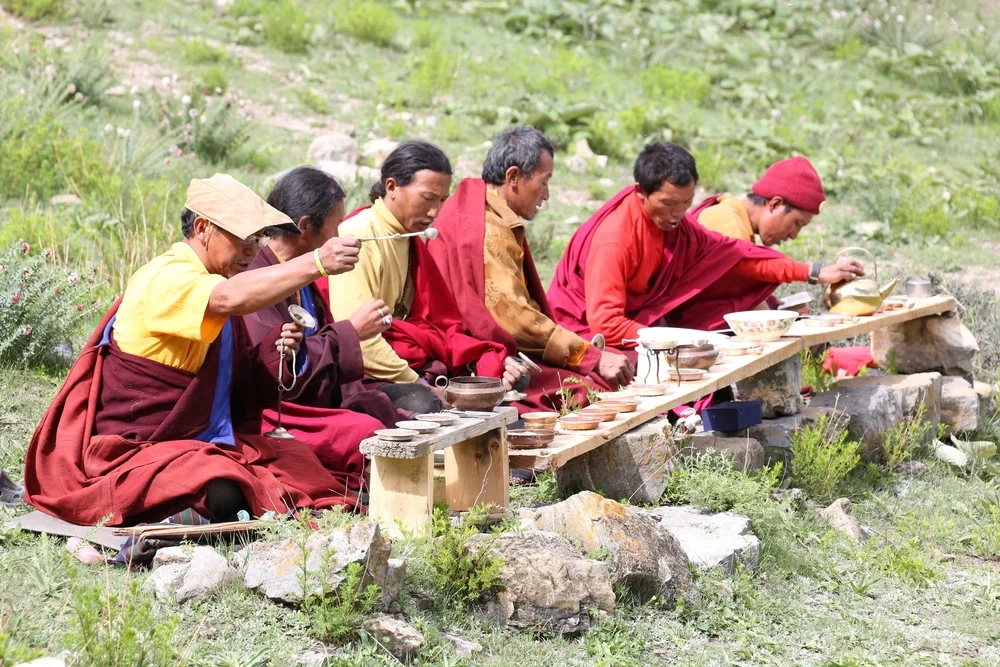
Bon ritual in Mustang is organized around relationships with the beings who own a place: gods of the sky, serpent spirits of water and the underground, and owners of the soil itself. Abstract description of that system belongs in a scholarly text, but its practical expression is visible in the village.
Lubra’s name is read locally as a compound of lu, the serpent spirits, and a word for rock cliff, pointing to the snakeskin-textured cliffs opposite the village. When water runs dangerously short, villagers still perform a ritual for the lu. Manuscripts from the royal chaplains at Lo Manthang contain invocations to territorial gods alongside Bon deities, which tells you the same logic once operated at the level of a kingdom.
The main annual event at Lubra is a year-end exorcism, recorded in the village’s own register, the ma yig, which is the authority on timing. Sources describe it variously as five days or about a week, and they do not agree on the month, so visitors should ask locally rather than plan around a date found online. Ramble has photographed a Tsochok torma at Lubra and describes masked dancers in Mustang representing that deity and his entourage, which links the painted iconography directly to performed ritual.
Reading Bon murals without getting it wrong
Three things are worth knowing before you look at a wall painting.
- The yungdrung. Bon’s swastika emblem must turn to the left, and the word is said to come from Zhangzhung meaning everlasting. Himalayan Art Resources is careful to add that Buddhist use of the symbol requires no particular direction, and both directions appear in Buddhist art roughly equally. A left-turning yungdrung is required for Bon, but direction alone is not a reliable test of affiliation.
- Sidpa Gyalmo, the Queen of the Universe, began as an ancestral Tibetan goddess and her iconography has merged with that of the Buddhist goddess Palden Lhamo. In painting she rides a red mule. Nothing illustrates the fusion argument better than a goddess two traditions both claim.
- Walse Ngampa, one of the Five Supreme Ones of Father Tantra, appears wrathful and blue-black, with nine faces and eighteen hands, snow lion, tiger and leopard heads above the central faces, and a crown bearing garuda, dragon and makara.
Conservation is the uncomfortable part. The celebrated mural restoration projects in Mustang, at Thubchen and Jampa Lhakhang in Lo Manthang, are Buddhist, funded from 1996 by the American Himalayan Foundation with Italian conservators arriving in 1999 and training a local team. Their guiding principle was to conserve rather than repaint, specifically to avoid falsifying history. No comparable funded mural conservation project at a Bon site in Mustang appears in the published record. Restoration efforts for Lubra’s monastery are currently at the grant-application stage, led by landscape architect Dane Carlson and the group Mustang Bon Action.
The library in Lo Manthang
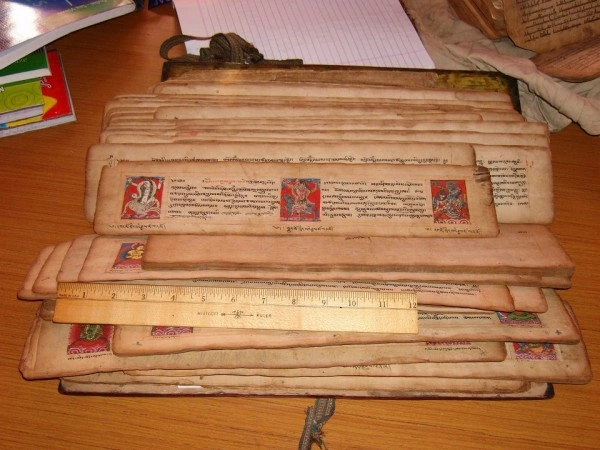
Found by accident in a house near the King’s Palace, the Drangsong collection is the ritual repertoire of the Bon chaplains who served the kings of Mustang. Agnieszka Helman-Wazny’s 2024 study in Manuscript and Text Cultures counts about 340 items across 3,477 folios, sheets and cards, assembled over roughly six centuries. A grant abstract from the earlier inventory in 2018 gives about 280 manuscripts and 2,900 folios, so the figure depends on which stage of cataloguing you cite.
Contents run to divination, mantras, ritual instruction, invocations to territorial gods, fumigation rites, protection of fields, and even a treatment for rabies. Use continued until the priestly line ended around 1960, when the last male heir died. Manuscripts stayed in the family shrine room until the 1990s, when a relative talked the occupant out of burning them.
Condition is poor in places. Sewing thread has perished on many items, some have lost their front pages, and at least one shows mouse and worm damage. Work continues under a project led by Helman-Wazny with Charles Ramble, funded by Poland’s National Science Centre. This is private family property inside an occupied house, not a site open to visitors.
Manuscript survival is better in Dolpo. Amy Heller reports that the dry high-altitude climate there has kept pigment bright with little page deterioration, and that the earliest dated item found is a dedication leaf from around 1330 to 1350. Our article on the cave inscriptions of Shey Phoksundo covers the neighboring Dolpo material.
Water, not modernity, is the immediate threat
Mustang lies in the rain shadow north of the Annapurna and Dhaulagiri massifs, which historically made it dry and stable. That stability is breaking down. Al Jazeera’s 2026 reporting from Lubra describes flooding every monsoon for about a decade, a 2021 flood that buried one family’s home, and a riverbed that a researcher estimates has risen by around 12 meters over ten years. Residents said there had been no snow for three years. A government-funded flood wall costing roughly 80,000 US dollars was destroyed in a single day, and rain now leaks through the monastery roof.
Of sixteen families reported in the village, four have abandoned their homes to floods within the past decade. Household counts differ between sources partly because estates, households and hearths are counted differently, so no single number should be treated as definitive.
Our explainer on the rain shadow that shapes Mustang’s high-altitude desert sets out the climate mechanics behind this shift.
Visiting responsibly
Lubra lies within the Annapurna Conservation Area and does not sit inside the restricted zone, so it is reachable on foot from Jomsom. Upper Mustang has been a restricted area since reopening in 1992, and the permit rules were reported as changing during 2025 and 2026. Published fee figures currently circulate only on commercial trekking sites and do not agree with each other, so check directly with Nepal’s Department of Immigration or a registered agency before budgeting.
Two courtesies matter more than any permit. Meditation caves and private family libraries are in use and are not attractions. And the village’s ritual calendar belongs to the village, so ask before photographing, and accept a no.
Frequently asked questions
Is Bon older than Buddhism in Tibet?
Yungdrung Bon, the system practiced in Mustang, took organized form in the tenth and eleventh centuries, which is after Buddhism reached Tibet. Bon accounts trace its teachings far earlier through Zhangzhung, and practitioners reject the division scholars draw. Both positions should be reported, not merged.
Can visitors go to Lubra?
Yes. Lubra is reached on foot from Jomsom in about two hours and lies within the Annapurna Conservation Area rather than the restricted zone. It is a working village, so behave accordingly.
Does a left-turning swastika always mean Bon?
No. Bon requires the left-turning form, but Buddhist art uses both directions, so the symbol alone does not identify a site’s affiliation.
Are there Bon monks in Mustang?
Lubra has no resident celibate monastic community in the usual sense. Every male household head serves as a lama, a hereditary non-celibate priesthood, and a small number of women take vows as nuns. Boys travel to Menri in India for formal monastic training.
What happened to the Bon chaplains of the kings of Lo?
Their line ended around 1960 with the death of the last male heir, and the rituals were discontinued. Their manuscripts survive in Lo Manthang and are now being catalogued by an international research project.
Are Bon murals in Mustang being restored?
Not yet, as far as the published record shows. The well-documented mural conservation work in Lo Manthang was carried out at Buddhist temples. Fundraising for Lubra’s monastery is underway.
What languages are spoken in Mustang?
Nepal’s 2021 census records Nepali as the largest mother tongue in Mustang district, followed by Lhopa, Baragunwa, Thakali and Tibetan. Census labels are administrative categories, and Baragunwa corresponds to what linguists call Seke, spoken in the Baragaon villages.
Is the Bon tradition in Mustang disappearing?
Residents are not describing it that way. A hostel founded 25 years ago keeps children connected to language and ritual, and marked its anniversary in 2026. Pressure comes from flooding and migration, not from loss of interest.
Follow Mustang beyond the trekking route
Mustang rewards readers who slow down and get the details right. Explore more of our Mustang and Himalayan culture coverage on NepalVue, save this guide for your next trip north of Jomsom, and pass it to anyone still calling Bon a lost religion.


