


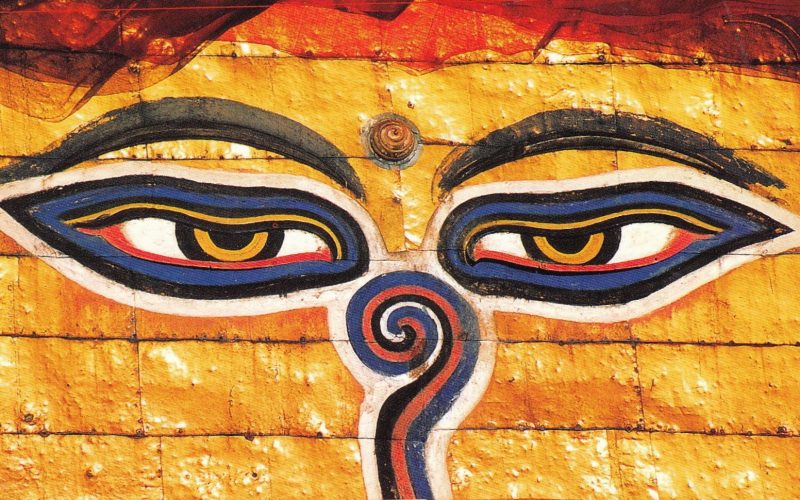
Swoyambhunath is considered to be one of the most important and oldest religious sites of the Buddhists. The word ‘Swoyambhu’ means self-originated. It is situated on top of a hill in Kathmandu. There are other religious sites besides the Stupa in the area, and it is considered to be the major site for the Newar Buddhists.

History of Swoyambhunath
According to Swoyambhu Puran, Swoyambhu was introduced even before Siddhartha Gautam Budhha. When Kathmandu was a big lake, Vipaswi Buddha planted a lotus here and everyone visited this glowing place. Manjhushree Bodhisatva, in 3rd Century AD visited here all the way from Tibet. He cut a gorge at Chobar and let the water flow from the Kathmandy valley. In this way, he formed the Kathmandu valley. In around 3rd Century to 4th Century AD, King Prachanda Dev from Benaras establidhed Swoyambhunath properly. According to Gopal Raj Vanshawali(Oldest Script established during Jayasthiti Malla’s period), King Vrishyadev, the great grandfather of King Mandev was the the one who established the stupa of Swoyambhunath.
However, in 1406 BS, there was a big attack from Samsuddin Ilyas Shah, the Muslim emperor. During this period, the stupa of Swoyambhunath was separated into two parts. After 10 years from the attack, King Harshvardhan Dev Malla was able to renovate it. Similarly, a massive renovation occurred during the period of the Shah King, Rajendra Bikram Shah (1900s). Even after the 2015 earthquake, the stupas stood tall despite the fact that its neighboring temples were completely wrecked. With a few renovation projects, it still possesses its immense glory.

Other religious sites in the Swoyambhunath Stupa Area:
1. Basuvandhu Chaitya
- It belongs to the medieval period.
- It is a red inverted mantra.
2. Shantipur
- Guru Shantikaracharya built it during King Pratap Malla’s period.
- It was further renovated during the Shah dynasty.
3. Pratap Pur and Anant Pur
- Both of these temples are built side-by-side of the Swoyambhunath Chaitya.
- They are in a Shikhara style.
- They were built during Pratap Malla’s period.
- They were already damaged due to rain and storm, but was demolished completely during the 2015 earthquake.
4. Vajra
- It is a huge thunderbolt located on the eastern side of the stupa.
- It was also built during Pratap Malla’s period.
5. Harati Mandir
- It is a temple dedicated to Harati Devi, who is considered to be the Goddess of protection.
- It was built during the Malla period.
Other important sites of Swoyambhunath area are:
- Karma Raj Mahavihar
- Pawan Bhairav
- Gyan Maala Sattal
- Dev Dharma Mahavihar
- Chaitya Park