



Woodsmoke, juniper and wet stone. You smell a Helambu village before you reach it, walking up through terraced potato fields toward a cluster of slate-roofed houses and a gompa with new paint over old timber. North of here the ridges climb toward the Jugal Himal and, beyond, the Tibetan border. For centuries the people of this valley lived with that border as a working road rather than a wall. This article explains what the trans-Himalayan salt trade actually was, how the Yolmo homeland sits in relation to it, and where the historical record is solid and where it is not.
Who the Yolmo are
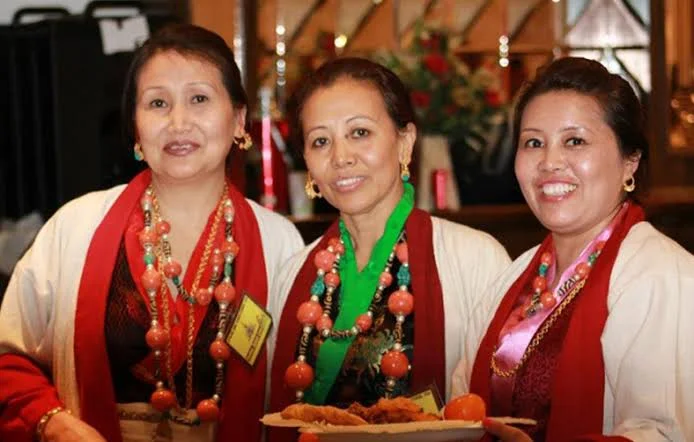
The Yolmo, who also write their name Hyolmo or Yholmo and call themselves Yolmopa, are an Indigenous people whose homeland is the Helambu and Melamchi valleys of Sindhupalchok District, roughly 70 to 80 km northeast of Kathmandu. Smaller Yolmo communities live in Lamjung, Ilam, near Pokhara, and across the border in Bhutan, Gyirong County in Tibet, and in Sikkim and West Bengal in India, where they are recognized as a Scheduled Tribe.
Nepal’s 2011 census recorded 10,752 Yolmo across 11 districts, with 99 percent reporting Yolmo as their language. In Helambu Rural Municipality itself, which had 17,497 residents at the 2021 census, Yolmo people make up about 16.8 percent of the population and Tamang about 53.4 percent. Naming matters here: Helambu is a shared landscape, not a single-community one.


Yolmo is a Tibeto-Burman language in the Kyirong-Kagate branch of Sino-Tibetan. It is closely related to Tibetan but not fully mutually intelligible with it, and is traditionally written in Tibetan script. Nyingma Buddhism is the dominant religious tradition, practiced alongside older ritual practices that vary between villages and households.
From the 1980s, many Yolmo described themselves as “Helambu Sherpa” to align with the better-known Sherpa of Solukhumbu, and that label still appears in some older references and language codes. Few Yolmo today regard themselves as a Sherpa subgroup. The Nepal Federation of Indigenous Nationalities uses the spelling Hyolmo.
Origins in Kyirong
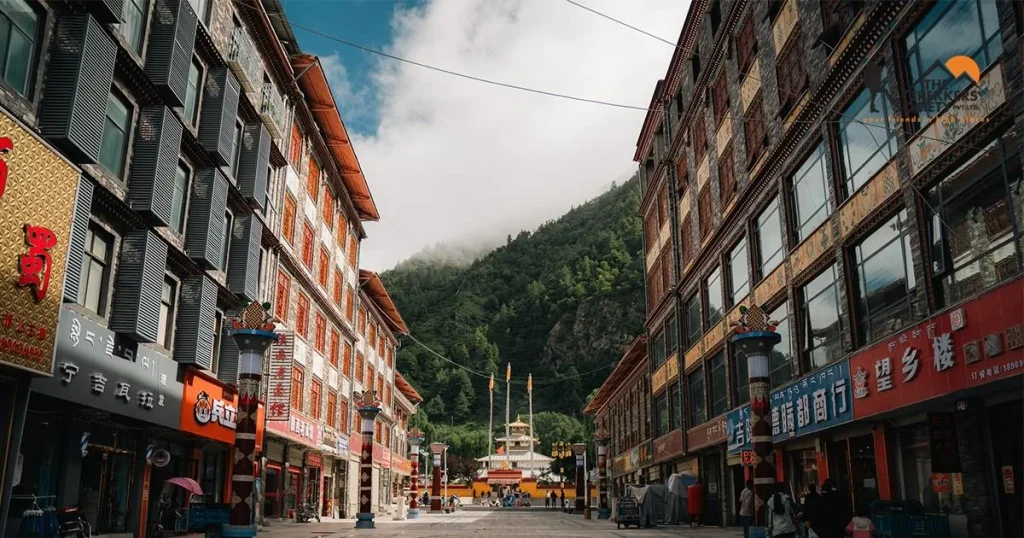
Anthropologist Graham Clarke, whose fieldwork in the region produced the standard early studies of Helambu history, concluded that Yolmo families migrated from the Kyirong valleys of southwestern Tibet roughly 200 to 300 years ago. Linguistic evidence supports the connection: Yolmo sits in the same branch as Kyirong Tibetan. After settling, intermarriage between Yolmo lamas and local Tamang women became common, which is part of why Helambu’s social map is layered rather than neat.
That Kyirong origin matters for the trade story, because Kyirong was one of the principal gateways between Tibet and the central Nepali hills.
The salt trade: what it was and how it worked
Across the Himalaya, one geographic fact drove centuries of commerce. Tibet had salt and no rice. Nepal’s hills and lowlands had grain and no salt.
Tibetan rock and lake salt, much of it from lakes such as Namtso and the Changthang basins, moved south across the passes. Rice, barley, buckwheat, millet and manufactured goods moved north. Traders made their living from the difference in exchange rates between the two ends of the route, which is a point the economist J. L. Ross made in a 1983 study of Humla: the profit was not in salt itself but in the gap between what salt bought in Tibet and what it bought in the middle hills.
How big was that gap? A 2001 Nepali Times feature by Chhakka Bahadur Lama reported that in the Karnali system a single sack of Tibetan salt could be exchanged for as many as 15 sacks of rice at the southern end of the route. Treat that as a reported figure from one region at one period rather than a constant. Ratios varied by year, route, harvest and distance.
Why yaks, and why not only yaks
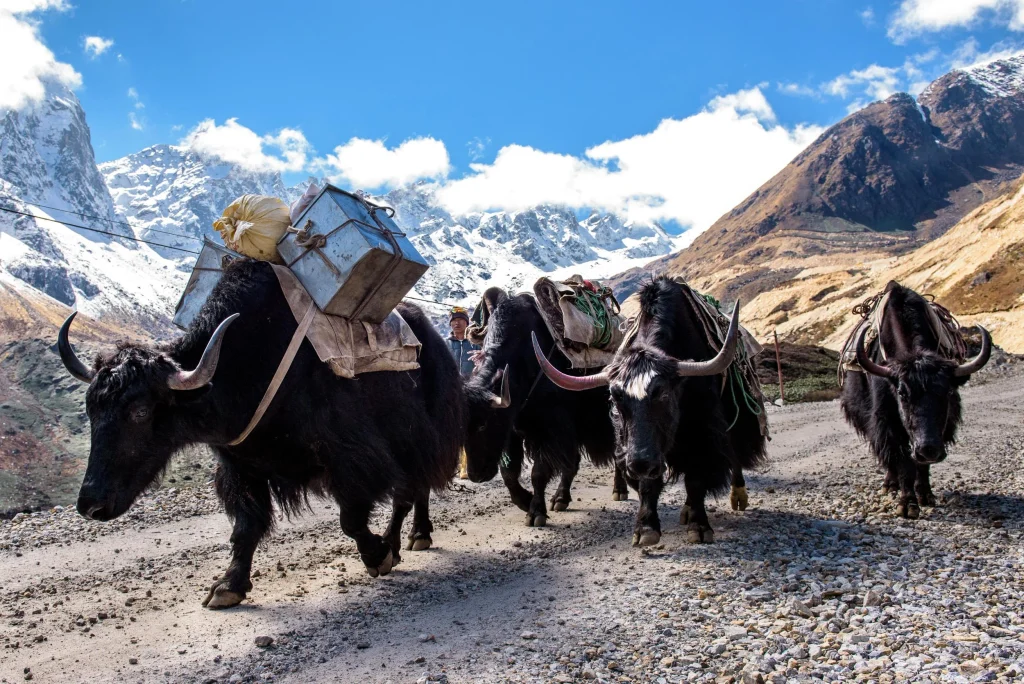
Pack animals were chosen by altitude, not preference.
| Animal | Working zone | Role |
|---|---|---|
| Yak | Roughly above 3,000 m | Heavy loads across high passes and the Tibetan plateau; cannot tolerate sustained heat or low elevation |
| Dzo (yak-cattle cross) | Middle to high | Transitional animal, more heat-tolerant than yak |
| Sheep and goats | Hills to the Terai | Small loads in large flocks; could walk all the way to lowland markets |
A caravan was therefore usually a relay, not a single animal train running end to end. Yaks brought salt down to a transfer point. Sheep flocks, called bhagri in parts of the Karnali, carried it onward in small saddlebags to hill and lowland markets. Timing followed snowmelt: in the Karnali system traders moved north in spring as the passes cleared, traded through the summer, and came south again before winter closed the route.
The Kyirong and Rasuwa corridor
The route most relevant to the Yolmo homeland runs north from the Kathmandu Valley through Rasuwa to Kyirong. Rasuwagadhi, the fort at the frontier near the confluence of the Lhende and Kerung Khola, marks the choke point. Its military history makes the corridor’s importance obvious: a three-day battle was fought there in July 1792 during the second Sino-Nepalese campaign, and the present fort was built in 1855 during the Nepalese-Tibetan war under Jung Bahadur Rana.
Governments do not fortify unimportant passes. Rasuwagadhi was built where it was because goods, people and armies moved through there.
Today the same corridor carries a different kind of trade. Nepal and China agreed in 2012 to develop Rasuwagadhi as a formal crossing, and it opened to trade in December 2014, becoming an important alternative to the Zhangmu-Kodari route. Floods have repeatedly cut it since: the Miteri Bridge was destroyed on 8 July 2025, and floods in late August 2026 destroyed the border complex and washed away several bridges.
What the record supports, and what it does not
Here is where honesty matters more than a good story.
The ethnographic literature on Himalayan salt caravans in Nepal is detailed and specific for certain communities: the Nyinba and other Humla groups, the people of Dolpo, Mustang’s Thakali and Loba traders, the Khampa herding groups of the far west, and the Nubri valley. Scholars including Ross, Lama and later researchers on Humla’s trans-Himalayan trade document those systems directly.
The published scholarship on the Yolmo is extensive but points elsewhere. Clarke wrote on Helambu history, lama-Tamang relations, social hierarchy and ideas of material prosperity. Robert Desjarlais wrote on emotion, illness and biography. Lauren Gawne and Anna Hári worked on the language. Goldstein and Beall studied aging and migration in Helambu. Reviewing the bibliographies maintained by the Hyolmo Heritage Project and the collected literature on Yolmo people, no study found for this article documents a specifically Yolmo long-distance yak-caravan salt trade as a described institution.
What is well supported is narrower and still interesting: Yolmo families originate from Kyirong, sit directly on the Kathmandu-Rasuwa-Kyirong axis, and historically farmed and herded with yak in the high pastures above their villages. Potatoes and radishes are staple crops, supplemented by yak milk and meat, as Naomi Bishop documented in work on Himalayan herding. Cross-border kinship and movement between Helambu and Kyirong are a matter of record.
What is not established is a documented Yolmo caravan trade of the kind recorded for Humla or Dolpo. Anyone who tells you otherwise should be asked for a citation. Absence of documentation is not proof of absence, and local oral history may well hold more than the published record. But a claim without a source stays a claim.
Why the caravans ended
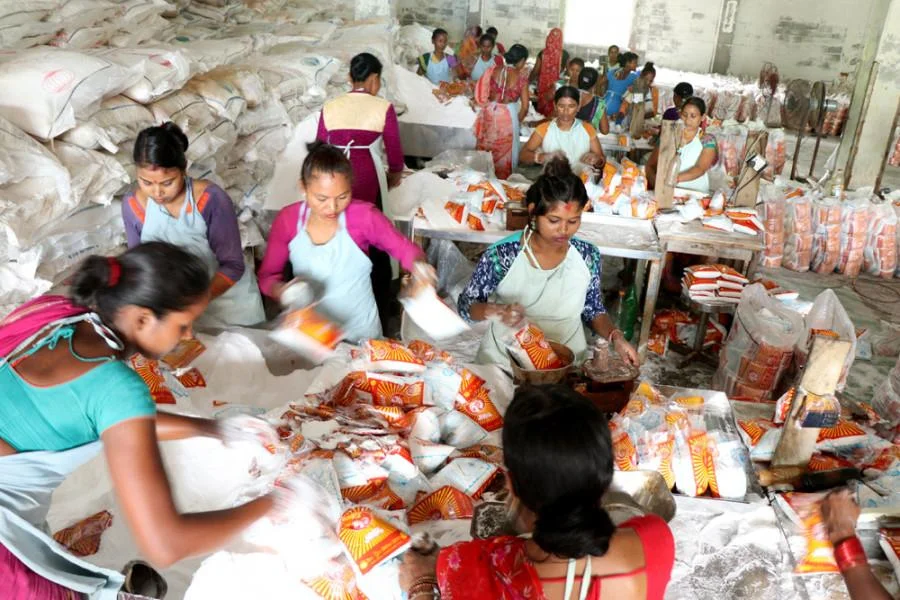
The decline was not one event. It was a sequence, and most of it happened within living memory.
- 1950 onward. China’s annexation of Tibet changed the political conditions of cross-border exchange.
- 1950s. New highways on the Tibetan plateau delivered Chinese grain to Tibetan nomads, reducing their need for Nepali rice.
- 1950s to 1960s. Roads and malaria control opened Nepal’s Terai. Cheap Indian sea salt reached hill markets, and prices for Tibetan salt collapsed.
- 1962. The Sino-Indian war disrupted the wider regional trade network.
- 1960s. Kora La in Mustang closed due to conflict and has since opened only for limited local trade.
- 1980s. Highway construction, including the Dadeldhura-Doti and Kohalpur-Banbasa roads, ended the lowland haat bazaars the caravans served. Community forestry rules from the same decade curtailed herders’ grazing rights along the routes.
One more factor is easy to overlook: iodine. Goitre and cretinism were widespread in Nepal’s hills, and iodized Indian salt was a genuine public health advance. Nostalgia for the caravans has to sit alongside that.
Helambu now
Helambu’s economy today runs on agriculture, apples, remittances from labor migration, and trekking. The Helambu trail is among the closest multi-day routes to Kathmandu, which has made guiding and lodge work significant sources of income. Many Yolmo work as guides in Helambu and elsewhere in Nepal. Circular migration between village and city, studied by Naomi Bishop in the 1990s, remains part of how households manage.
Religious life continues. Village gompas, lama lineages and ritual calendars are active, not preserved. Some practices are private or restricted, and this article does not describe them; if you visit, ask before entering a gompa, before photographing anything, and before attending a ceremony, and accept no as an answer.
For wider context on Nepal’s communities, see our guide to the ethnic groups of Nepal and the piece on how Nepal speaks 129 different languages. If you are walking the region, the Helambu Himalayan Trail trek guide covers the route itself.
Frequently Asked Questions
Who are the Yolmo people?
The Yolmo, or Hyolmo, are an Indigenous people of the Helambu and Melamchi valleys in Sindhupalchok District, with origins in the Kyirong valleys of southwestern Tibet. They speak Yolmo, a Tibeto-Burman language, and mainly follow Nyingma Buddhism.
Are Yolmo people the same as Sherpa?
No. Many Yolmo used the label “Helambu Sherpa” from the 1980s to align with the better-known Sherpa of Solukhumbu, and the name persists in some references, but Yolmo is a distinct community with its own language and history.
Did the Yolmo run salt caravans?
The published scholarship does not document a specifically Yolmo long-distance caravan trade. Yolmo families originate from Kyirong and live on a historic trade corridor, and they herd yak locally. Detailed caravan ethnography in Nepal concerns Humla, Dolpo, Mustang and Nubri communities.
What was traded on the Tibet-Nepal routes?
Tibetan salt and wool moved south. Rice, barley, buckwheat and other grain, plus manufactured goods from India, moved north.
Why did yaks only work on part of the route?
Yaks are adapted to cold and high altitude and do not cope with sustained heat or low elevations. Caravans handed loads over to dzo, sheep or goats for the descent toward the hills and Terai.
When did the Himalayan salt trade end?
It declined through the 1950s to the 1980s. Key factors were Chinese highways on the plateau, cheap iodized Indian salt reaching hill markets, the 1962 Sino-Indian war, road building in Nepal, and changes to grazing rights.
Can you still see caravans in Nepal?
Small-scale pack animal transport continues in parts of Humla, Dolpo and Mustang where roads are absent, but the long-distance salt-for-grain system as an economic institution has ended.
Is Helambu suitable for a short trek?
Yes. It is one of the nearest multi-day trekking regions to Kathmandu, with village lodges and ridge walking rather than high-altitude passes on the standard route.
Sources and further reading
Background on the routes and their decline draws on J. L. Ross’s 1983 study “Adaptation to a changing salt trade: the view from Humla”, held in the ICIMOD library, and on Chhakka Bahadur Lama’s reporting for Nepali Times on Karnali’s salt caravans. For Yolmo scholarship, the Hyolmo Heritage Project bibliography is the best starting point.
Explore more of Nepal’s living cultures with NepalVue, save this guide for your reading list, and share it with anyone who assumes the Himalaya’s trade history belongs to a single people.


