



Nepal’s protected areas are usually described as working. Rhino numbers are up, tiger numbers are up, and the park system is held out as a conservation success story. Underneath that, the grassland those animals eat is being replaced by plants they will not touch. Twenty-seven invasive alien plant species are recorded in Nepal, around 23 of them inside protected areas, and the damage they do is to forage rather than to animals directly.
Understanding invasive plants in Nepal’s national parks means understanding what grows back after the grass is gone.
The scale, as recorded
A systematic review by Dhungana, Yuangyai and Sinutok, published in the Journal of Ecology and Environment in 2024, pulled together what is known across Nepal’s protected area network.


Their headline counts: 27 invasive alien plant species in Nepal, about 23 of them present in protected areas. Of 20 protected areas assessed, 13 showed invasion and 7 did not.
| Protected area | Invasive alien plant species recorded |
|---|---|
| Koshi Tappu Wildlife Reserve | 17 |
| Chitwan National Park | 16 |
| Shuklaphanta National Park | 16 |
| Khaptad National Park | 2 |
Three species do most of the damage in terrestrial habitats, according to that review: Lantana camara, Mikania micrantha and Chromolaena odorata.
Worth noticing in the table above: the worst-affected reserves are the lowland wet ones. Khaptad, high and cold, has two. Invasion in Nepal is substantially a Terai and inner Terai problem, for now.
Mikania, the vine that eats grassland
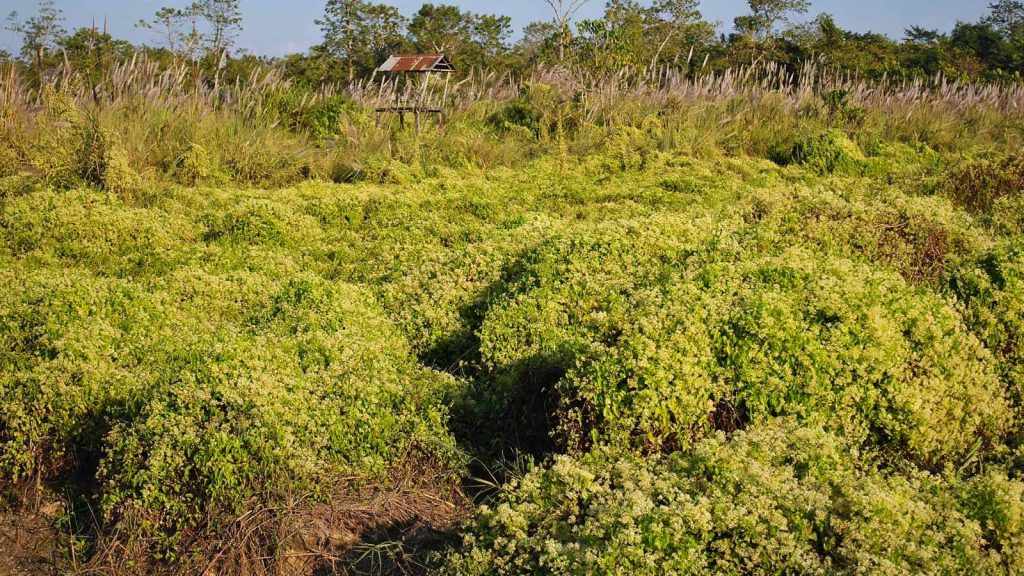
Mikania micrantha is a climbing vine in the daisy family. It does not poison anything or push anything over. It simply covers.
Growth is the whole story. Shoots can extend up to 27 millimeters in a day. A single plant can cover more than 25 square meters within months. Each plant releases roughly 40,000 seeds a year, and its stem nodes root wherever they touch ground.
Cast that over tall grassland and the mechanism is obvious. Grass underneath is shaded out, tree seedlings cannot get above the mat, and regeneration stops.
For the greater one-horned rhinoceros that matters directly, because tall grassland and riverine forest are exactly the habitats it depends on. Work by Murphy and colleagues, published in 2013 and cited in the 2024 review, found Mikania affecting about 44 percent of rhino habitat in Chitwan National Park.
When it arrived, and where the record disagrees
Sources do not agree on dates, and the disagreement is worth stating rather than smoothing over.
Mikania was first reported in eastern Nepal in the early 1960s. For Chitwan specifically, Nepali press reporting gives 1963 as the first record in the park, while reporting drawing on researchers at Arizona State University and CABI gives 1997, with coverage reaching roughly 20 percent of the park by 2010. Both figures circulate. No source reviewed here reconciles them.
How it reached Nepal is also unsettled. Proposed routes include arrival in shipping materials, spread from India on monsoon rains, and introduction to India after the Second World War to camouflage airfields. None is confirmed.
Is Mikania being beaten?
Possibly, in Chitwan, and the evidence is partial.
Nepali reporting in May 2021, drawing on the rhino census completed that April, put Mikania cover at about 35 percent of rhino habitats, down from the 44 percent figure, and described the plant as under control. Rhino numbers in that census were 694, up from 605 in 2015.
Read that carefully before celebrating. A drop from 44 to 35 percent is real and is still more than a third of the habitat. Rhino population growth over the same period is consistent with improved protection from poaching rather than with better forage, and the two cannot be separated from these figures alone.
Lantana, the problem that spreads west
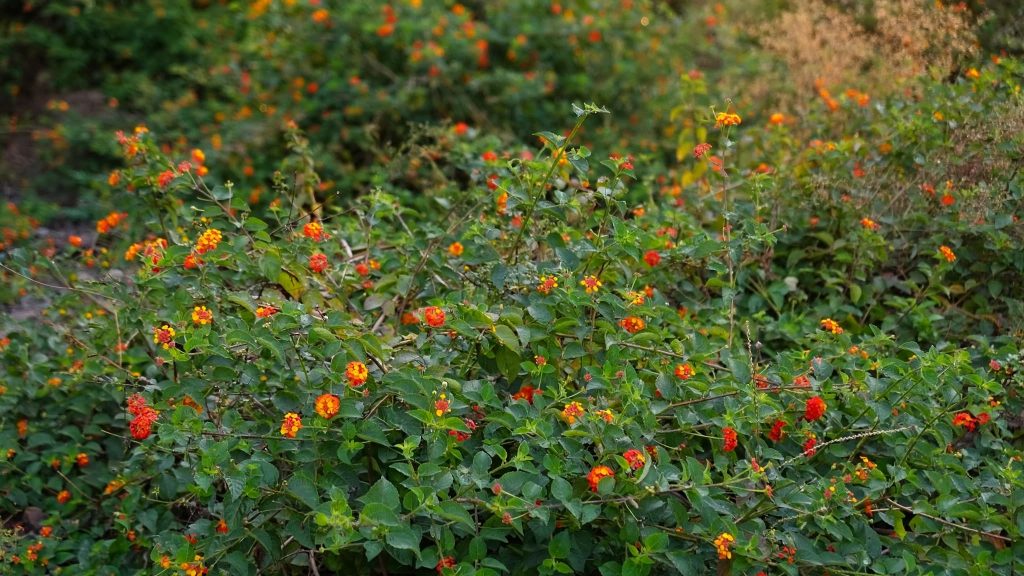
Lantana camara is a woody shrub, originally ornamental, and it behaves differently from Mikania. Rather than smothering from above, it establishes dense thorny thickets that displace ground flora and physically exclude grazing animals.
The 2024 review records its effects park by park. In Bardiya National Park, Lantana degrades habitat for elephant, rhinoceros, tiger and deer. In Parsa National Park it contributes to declining tree species and impairs tree regeneration. In Shivapuri Nagarjun National Park it threatens Saccharum spontaneum and Cynodon dactylon, both important grasses for herbivores. In Krishnasaar Conservation Area it threatens the palatable grasses blackbuck depend on.
Chromolaena odorata belongs in the same conversation. In Bardiya it threatens prime rhinoceros habitat, and across parks it is linked to declining ungulate populations.
One honest limitation runs through all of this. The review reports only a single quantified figure, the 44 percent for Mikania in Chitwan. Everything else is documented as presence and effect without cover or density measurements. Anyone citing precise Lantana coverage percentages for Nepali parks should be asked where the number came from.
Parthenium, and why the list keeps growing
Parthenium hysterophorus, sometimes called carrot grass, is the newer arrival. Nepali reporting in 2021 put it at roughly 5 to 7 percent of total rhino habitat in Chitwan.
Baburam Lamichhane, a conservation biologist and chief of the National Trust for Nature Conservation’s Biodiversity Conservation Centre at Sauraha, described uprooting as the only effective removal method while noting it is not feasible across large areas. His recommendation was to clear it without delay in animal habitats and grasslands, and to develop a separate plan for larger infestations.
Parthenium illustrates the structural problem. One invader comes under partial control and another establishes behind it, because the conditions that let the first one in have not changed.
Why parks are especially vulnerable
It seems backwards that protected areas should be worse affected than farmland. Several things explain it.
- Disturbance creates openings. Flood scouring, grazing and management burning all expose bare ground, which is where invasive species establish fastest.
- Rivers are highways. Lowland parks sit on floodplains, and seeds and stem fragments move downstream and across park boundaries without regard for management.
- Management is seasonal. Grassland burning and cutting follow an annual cycle, and a vine growing 27 millimeters a day does not.
- Boundaries are permeable. Invasion arrives from surrounding farmland, roadsides and settlements, so a park cannot solve the problem inside its own fence.
What control actually looks like
The 2024 review is sober about methods.
Mechanical control through uprooting, cutting, burning and ploughing is the main approach used in Nepal. Effectiveness is described as proven, and the review is equally clear that it is costly and that manual clearing is difficult across grassland at scale.
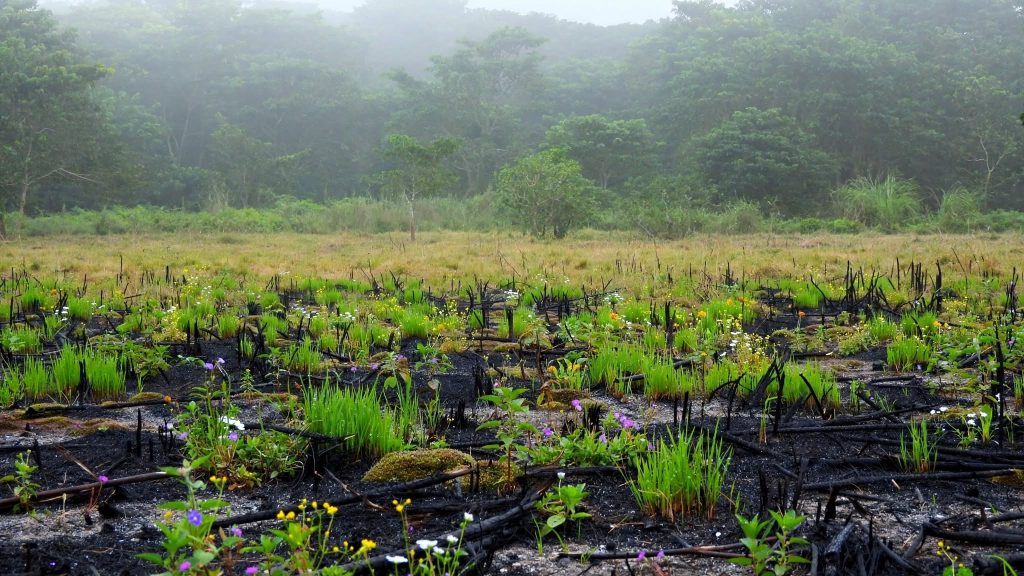
Controlled burning has evidence behind it. Work by Aryal and colleagues in 2018 found it reduced Mikania growth and promoted grasses in Chitwan’s grasslands. Uncontrolled burning and indiscriminate chopping, by contrast, can damage species composition and harm small mammals.
Biological control has been tried. The beetle Zygogramma bicolorata is reported to help against Parthenium, with field effectiveness described as marginal, and mass rearing and release are not yet implemented in Nepal.
Chemical control is constrained by cost and is practical only for high-value species over small areas. Spraying herbicide across rhino habitat is not a realistic option.
The review’s most useful observation is administrative rather than botanical: monitoring, follow-up and budgets are often lacking. Clearing done once and not repeated is clearing wasted, because these species regenerate from fragments and seed banks.
What this means for visitors
Most people walking or driving through Chitwan or Bardiya will not notice any of this. Invaded grassland still looks green.
If you want to see it, look at edges: track margins, riverbanks, the first few meters inside a forest boundary. A wall of vine over shrubs is Mikania. Dense thorny shrub with small clustered flowers is likely Lantana.
Practical courtesy helps marginally. Seeds travel on boots, tyres and clothing, so cleaning footwear between protected areas is a small real contribution. Background on these parks is in our Chitwan National Park guide, our Bardia safari guide, and our overview of Nepal’s tiger parks, with wider species context in the Nepal wildlife guide. Koshi Tappu, which carries the heaviest invasive load of any Nepali reserve, is covered in our Koshi Tappu guide.
Where the evidence is thin
Three gaps deserve naming.
Quantified cover data barely exists. One figure, for one species, in one park, is not a monitoring system, and national trend statements about invasive cover are not currently supportable.
Upslope movement under climate change is modeled rather than measured. Warming is expected to let lowland invaders establish higher, and the 2024 review notes possible consequences for habitat in Langtang National Park, including for red panda. How fast, and how far, is projection.
Effects on wildlife populations are inferred. Habitat degradation is documented and animal population responses are confounded by anti-poaching work, translocations and protection effort. Attributing a population change to forage loss alone is not something the available data supports.
Frequently asked questions
How many invasive plant species does Nepal have?
Twenty-seven invasive alien plant species are recorded nationally, with about 23 present inside protected areas, according to a 2024 systematic review in the Journal of Ecology and Environment.
Which Nepali park is worst affected?
By species count, Koshi Tappu Wildlife Reserve with 17, followed by Chitwan and Shuklaphanta with 16 each. Khaptad, at high elevation, has two.
Why does Mikania matter for rhinos?
It smothers tall grassland and riverine forest, the habitats greater one-horned rhinos depend on, suppressing grass growth and blocking tree regeneration. A 2013 study found it affecting about 44 percent of rhino habitat in Chitwan.
Is the Mikania problem getting better?
Partly, in Chitwan. Reporting tied to the 2021 rhino census put cover at about 35 percent of rhino habitats, down from 44 percent. That is still more than a third of the habitat, and rhino population growth over the same period is not clear evidence of better forage.
What is the difference between Lantana and Mikania?
Mikania is a fast-growing climbing vine that smothers vegetation from above. Lantana is a woody shrub that forms dense thorny thickets, displacing ground flora and excluding grazing animals.
Can these plants be eradicated?
Not realistically with current methods. Mechanical clearing works but is costly and hard to sustain at scale, biological control is at an early stage, and chemical control is impractical across large wildlife habitats. Management rather than eradication is the working goal.
How did they get to Nepal?
Routes are not confirmed. For Mikania, proposals include shipping materials, spread from India on monsoon rains, and wartime introduction to India for airfield camouflage. Lantana was originally introduced as an ornamental plant.
Will invasive species move into the mountains?
Possibly. Warming is expected to allow lowland invaders to establish at higher elevations, with Langtang National Park and red panda habitat flagged as examples. These are projections rather than measured changes.
Further reading
The main source here is Dhungana, Yuangyai and Sinutok’s systematic review of invasive alien plant species in Nepal’s protected areas (Journal of Ecology and Environment, 2024), alongside Nepali reporting on the spread of Parthenium in Chitwan.
NepalVue covers conservation as it is, not as a brochure. Save this one, pass it to anyone who thinks a protected area is automatically an intact one, and follow NepalVue for more on Nepal’s parks and the species inside them.


