



How do you reconstruct a city that left almost no buildings behind? For the Kathmandu Valley between roughly the fifth and eighth centuries CE, the answer is stone. Carved inscriptions on pillars, temple plinths, statue bases, and water conduits are the primary written record of the Lichhavi period, and they contain something unexpected. Alongside royal praise and religious dedications sit administrative details: land grants, tax arrangements, village councils, and above all, water. This article explains what the Lichhavi inscriptions actually say, how scholars date and read them, and what recent archaeology has added to the picture.
Who the Lichhavis Were
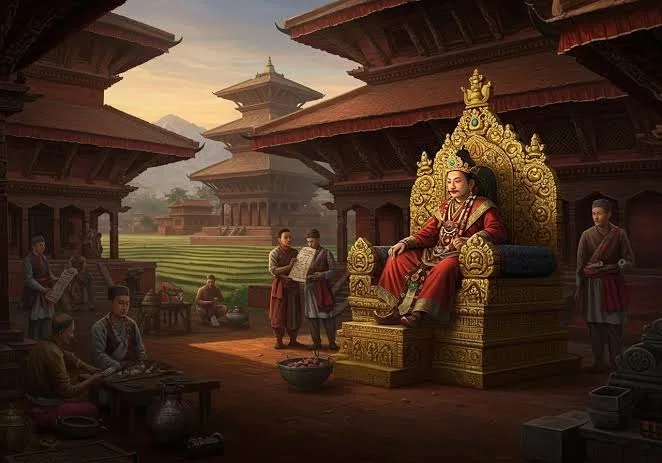
Lichhavi rule over the Kathmandu Valley is conventionally dated to roughly 450 to 750 CE, though the dynasty’s origins run earlier. Manadeva I, whose reign is usually placed from about 464 to 505 CE, is the first ruler documented by a securely dated inscription of his own. That record mentions three preceding rulers, which pushes the dynasty’s beginning back into the late fourth century.
Amshuvarma stands out as the other central figure. Serving first as a powerful minister, he took effective rule in the early seventh century, with his period conventionally placed from about 605 CE onward. Inscriptions from his time are notably rich in administrative detail.


Note the spelling here. “Lichhavi,” “Licchavi,” and “Lichchhavi” all appear in English-language scholarship for the same dynasty. Transliteration conventions differ, and no single form is uniquely correct.
The Corpus: How Many, and Where
Counts vary by source and by what is being counted. A commonly cited figure is more than 170 inscriptions securely assigned to the Lichhavi period, while surveys of all historical stone inscriptions across the Valley run into the hundreds across later periods as well.
Locations tell their own story. Lichhavi inscriptions appear at crossroads, at shrines, on the pedestals of deities, on water conduits, in alleys, and in open public spaces. They were not archives hidden in a palace. Placing a legal or administrative record in a public thoroughfare, in durable stone, was itself a governing act.
Handigaun, also written Hadigaon, in northeastern Kathmandu holds a particular concentration of these inscriptions, which is a major reason archaeologists have focused on it.
Dating and the Era Problem
Dates in these inscriptions are given in regnal or calendrical eras, not in a system modern readers can convert at a glance. Converting them is where much of the scholarly argument happens.
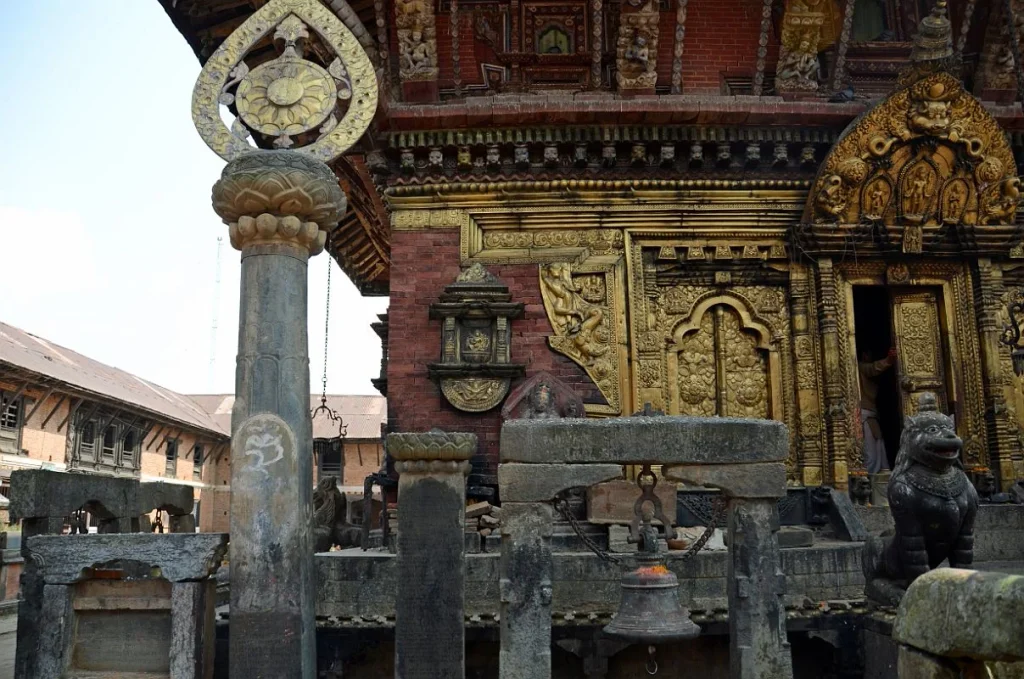
Consider the best-known case. A pillar inscription at Changu Narayan, long treated as the earliest dated Lichhavi record, bears the year 383, which is conventionally read as 464 CE. Then in 1992 a find at Maligaon complicated the picture: a statue pedestal inscription associated with Jaya Varma, dated by most readings to around 185 CE, roughly 280 years earlier than the Changu Narayan pillar.
Which era is in use determines the conversion. Scholars including Dinesh Chandra Regmi have proposed alternative era identifications for some records, producing different absolute dates. Treat any single conversion you read as one interpretation among several, unless the source states that the era is explicit in the stone.
Script and Language
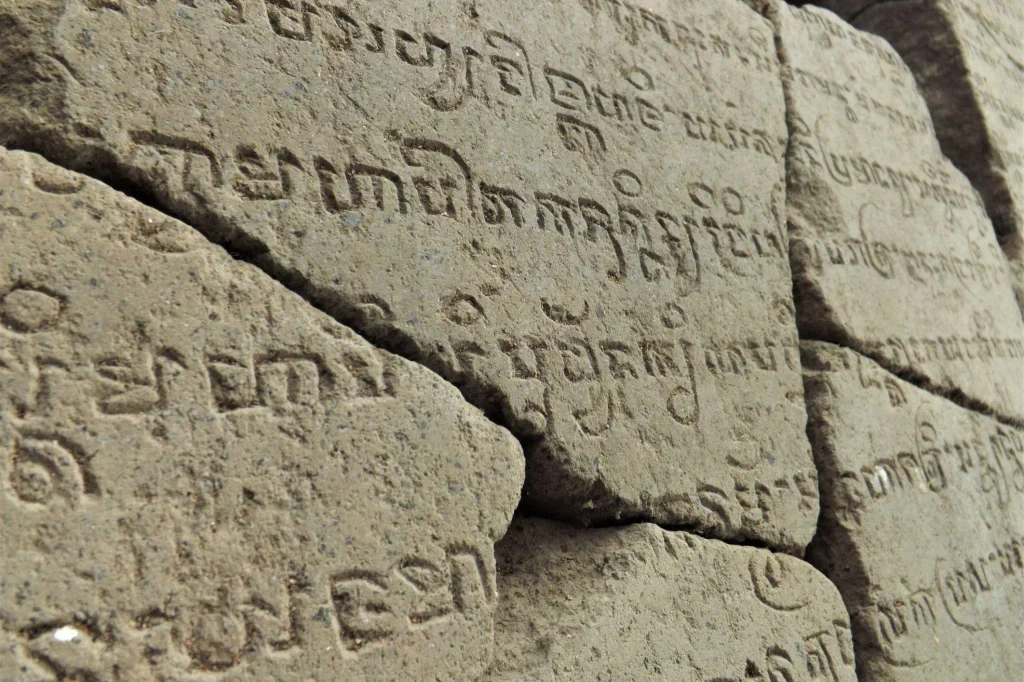
Early Lichhavi inscriptions are written in Sanskrit, carved in a script descended from the Gupta-period Brahmi of northern India. Paleographers distinguish an early Lichhavi script from a later one, and that distinction is itself a dating tool: letter forms evolve, and a record with no legible date can often still be placed within a range on script alone.
Something linguistically important shows up inside these Sanskrit texts. Place names, agricultural terms, measurements, and administrative titles appear that are not Sanskrit. They are early forms of local vocabulary, including terms recognizable in later Newar language records. Those embedded words are some of the earliest written evidence for the Valley’s indigenous languages.
Reading this evidence requires care. A Sanskrit inscription issued by a royal court tells you what that court recorded, not how most residents of the Valley spoke. Nepal’s linguistic landscape was already plural, as it remains today across the country’s many spoken languages.
What the Inscriptions Record About Governance
Strip away the opening verses of praise and a functioning administrative system appears.
- Territorial units. Settlement was organized into grama, villages, and dranga, larger units grouping villages together.
- Royal structure. A maharaja ruled with a prime minister responsible for military affairs, alongside other ministers.
- Land and taxation. Land was held by the royal family and nobles. The population supplied land taxes and labor obligations, including vishti, conscript labor owed to the state.
- Local bodies. Inscriptions reference village-level councils, indicating that administration was not purely top-down.
- Endowments. Grants established and maintained religious and public facilities, assigning specific revenues to their upkeep.
That last category links directly to urban infrastructure. An inscription recording a grant for the maintenance of a water conduit is simultaneously a religious act, a legal document, and a piece of municipal engineering policy.
Water: The Clearest Case of Early Urban Planning
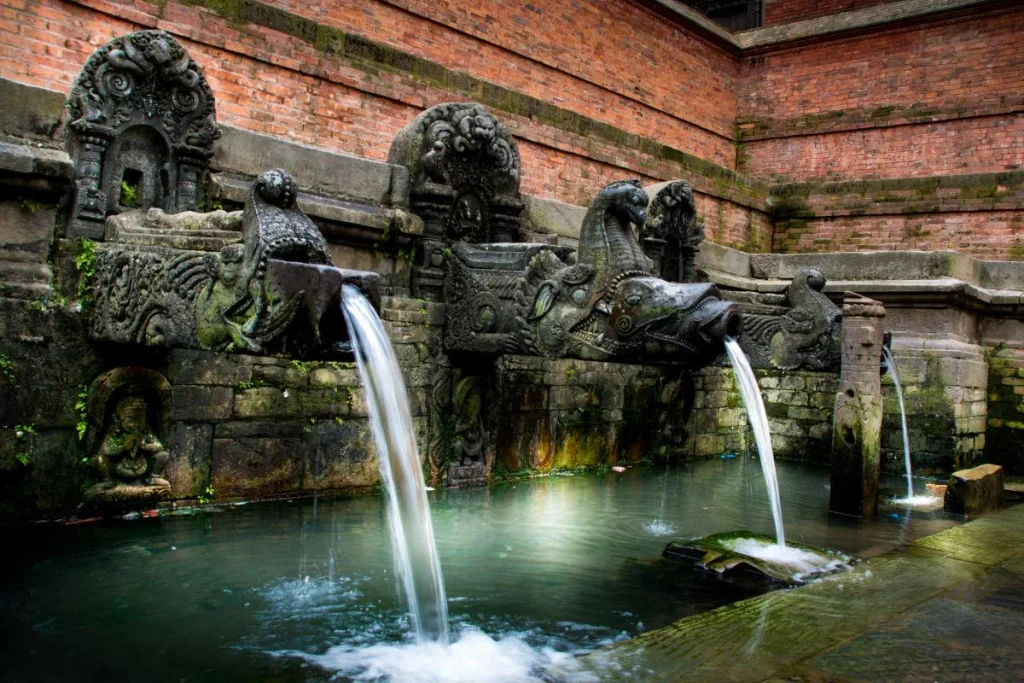
Nothing demonstrates Lichhavi-era planning better than the Valley’s stone water spout system, known as hiti in Newar and dhunge dhara in Nepali.
Origins of the system are placed in the Lichhavi kingdom, roughly 400 to 750 CE. The oldest spout still functioning is Manga Hiti at Mangal Bazar in Patan, dated to 570 CE by an inscription on stone at the site. Water has run there, with interruptions, for more than fourteen centuries.
How the System Works
Design is genuinely sophisticated, and it is a system rather than a set of isolated taps.
- Groundwater is gathered in an underground infiltration chamber, the navi mandal.
- Terracotta pipes, laid at depths of roughly one to five meters, carry water to the spout.
- Royal canals, rajkulo, bring water from distant sources to artificial ponds.
- Ponds recharge shallow aquifers, which is what keeps spouts flowing through the dry season.
- Before discharge, water passes a filtration arrangement using gravel, sand, charcoal, and in some cases lapsi, graded from coarse to fine.
Read that list again as a planning document. Recharge, conveyance, storage, filtration, and public distribution points placed within walking distance of households. Later Malla-period rulers extended and elaborated the network considerably, so the system visible today is cumulative rather than purely Lichhavi.
The System Today
A 2019 survey by the Kathmandu Valley Water Supply Management Board, published as Stone Spouts and Ponds of Kathmandu Valley, documented 573 dhunge dharas across ten municipalities. Of those, 94 were destroyed entirely. Among the 479 remaining, 224 produced water, together discharging roughly 2.4 million liters per day.
| Status | Number | Share of 573 |
|---|---|---|
| Documented stone spouts in the Valley | 573 | 100% |
| Destroyed entirely | 94 | About 16% |
| Surviving | 479 | About 84% |
| Producing water at survey | 224 | About 39% |
Pressures are well understood: groundwater extraction lowering the water table, urban construction severing recharge channels and buried conduits, contamination from sewage, and reduced discharge. Many surviving spouts now run seasonally rather than year-round. In 2022 the dhunge dharas were included on the World Monuments Watch by the World Monuments Fund.
Restoring a spout head without restoring its aquifer connection produces a monument rather than a water source. That distinction is the whole conservation argument in one sentence.
What Archaeology Has Added
Inscriptions tell you what people wrote down. Excavation tells you what they built, and the two do not always match neatly.
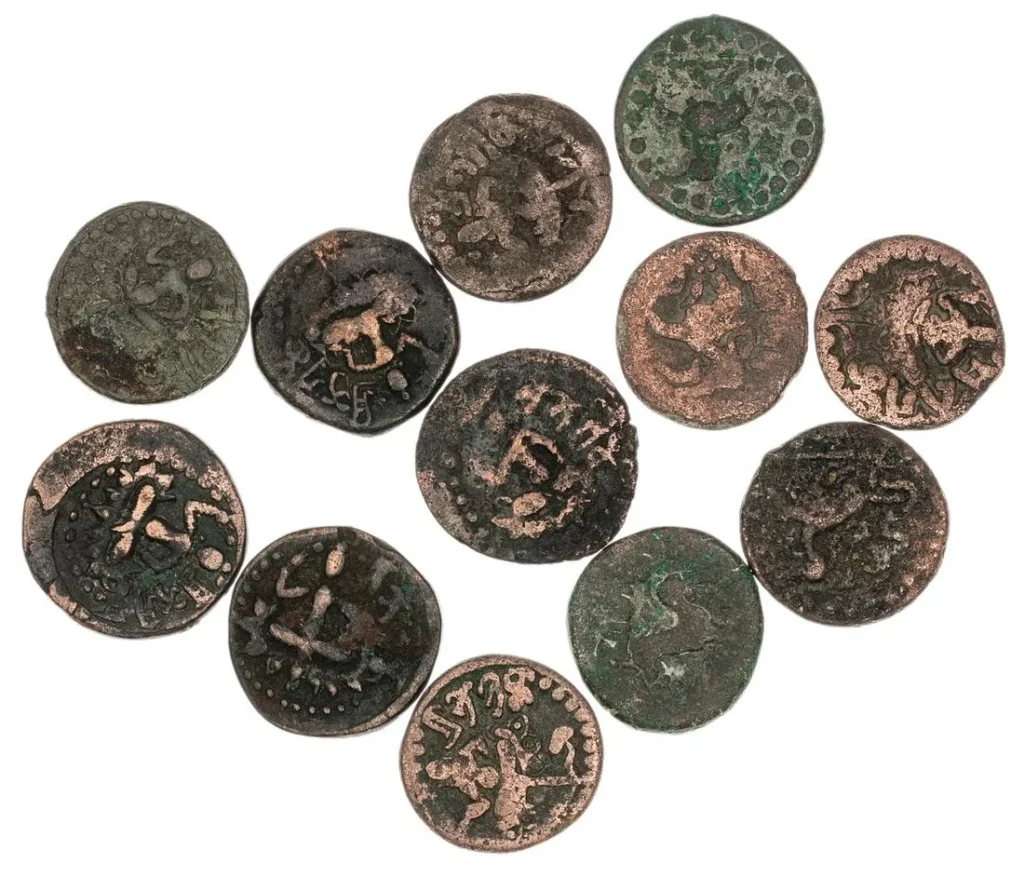
Joint Nepali and Italian excavations at Handigaun, directed from 1988 by Giovanni Verardi for the Istituto Italiano per il Medio ed Estremo Oriente in collaboration with Nepal’s Department of Archaeology, produced a large stratified assemblage. Reported finds include some 898 kilograms of ceramic material with 213 intact vessels, a Mathura-style sandstone fragment depicting Krishna, Buddhist material including a sealing with stupa imagery, and a water drain carrying a date corresponding to 4 March 749 CE together with the place name Andigrama. Results were published in 2024 as Harigaon Revisited.
Separately, a Durham University project on Kathmandu’s early urbanism, working with Nepal’s Department of Archaeology, the Pashupati Area Development Trust, ICOMOS Nepal, the University of Stirling, and the Austrian Academy of Sciences, combined geophysical survey, auger coring, and excavation. At Pashupati the team identified a monumental water tank measuring about 25 by 20 meters, with Lichhavi coins and pottery bearing Lichhavi script, and exposed brick structures dated to the eighth century CE. At Handigaun, ground-penetrating radar and magnetometry mapped buried brick wall footings and stone drains.
Buried drains and a monumental tank are the physical counterpart to inscriptions about water endowments. Two independent lines of evidence converging on the same conclusion is the strongest kind of argument available here.
What Remains Unresolved
Plenty. Kailashkut Bhawan, the palace attributed to Amshuvarma and described in later accounts, has not been securely located. Managriha, another named Lichhavi royal residence, is likewise unidentified on the ground. Extent and layout of the Lichhavi settlement at Handigaun are still debated.
Honest history writing about this period means holding those gaps open. A confident map of Lichhavi Kathmandu would be a reconstruction, not a finding.
Seeing the Evidence Yourself2
Several inscriptions remain in place and publicly visible. Changu Narayan, east of Bhaktapur on its ridge, holds the famous fifth-century pillar along with a dense concentration of early sculpture, and our guide to the sites at Changu Narayan covers what to look for. Handigaun in Kathmandu retains inscription stones among its lanes, though the archaeology lies beneath modern buildings.
Older settlements elsewhere in the Valley preserve the spatial logic that the Lichhavi and Malla periods established, including the hill town described in our Kirtipur neighborhood guide.
A practical note for visitors: inscription stones are often worn, lichen-covered, and unlabeled. Do not chalk, wet, or rub them. Those methods damage the surface and are no longer used in professional epigraphy.
Frequently Asked Questions
What are the Lichhavi inscriptions?
They are stone inscriptions carved in Sanskrit during the Lichhavi period in the Kathmandu Valley, roughly the fifth to eighth centuries CE. More than 170 are commonly attributed to the period. They record royal grants, religious dedications, administrative arrangements, and endowments for public infrastructure including water systems.
What is the oldest Lichhavi inscription?
The Changu Narayan pillar inscription, bearing the year 383 and conventionally read as 464 CE, was long regarded as the earliest dated record. A 1992 discovery at Maligaon associated with Jaya Varma is dated by most readings to around 185 CE, which would make it considerably older. Dating depends on which calendrical era is identified, and scholars differ.
What language and script were used?
Sanskrit, written in a script derived from Gupta-period Brahmi. Paleographers distinguish early from later Lichhavi letter forms, which helps date undated records. Non-Sanskrit local vocabulary appears embedded in the texts, giving early evidence for the Valley’s indigenous languages.
What do the inscriptions reveal about city planning?
Mostly through water and administration. They record grants maintaining water conduits, define territorial units such as grama and dranga, reference village councils, and set out taxation and labor obligations. Placement of inscriptions in public spaces was itself an administrative practice.
How old is Kathmandu’s stone spout system?
Origins trace to the Lichhavi period, roughly 400 to 750 CE. Manga Hiti in Patan, dated by an inscription to 570 CE, is the oldest still functioning. Malla-period rulers later extended the network substantially, so what survives is cumulative.
How many stone spouts still work?
A 2019 Kathmandu Valley Water Supply Management Board survey documented 573 spouts, with 94 destroyed. Of the 479 remaining, 224 produced water, discharging around 2.4 million liters daily. Many of those now flow seasonally rather than year-round.
Has archaeology confirmed what the inscriptions say?
Partly. Excavation and geophysical survey at Pashupati and Handigaun have found Lichhavi coins, pottery with Lichhavi script, buried brick wall footings, stone drains, eighth-century brick structures, and a monumental water tank. Those findings support the inscriptions on water infrastructure. Major sites named in texts, including Kailashkut Bhawan and Managriha, remain unlocated.
Where can I see Lichhavi inscriptions today?
Changu Narayan holds the best-known early pillar inscription in situ. Handigaun in Kathmandu retains inscription stones among its streets. Many others sit at temple plinths, statue bases, and hiti courtyards across Kathmandu, Patan, and Bhaktapur, often unlabeled and heavily weathered.
Further reading from the sources used here: Durham University’s Kathmandu Early Urbanism project and Nepali Times on the Handigaon excavations.
NepalVue covers Nepal’s history with the evidence attached. Save this guide for your next walk through the old quarters, share it with anyone who thinks Kathmandu’s heritage begins with the Mallas, and follow NepalVue for more from the Valley.


