


Nepal’s 2021 census counted 142 caste and ethnic groups speaking more than 120 languages. Dashain is often described as the festival all of them share. That description is convenient for travel writing and wrong in practice. Across the country, Dashain in different regions of Nepal runs on different calendars, different rituals, and in several communities it is not the main festival of the year at all. Understanding that variation changes how you read what you see during October, and it keeps you from assuming that one household’s practice speaks for the whole country.
What Dashain Is, Before the Variation
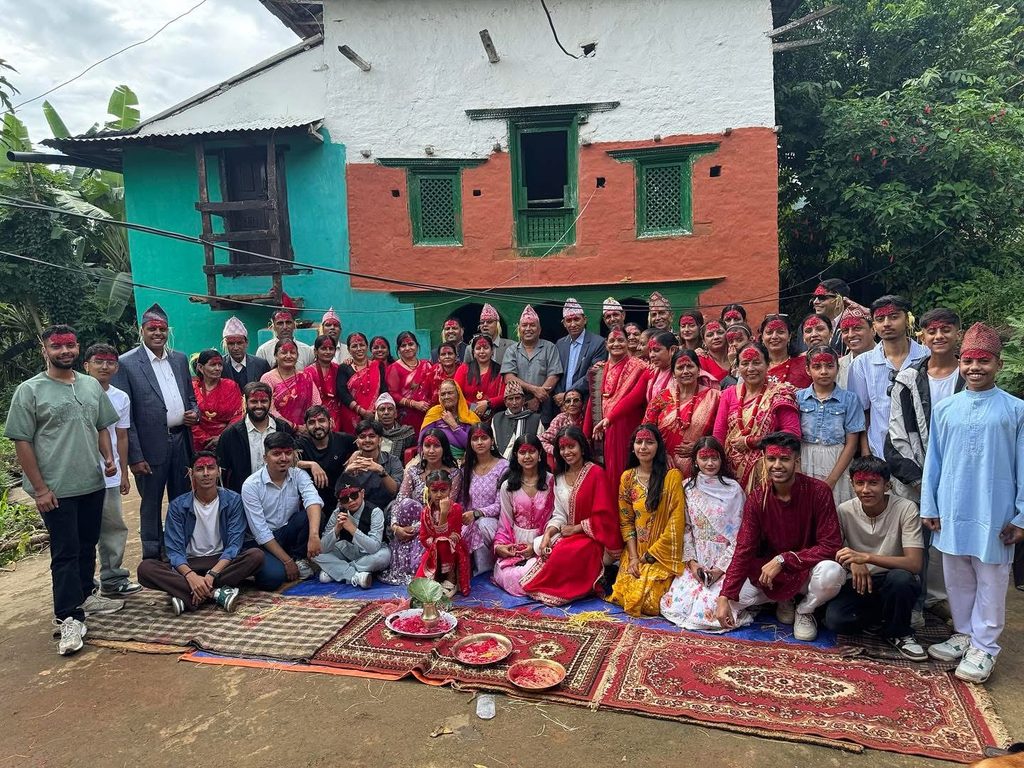
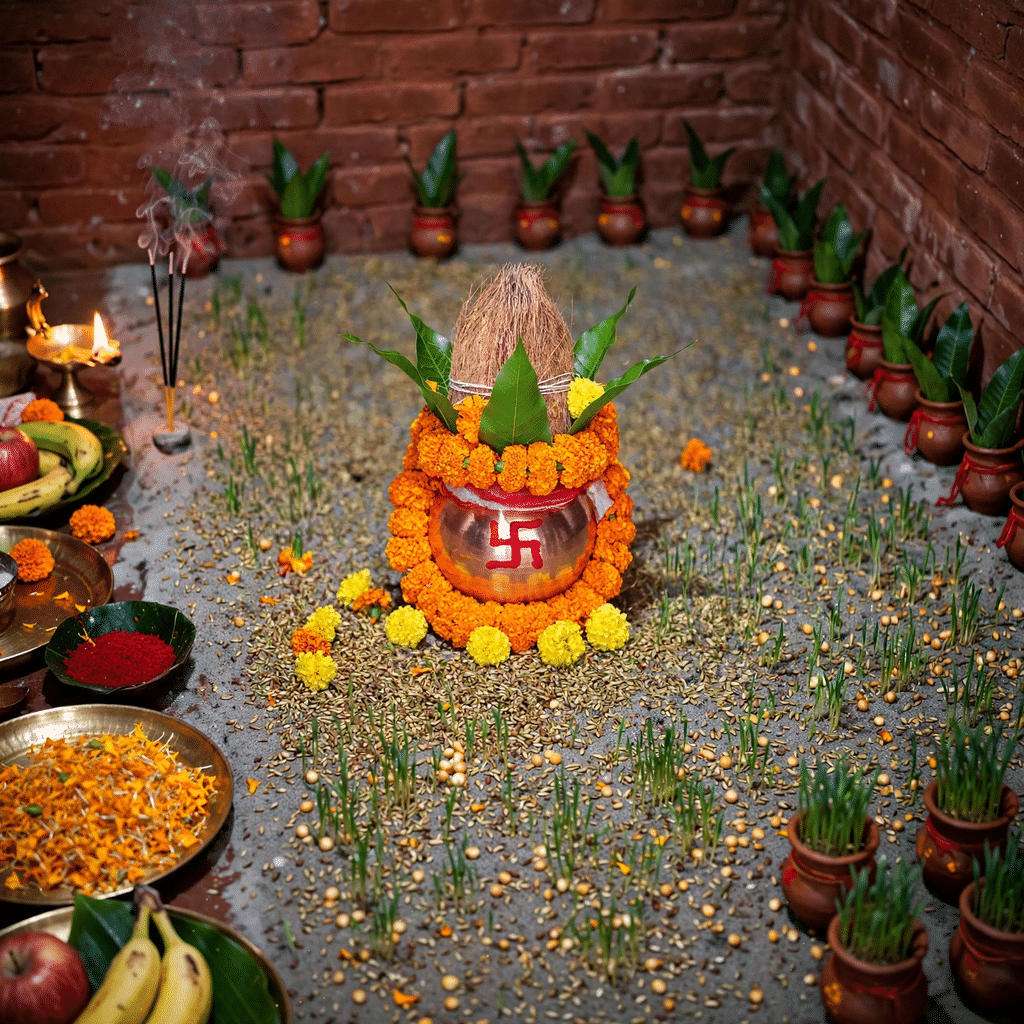
In broad terms, Dashain is a fifteen-day observance in the lunar month of Ashwin. It begins with Ghatasthapana, when barley seeds are sown in a dark room to grow into the pale yellow jamara. Nine nights of Durga worship follow. On the tenth day, Vijaya Dashami, elders place tika and jamara on younger family members and give blessings, and often cash.
For 2026, corresponding to Bikram Sambat 2083, Ghatasthapana falls on Sunday, October 11. Vijaya Dashami falls on Wednesday, October 21, with the auspicious tika moment calculated for late morning. Kojagrat Purnima closes the period on Sunday, October 25.


Those dates are the fixed frame. Almost everything inside the frame varies.
Kathmandu Valley: Dashain and Mohani Are Not the Same Thing
Visitors in the Valley during October usually assume they are watching Dashain. Among Newar families they are often watching Mohani, which overlaps the same fifteen days but follows its own internal logic.
Mohani keeps its own named days. Kuchhi Bhwe, on the eighth day, is a household feast built around measured portions of beaten rice served to everyone present. On the ninth day, Syako Tyako, families worship their tools, workshops and vehicles. Blessings on the tenth day use mohani, a dark tika, alongside the jamara, rather than the red rice-and-vermilion tika most travelers picture.
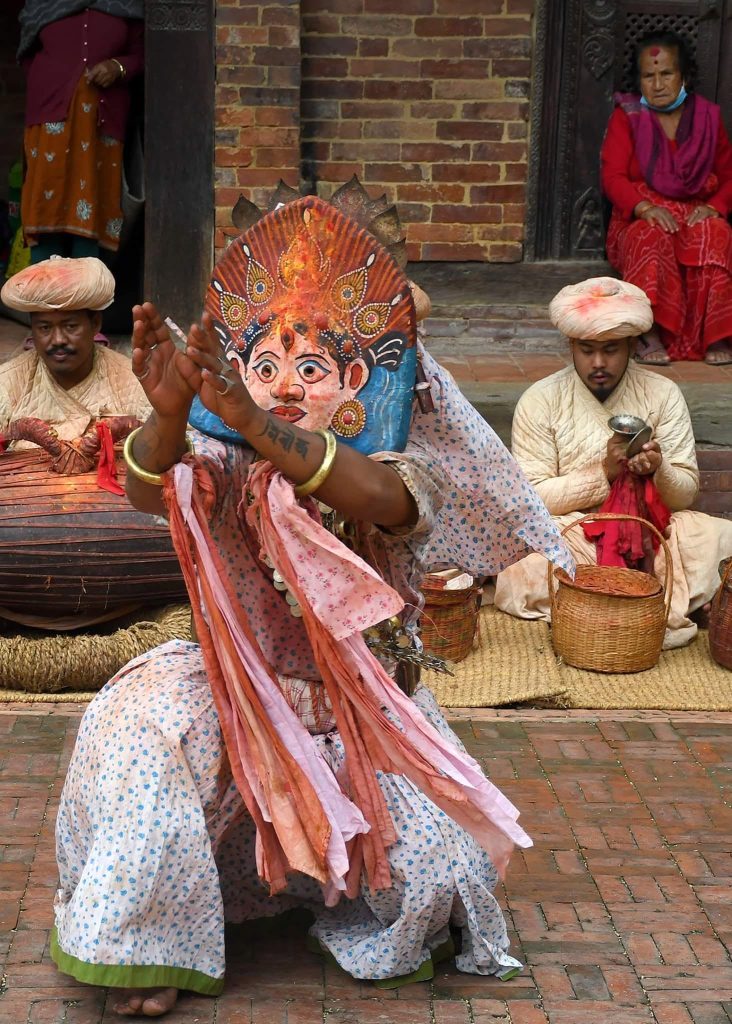
Public ritual in the Valley is also denser than elsewhere. Bhaktapur holds Khadga Jatra, a sword procession, with families ritually cutting vegetables in place of animals in many households. Patan performs the Astamatrika masked dances. Kathmandu’s Pachali Bhairab observance is carried by the Jyapu farming community. Taleju Temple, closed to the general public for most of the year, opens for a single day during this period, and the queue starts long before dawn.
Practical consequence for a traveler: in the Valley, Dashain is visible in public space. Elsewhere in the country it mostly is not.
The Western and Central Hills: Household Scale, Long Journeys
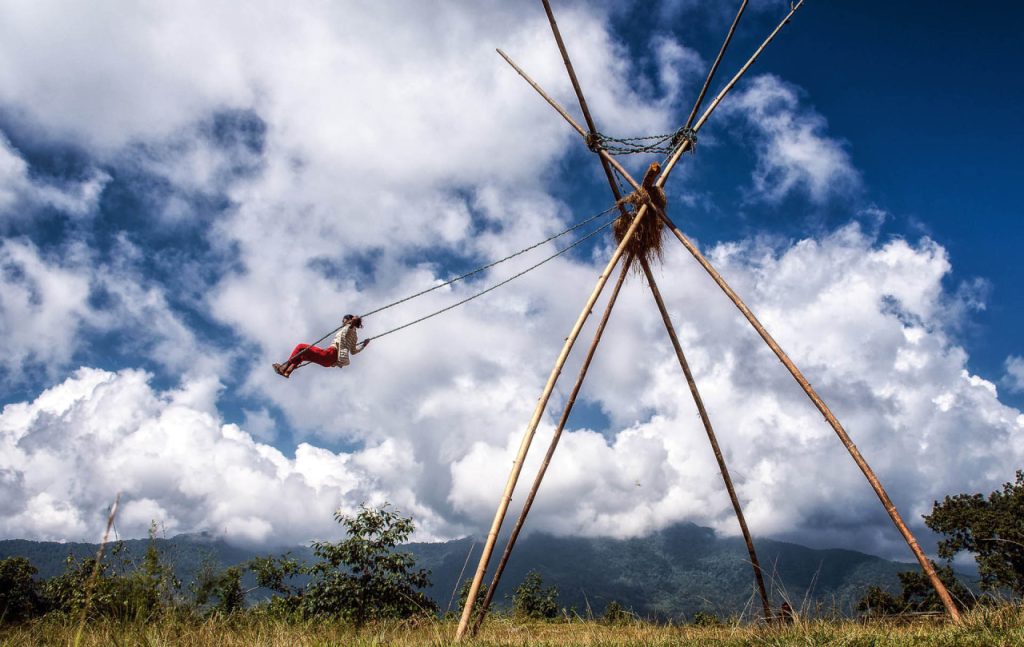
Across the middle hills, from Gorkha and Lamjung west into Palpa and Baglung, Dashain is primarily domestic. Homes get replastered with red clay. Bamboo swings called ping go up at village crossroads, usually built by younger men and left standing until Tihar. Kites appear over ridgetops.
Magar and Gurung households in these districts widely observe Dashain, though the emphasis differs. In many Gurung families, Dashain is recognized but Tamu Lhosar in late December carries more weight as the community’s own new year. Traditions vary by household, and a family in Pokhara may keep both fully while relatives in a Manang village keep one lightly.
Travel is the defining feature here. Long-distance buses fill weeks in advance, and highway traffic from Kathmandu toward the hills peaks in the three or four days before tika. Roads that were already rough after monsoon do not get better under that load.
The Eastern Hills: Kirat Communities and a Different Calendar
Among Rai, Limbu and other Kirat communities in Nepal’s eastern hills, the religious center of the year sits elsewhere. Kirat Mundhum tradition organizes the calendar around Ubhauli in spring and Udhauli in late autumn, marked with Sakela dances. Limbu households additionally observe Chasok Tangnam, a harvest thanksgiving.
Practice is genuinely mixed. Many Kirat families observe Dashain as a family holiday and accept tika, particularly where households are mixed or where working life runs on the national holiday calendar. Others decline tika deliberately, treating it as a Hindu observance rather than their own, and some community organizations have campaigned on that point for decades. Neither position is a deviation from a norm. Both are ordinary in eastern Nepal.
If you are in Dharan, Ilam or Dhankuta in October, expect offices closed and a quieter town, but do not expect every household to be doing the same thing.
Himalayan and Predominantly Buddhist Communities
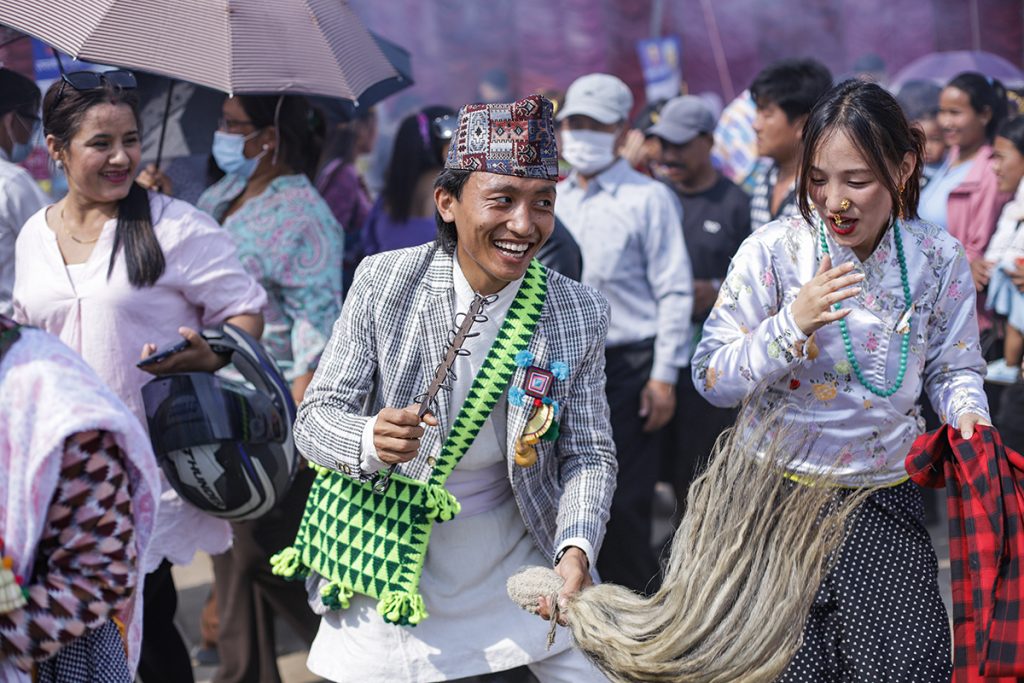
In Solukhumbu, Mustang, Dolpo, Manang and much of the high north, Dashain registers mainly as a national holiday rather than a religious event. Sherpa, Thakali, Lopa and other Himalayan communities of Tibetan Buddhist heritage organize their year around Losar, monastery festivals such as Mani Rimdu, and agricultural markers tied to altitude.
Animal sacrifice, which appears in some Dashain observance in the hills and Terai, sits in direct tension with Buddhist practice, and in many high villages you will not see it during this period.
Trekkers notice Dashain in these regions mostly through logistics. Domestic flights book out, Kathmandu offices close, permit counters run on holiday hours, and lodge staff who come from the hills go home. Trails themselves are busy, because October is peak season regardless of the festival.
The Terai: Weight Shifts to Other Festivals
In the Terai, Dashain is observed widely but competes with festivals that carry more local meaning. Among Madhesi communities in Madhesh Province and the eastern plains, Chhath in November is frequently described as the most important observance of the year, involving far more preparation and community mobilization than Dashain. Jitiya, observed by mothers in late September, matters enormously in Maithili households and barely registers in the hills.
Tharu communities across the western and central Terai present a clearer case. Maghi, at the start of Magh in mid-January, functions as the Tharu new year, and for many Tharu families it is the year’s principal festival: the time for family gatherings, community decisions, and in some areas the renegotiation of labor arrangements. Dashain is often marked, sometimes lightly, sometimes fully, and its weight varies by district and by household.
Presenting Maghi as a smaller regional version of Dashain gets this backwards. Two calendars exist side by side, and in Tharu villages one of them is simply more central.
A Practical Comparison
| Region or community | How Dashain is observed | What often matters more | What a visitor is likely to see |
|---|---|---|---|
| Newar households, Kathmandu Valley | As Mohani, with its own named days and dark tika | Mohani itself, plus the Valley’s jatra calendar | Masked dances, sword processions, Taleju open one day |
| Central and western hills (Bahun, Chhetri, Magar, many Gurung) | Fully, as the year’s main family festival | For some Gurung families, Tamu Lhosar | Swings, kites, packed buses, quiet towns, closed shops |
| Eastern hills (Rai, Limbu and other Kirat) | Mixed: some observe fully, some decline tika | Ubhauli, Udhauli, Sakela, Chasok Tangnam | Holiday closures, variable household practice |
| Himalayan Buddhist communities | Largely as a public holiday, not a religious event | Losar, monastery festivals, harvest markers | Normal trekking season, closed government offices |
| Madhesi communities, Terai | Observed, but not the peak of the year | Chhath, Jitiya, Sama Chakeva | Moderate closures, far bigger activity in November |
| Tharu communities, Terai | Varies widely by household and district | Maghi in mid-January as the community new year | Quieter Dashain than hill towns of similar size |
Animal Sacrifice: Where It Happens and Where It Does Not
Sacrifice on Maha Ashtami and Maha Navami is real in parts of Nepal and absent in others. Some Hindu households in the hills and Terai sacrifice goats, ducks or buffalo at home or at a temple. Many others substitute coconuts, pumpkins, cucumbers or sugarcane, and that substitution is a long-standing practice rather than a modern compromise. Several major temples have reduced or restricted sacrifice in recent years, and a number of families now avoid it entirely.
Buddhist Himalayan communities generally do not participate. Newar Mohani includes ritual cutting in some lineages and vegetable substitution in others.
If you would find it distressing, avoid temple courtyards on Ashtami and Navami morning, October 18 and 20 in 2026. If you happen on it, do not photograph it without permission. Treating someone’s worship as a shock image is the fastest way to give offense.
How Regional Difference Affects Your Trip
- Public visibility is highest in the Kathmandu Valley. If you want to see ritual rather than infer it, the Valley is where Dashain happens outdoors.
- Hill towns empty out and then fill up. Residents leave cities for ancestral homes, so Kathmandu thins while Gorkha, Palpa and Baglung swell.
- Terai districts run closer to normal during Dashain than hill districts of similar size, and then slow markedly during Chhath in November.
- Trekking regions are busy regardless, but offices, banks and permit counters keep holiday hours nationwide.
- Do not assume your guide celebrates. Ask rather than congratulate. A Sherpa guide and a Bahun guide are having very different weeks.
For the practical closure picture, our guide to what Dashain involves day by day covers the shared structure, and our piece on Nepal’s ethnic groups gives useful background on who lives where. For a Terai counterpoint in the same season, see our coverage of Jitiya.
Language That Travels Well
Small phrasing choices matter. Saying “Happy Dashain” to someone who does not observe it is harmless but slightly off. Asking “do you celebrate Dashain?” works everywhere and invites a real answer.
Avoid describing any of these practices as more or less authentic. A Tharu household keeping Maghi as its main festival is not holding a lesser version of Nepali culture. Neither is a Limbu family that declines tika, nor a Sherpa village where the month passes with no ritual at all.
Frequently Asked Questions
Do all Nepalis celebrate Dashain?
No. Dashain is the most widely observed festival in Nepal and a national holiday, but observance varies. Many Himalayan Buddhist communities treat it mainly as a holiday, some Kirat households decline tika on religious grounds, and in several Tharu and Madhesi communities other festivals carry more weight.
When is Dashain in 2026?
Ghatasthapana falls on October 11, 2026, and Vijaya Dashami, the tika day, falls on October 21, 2026. Kojagrat Purnima closes the period on October 25. Dates are set by the lunar calendar and shift each year, so always confirm against a current Nepali calendar.
What is Mohani and how is it different from Dashain?
Mohani is the Newar observance that runs alongside Dashain in the Kathmandu Valley. It shares the fifteen-day frame but has its own named days, its own feasts, a dark tika rather than red, and a dense schedule of public dances and processions.
Is Dashain a good or bad time to visit Nepal?
Weather in October is among the best of the year, which is why it is peak trekking season. Offset that against closed government offices, reduced bank services, crowded long-distance transport, and some family-run businesses shutting for several days. Book domestic flights and intercity buses well ahead.
Can visitors take part in tika?
If a household invites you, yes, and the invitation is usually sincere. Accepting tika means sitting before an elder, receiving rice and vermilion on your forehead and jamara behind your ear, and letting it stay there. Declining politely is also fine if you would rather not, and a quiet explanation is enough.
Will I see animal sacrifice?
Possibly, mainly on Maha Ashtami and Maha Navami and mainly in Hindu households and temple precincts in the hills and Terai. Many families substitute vegetables or fruit instead, and Buddhist Himalayan communities generally do not participate. Avoid temple courtyards on those mornings if it would upset you.
Which region is best for seeing Dashain as a traveler?
Bhaktapur, Patan and Kathmandu offer the most public ritual, because Newar Mohani plays out in courtyards and streets. In the hills, Dashain happens inside homes, so what you see there is village life at rest rather than ceremony.
Does Dashain shut the whole country down?
Not uniformly. Government offices and banks close for several days around tika, and closures are heaviest in hill districts. Tourist-facing businesses in Thamel, Pokhara and trekking areas generally stay open. Terai towns typically run closer to normal.
Before You Go
Nepal’s festival calendar rewards travelers who arrive with questions instead of expectations. Read the Nepal Tourism Board’s festival information for national-level dates, then ask locally about what actually happens where you are standing.
NepalVue publishes regional guides across all seven provinces, not just the Valley and the trekking corridors. Save this guide for your October planning, share it with anyone traveling in festival season, and explore more of our cultural coverage as you build your route.