


Research on Himalayan trekkers keeps producing a result that surprises people: age is not the altitude risk factor most travelers assume it is. One review in Age and Ageing concluded that older people are no more susceptible to acute mountain sickness than younger ones, and that increasing age was associated with less severe symptoms. If you are weighing a Nepal trek in your fifties, sixties, or beyond, that finding matters. It shifts the real question away from whether you are too old, and toward pacing, route choice, recovery time, and honest medical preparation. Here is what actually changes after 50, which routes suit which bodies, and where older trekkers genuinely do need to plan differently.
What the Research Says About Age and Altitude
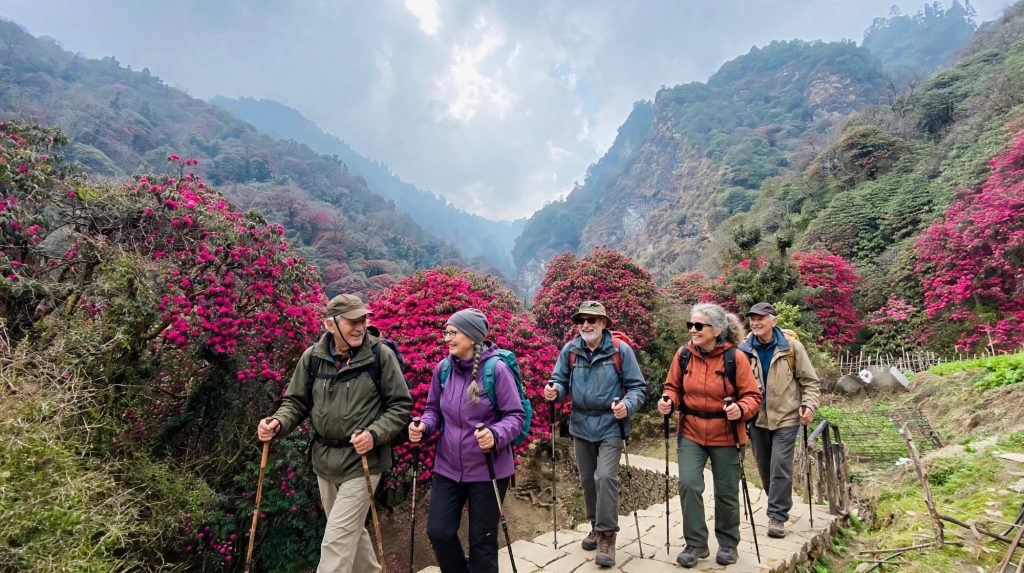
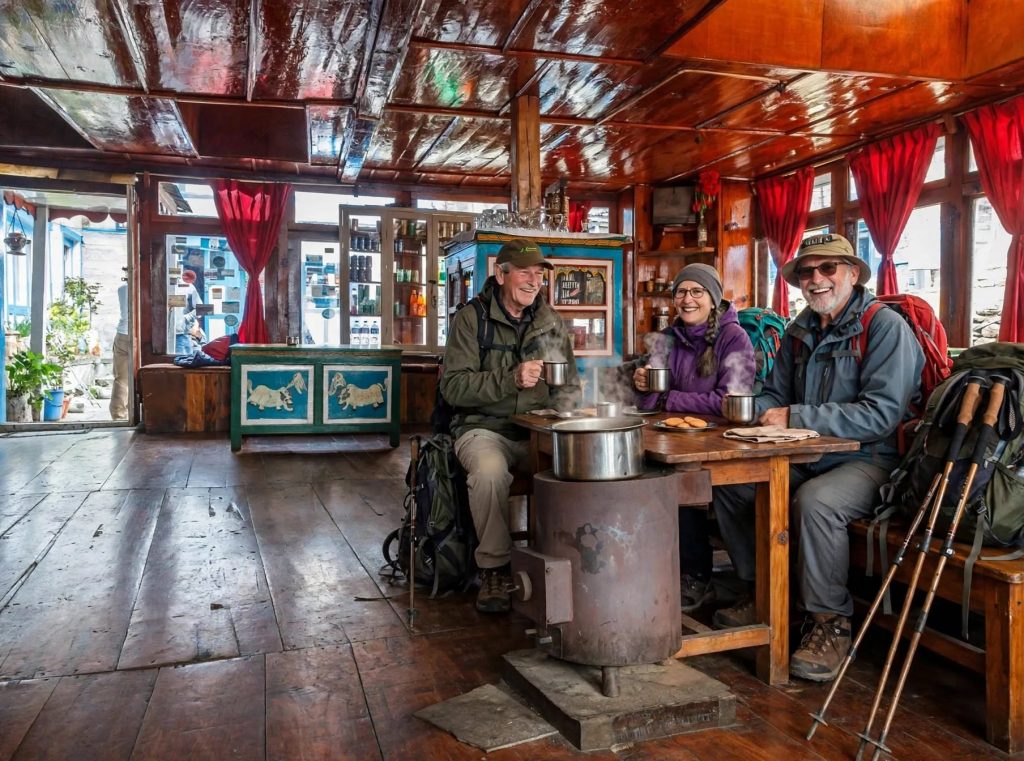
Trekking Nepal over 50 is common enough that it barely registers as unusual on the main trails. Teahouses in Ghorepani and Namche see trekkers in their sixties and seventies every season.
Evidence on altitude and age is reasonably consistent. Several studies of trekkers in the Nepali Himalaya have found no increase in acute mountain sickness, or AMS, with older age. Some found the opposite. Researchers writing in Age and Ageing noted that older people had more pre-existing conditions, yet still showed lower AMS risk than younger trekkers.


Why that happens is not fully settled. One suggestion is behavioral rather than physiological: older trekkers tend to ascend more slowly and push less hard. Younger trekkers more often race a schedule.
Caution is still warranted. Those same researchers flagged that rapid ascent and heavy exertion hit older bodies harder, because maximum oxygen uptake and muscle mass both decline with age. Altitude tolerance may hold up. Recovery capacity does not.
What Genuinely Changes After 50
Altitude is the thing people worry about. It is rarely the thing that ends a trek.
Descent, Not Ascent, Breaks People
Nepali trails are built from stone staircases, not gentle switchbacks. A day losing 1,200 meters into a river valley can mean three hours of continuous downhill stepping. Knees, hips, and quadriceps take that load, and older joints complain first.
Most experienced trekkers over 50 use two trekking poles for exactly this reason. Poles move a meaningful share of the impact into the arms and shoulders. Buy them before you arrive, or rent decent ones in Thamel or Pokhara.
Recovery Between Days
A hard day at 25 may need one night of sleep. At 60 it may need two. Multi-day itineraries that string together six consecutive long days suit younger legs. Building in rest days, or choosing shorter walking days, usually matters more than total trek length.
Sleep Quality at Altitude
Periodic breathing at altitude disturbs sleep for almost everyone, and sleep already fragments with age. Expect poor nights above 3,500 meters. Plan lighter days after them.
Medication and Conditions
Many travelers over 50 take something regularly: blood pressure medication, anticoagulants, diabetes medication, inhalers. None of these automatically rule out trekking. All of them are reasons to see a doctor who understands altitude medicine before booking. Bring more than you need, split across two bags, with a copy of your prescriptions.
Choosing a Route That Fits
Route choice does more for an older trekker than any amount of training. Maximum altitude, daily distance, and the availability of an exit matter more than the famous name on the itinerary.
| Route | Highest point | Typical days | Why it suits older trekkers |
|---|---|---|---|
| Ghorepani and Poon Hill | About 3,210 m | 4 to 6 | Low altitude ceiling, dense teahouses, short days, easy exit to Pokhara |
| Ghandruk and Australian Camp | About 2,060 m | 2 to 4 | Minimal altitude concern, strong cultural interest, road access near both ends |
| Langtang Valley | About 3,870 m at Kyanjin Gompa | 7 to 9 | Gradual profile, one valley in and out, no high pass |
| Mardi Himal | About 4,500 m at View Point | 5 to 7 | Flexible turnaround, you can stop at Low Camp or High Camp |
| Everest Base Camp | About 5,364 m | 12 to 14 | Demanding, but helicopter evacuation and clinics are closest here |
| Annapurna Circuit | About 5,416 m at Thorong La | 12 to 16 | Long, with a committing pass day and limited bail-out above Manang |
Altitudes above are standard published figures. Day counts vary by operator and pace, so treat them as a planning range rather than a fixed schedule.
The Underrated Option: Go Lower, Stay Longer
Here is where many people over 50 get the decision backwards. They pick the highest trek their fitness allows, then spend the whole walk managing risk. A lower route walked comfortably usually produces a better trip than a high route survived.
Ghandruk, Dhampus, and the villages of the middle hills sit between roughly 1,600 and 2,100 meters. Altitude is a non-issue there. Culture, food, and mountain views are not diminished. Our guide to Ghandruk and Gurung village life covers what that kind of walking actually looks like.
If you want the famous names, read our comparison of Annapurna versus Everest Base Camp before committing. Both are achievable after 50. They demand different things.
Pacing: The Variable You Control
Ascent rate is the single strongest predictor of altitude illness. Standard guidance above 3,000 meters is to raise your sleeping altitude by no more than 300 to 500 meters per night, with a rest day roughly every 1,000 meters.
Older trekkers benefit from treating that as a floor, not a target. Adding one or two extra nights to a standard itinerary costs little. Teahouse accommodation is inexpensive, and an extra acclimatization night is far cheaper than an evacuation.
Walk slowly enough to hold a conversation. If you cannot speak in full sentences, you are going too fast for the altitude, regardless of how fit you are at sea level.
Recognizing Trouble
Headache, nausea, dizziness, and unusual fatigue are the common early signs of AMS. Any of them means stop ascending. Worsening symptoms, breathlessness at rest, confusion, or an unsteady walk mean descend immediately, at night if necessary.
Descent is the treatment. Nothing else reliably substitutes for it. Discuss preventive medication with your own doctor rather than relying on advice from other trekkers on the trail.
Permits, Guides, and the Current Rules
Nepal requires permits for its trekking regions, and the rules have tightened in recent years. For most routes you need a conservation area or national park entry permit, plus a TIMS card or an equivalent local permit.
As of the 2026 season, published rates put the TIMS card at NPR 2,000 for foreign trekkers and NPR 1,000 for SAARC nationals, with Annapurna Conservation Area, Sagarmatha National Park, and Langtang National Park entry each around NPR 3,000. Local municipal fees apply in parts of the Everest region. Figures do change between seasons, and some sources disagree on the Khumbu local fee, so confirm current rates with your agency or the Nepal Tourism Board before you travel.
Since 2023, foreign trekkers on Nepal’s main trekking regions have been required to walk with a licensed guide arranged through a registered agency rather than fully independently. Enforcement varies in practice by checkpoint and region. Our full permits guide goes through the paperwork region by region.
For trekkers over 50 the guide requirement is less of an imposition than it sounds. A good guide adjusts the pace, watches for altitude symptoms, and handles the logistics of changing plans mid-trek.
Insurance and Evacuation
Standard travel insurance frequently excludes trekking above a stated altitude. Policies commonly cap coverage at 3,000, 4,000, or 6,000 meters, and helicopter evacuation is often a separate add-on.
Read the altitude clause before buying. Check three things specifically: the maximum covered altitude, whether helicopter rescue and repatriation are included, and how pre-existing conditions are treated. Many travelers over 50 need to declare something, and an undeclared condition is a common reason claims fail.
Helicopter evacuation from the Khumbu or Annapurna regions runs into thousands of US dollars. Carry your policy number and the insurer’s emergency line in writing, not only on your phone.
Teahouse Realities Worth Knowing
Teahouse trekking is comfortable by expedition standards and basic by hotel standards. Knowing the specifics prevents unpleasant surprises.
- Rooms are usually unheated. Dining rooms are heated for a few evening hours.
- Toilets above 3,000 meters are often squat style and outside the main building.
- Hot showers cost extra and become unreliable higher up.
- Charging devices costs money per hour above about 3,000 meters.
- Beds are thin foam. A good sleeping bag matters more than almost any other gear.
- Dal bhat is the reliable meal everywhere, and refills are usually included.
Night-time trips to an outside toilet in freezing conditions are a real consideration for anyone with mobility or balance issues. Ask your agency to book lower floors and rooms near facilities where possible.
Training That Actually Transfers
Gym cardio helps less than people expect. What transfers to Nepali trails is loaded downhill walking and sustained time on feet.
- Walk hills with a daypack of 6 to 8 kg, including the descents.
- Build to back-to-back days, not single long efforts.
- Add single-leg strength work for knee stability: step-downs, lunges, calf raises.
- Break in your boots thoroughly. Blisters end more treks than altitude does.
If you are new to multi-day walking entirely, our beginner’s guide to trekking in Nepal covers the fundamentals before you add age-specific planning on top.
When to Go
Autumn, roughly October to late November, brings the most stable weather and clearest views. Spring, March to May, is warmer with rhododendron bloom and slightly more haze. Both suit older trekkers better than winter, when high passes close and unheated lodges get genuinely cold.
Monsoon months are wet and leech-prone on most routes, though rain-shadow regions like Mustang and Dolpo stay walkable. Our guide to the best time to visit Nepal breaks the seasons down by region.
Frequently Asked Questions
Is there an upper age limit for trekking in Nepal?
No official age limit applies to standard teahouse treks. Some agencies set their own policies for high-altitude or restricted-area routes, and expedition peaks have separate requirements. Fitness and medical clearance matter far more than the number.
Am I more likely to get altitude sickness because I am older?
Evidence suggests not. Multiple studies of Himalayan trekkers found no increased AMS risk with age, and some found older trekkers reported milder symptoms. Ascent rate remains the dominant risk factor at any age.
Can I trek with high blood pressure or heart disease?
Many people do, but this needs a conversation with your own doctor, ideally one familiar with altitude medicine. Bring a written summary of your conditions and medications. Do not rely on advice from guides or fellow trekkers for medical decisions.
Do I need a guide, or can I trek alone?
Current rules require foreign trekkers in Nepal’s main trekking regions to use a licensed guide booked through a registered agency. You can still trek as a single client with a private guide. Enforcement does vary by region and checkpoint.
What is the easiest worthwhile trek in Nepal?
Ghorepani and Poon Hill is the usual answer, with a ceiling around 3,210 meters and four to six walking days. Shorter options around Ghandruk, Dhampus, and Australian Camp stay below roughly 2,100 meters and remove altitude from the equation entirely.
How much should I budget?
Costs vary widely by region, season, and whether you book locally or from abroad. Teahouse food and lodging, guide and porter wages, permits, and transport are the main components. Prices rise with altitude because everything is carried or flown in, so Everest region costs typically exceed Annapurna.
Should I take a porter?
For most trekkers over 50, yes. Carrying 6 to 8 kg instead of 15 kg changes the experience substantially, reduces joint load on descents, and supports local employment. Agree on weight limits and ensure your porter has proper clothing and insurance.
What if I need to turn back partway?
Build that option into the route you choose. Mardi Himal, Langtang, and the Annapurna foothills all allow you to stop short and still have a complete trip. Routes with a single committing high pass, like the Annapurna Circuit at Thorong La, offer far less flexibility once you are above the last road.
Planning Your Trek
Trekking in Nepal after 50 is less about proving something and more about choosing well. Pick a route with an exit, add acclimatization nights you may not need, buy insurance that actually covers your altitude, and walk slowly enough to enjoy the walking.
For more on routes, seasons, and practical Nepal travel, explore the rest of NepalVue. Save this guide for your planning, and share it with anyone talking themselves out of a trek for the wrong reason.