



Everyone repeats the same line: Nepal banned solo trekking, so you have to join a group now. Neither half of that sentence is accurate. You can absolutely trek alone in Nepal in 2026, walking by yourself all day, sleeping in your own room, choosing your own pace. What you cannot do is trek unaccompanied by a licensed guide inside a national park or conservation area, which is a very different rule with very different consequences for how you plan.
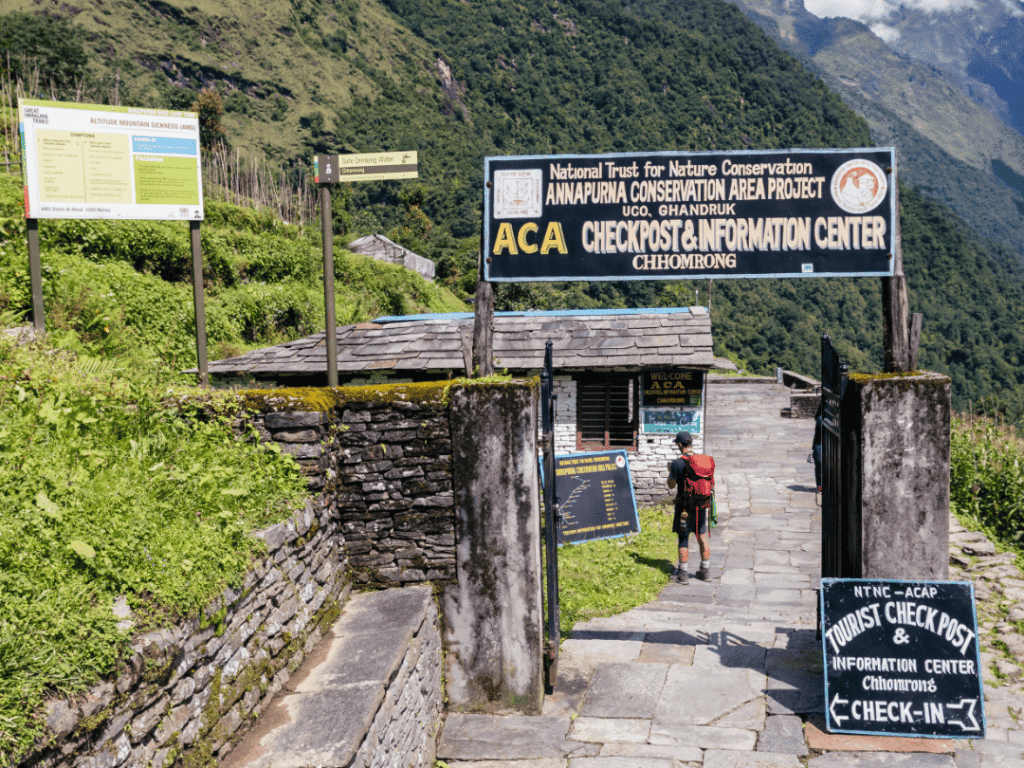
Getting that distinction wrong is why people arrive in Kathmandu with a booking that does not work, or turn back at Monjo with a permit nobody will stamp. Here is exactly where the solo trekking Nepal ban applies, where it does not, and what happens at the checkpoint if you try it anyway.
What the Rule Actually Says
Nepal Tourism Board announced in March 2023 that foreign trekkers would need a licensed guide on routes requiring a TIMS card, with enforcement phasing in through that year. Alongside it, the old green TIMS card that independent trekkers could buy over the counter in Kathmandu was retired. Permits for protected-area routes are now issued through a registered trekking agency as part of a guided package.


Three things follow from that, and only three:
- A licensed guide, or a licensed porter-guide, must accompany you inside national parks, conservation areas, and restricted regions.
- Your permits must come through an agency registered with the government, not from a counter you walk up to alone.
- Nothing requires you to travel with other tourists. One trekker plus one guide is a completely legal and very common arrangement.
Notice what is absent. No minimum group size for ordinary routes. No requirement to join a fixed departure. No ban on walking ahead of your guide, taking rest days, or changing your itinerary mid-trek. If an agency tells you otherwise, they are selling you their group product, not quoting the law.
Trails Where a Guide Is Mandatory
The list is long because Nepal’s famous trails almost all sit inside protected areas. Every route below requires a licensed guide in 2026.
| Route | Protected area | Guide required | Additional restriction |
|---|---|---|---|
| Everest Base Camp | Sagarmatha NP | Yes | Local municipality permit, NPR 3,000 |
| Gokyo Lakes / Three Passes | Sagarmatha NP | Yes | Same as above |
| Annapurna Circuit | ACAP | Yes | None beyond ACAP and TIMS |
| Annapurna Base Camp | ACAP | Yes | None beyond ACAP and TIMS |
| Mardi Himal | ACAP | Yes | None beyond ACAP and TIMS |
| Langtang Valley | Langtang NP | Yes | None beyond park fee and TIMS |
| Manaslu Circuit | MCAP, restricted | Yes | Restricted permit, agency-issued |
| Upper Mustang | ACAP, restricted | Yes | ~$500 for 10 days |
| Upper and Lower Dolpo | Shey Phoksundo, restricted | Yes | High per-day restricted fee |
| Nar Phu Valley | ACAP, restricted | Yes | Restricted permit |
| Kanchenjunga | KCAP, restricted | Yes | ~$20 per week |
| Tsum Valley | MCAP, restricted | Yes | Restricted permit |
| Humla and Limi Valley | Restricted | Yes | Restricted permit |
Restricted areas were never open to solo trekkers in the first place. Long before 2023 those regions required a government-registered agency and a liaison arrangement, and for years the rule also demanded a minimum of two foreign trekkers on one permit. That two-person floor is the part that has genuinely loosened. Solo applicants can now be issued restricted-area permits individually in several regions, which quietly opened Upper Mustang and Manaslu to people traveling alone for the first time in decades. Verify the current position for your specific region with your agency, because restricted-area policy changes more often than anything else in Nepali trekking.
Where You Can Still Walk Alone
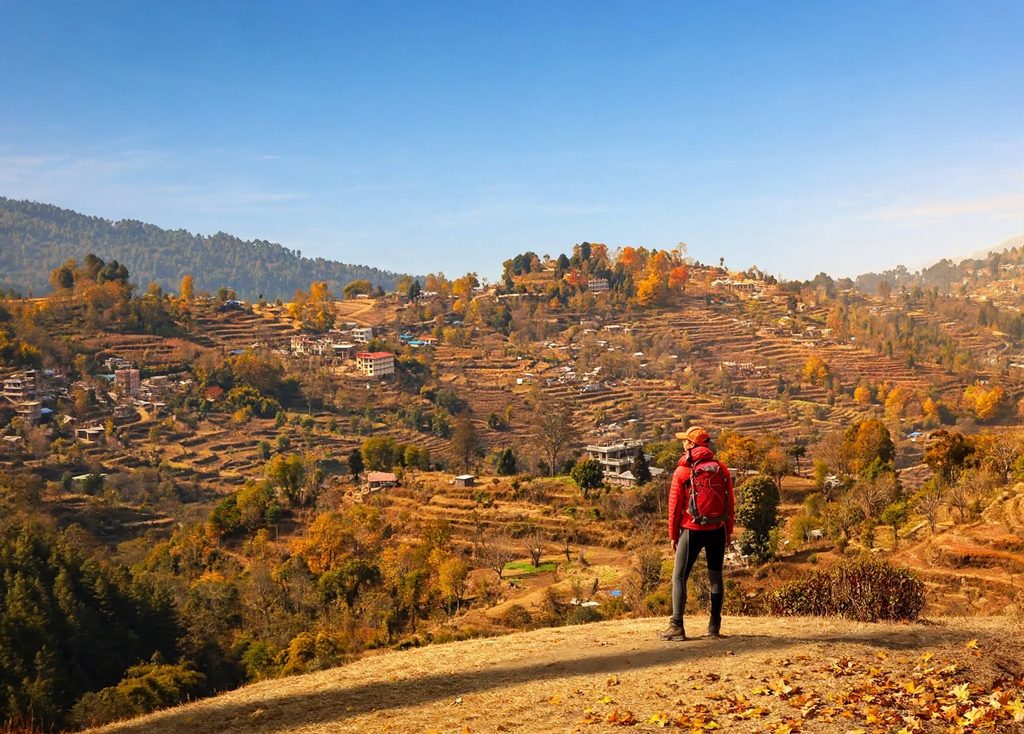
Plenty of Nepal remains completely unregulated, and some of it is genuinely excellent walking.
- Shivapuri Nagarjun National Park day hikes. You pay a NPR 1,000 entry fee and walk. No guide, no TIMS, no agency.
- Nagarkot to Dhulikhel ridge walk. Roughly 20 km along an open ridge with Himalayan views on clear mornings. Entirely unrestricted.
- Champa Devi and Phulchowki, the valley rim summits above Kathmandu at 2,278 m and 2,782 m. Popular with local hikers on weekends.
- Sarangkot, the Pokhara ridge, and the Australian Camp to Dhampus stretch, provided you stay outside the ACAP boundary. Read that boundary carefully, because it is closer to Pokhara than most people assume.
- Village and hill walks in the mid-hills, in districts like Kavre, Ilam, Tanahun and Dhankuta, where no conservation area applies.
Ghorepani Poon Hill sits awkwardly in between. That trail enters ACAP, so a guide is technically required, yet enforcement there has been inconsistent enough that people report walking it both ways. Do not build a plan around inconsistent enforcement. A guide for three days costs less than the fine.
How It Is Enforced
Enforcement in 2026 is meaningfully tighter than it was in the first year of the rule, and the reason is technology rather than manpower. Checkpoints at Besisahar, Birethanti, Dharapani, Monjo, Syabrubesi and Jagat now scan digital permits and verify the guide’s licence against the manifest. A permit with no guide attached to it does not scan clean.
What happens if you are stopped:
- You are turned back at the checkpoint, at your own expense, with no permit refund.
- Fines have been reported up to NPR 50,000, roughly $375, though in practice most trekkers are simply refused entry rather than fined.
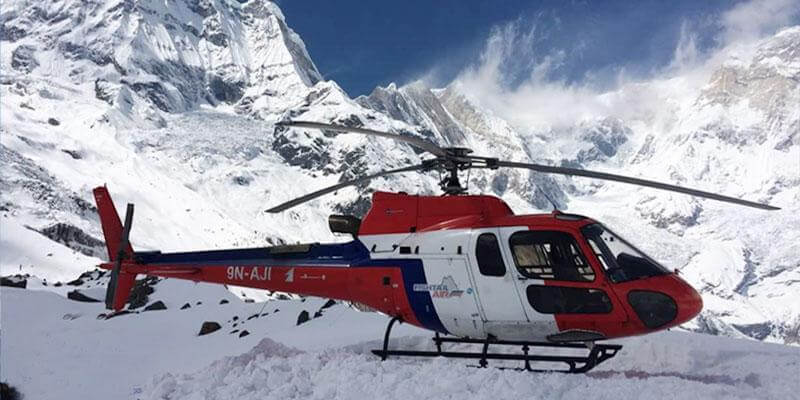
- Insurance claims can be denied. Trekking in breach of local regulation voids most policies, which matters enormously if you need a helicopter off a pass.
Teahouse owners have also been asked to report unaccompanied trekkers, and in the Khumbu that has teeth, because there are only so many lodges and everyone knows everyone. Here is where most people go wrong: they assume the rule is a soft recommendation because a blog post from 2023 said enforcement was patchy. Three years of digital checkpoints later, it is not.
What This Costs You
A licensed guide runs $25 to $35 per day in 2026 on standard teahouse routes, and $40 to $60 for senior guides with technical certification. On a 12 day Annapurna Base Camp trek that is $300 to $420 added to your budget. Compare it against your total: it is significant, but it is not the trek-killer people describe online.
A porter-guide at $20 to $30 daily is the smart compromise for a solo trekker on a straightforward route. You get the legal requirement satisfied, someone who knows the trail, and a lighter pack, for less than a full guide. Our full Nepal trek cost breakdown puts these numbers alongside every other line item.
Three ways to keep the cost down without cutting corners:
- Trek in the shoulder season. Guide rates rise 20 to 30 percent in October and November. Late September, early December, and March are cheaper and often clearer.
- Book direct in Kathmandu. International resellers add 40 to 100 percent for the identical Nepali ground crew.
- Find a trekking partner on arrival. Splitting one guide across two people halves the per-person cost, and Thamel guesthouse noticeboards and Kathmandu trekking forums are full of people doing exactly that.
Why Nepal Did This
Two reasons get cited officially, and they pull in different directions.
Safety is the stated one. Independent trekkers were going missing, and searching for someone whose route nobody recorded is slow, expensive, and frequently unsuccessful. High-profile disappearances on the Annapurna Circuit and in Langtang made the case hard to argue with. A guide is a recorded itinerary, an altitude sickness assessment, and a phone call to a rescue coordinator, all in one person.
Employment is the other. Nepal licenses thousands of trekking guides, and the shift from independent trekking toward budget flashpacking had eroded their work. Making guides mandatory was, transparently, an industry protection measure as much as a safety one, and TAAN lobbied hard for it.
Critics have a real case too. Nepal built its trekking reputation partly on being the one great mountain range you could explore on your own terms and a small budget. Some of that is now gone, and the trekkers most affected are the young, low-budget travelers who once stayed for months. Whether the safety gain justifies that is a genuinely open question, and both sides argue it in good faith.
How to Plan a Solo Trek That Is Legal
- Pick your route and check whether it lies inside a national park, conservation area, or restricted zone. Almost every named trek does.
- Choose a TAAN-registered agency in Kathmandu or Pokhara. Ask for their registration number and check it.
- Book a private guide, not a group departure. Say the words “solo trek with private guide” so nobody sells you a fixed date.
- Confirm what the daily rate includes: the guide’s food, lodging, insurance and transport should all be inside it.
- Let the agency pull your TIMS and area permits. Carry printed copies plus your passport.
- Buy insurance with an altitude ceiling above your highest point and explicit helicopter evacuation cover.
If what you actually wanted was solitude rather than independence, the answer is route choice, not rule-dodging. Tilicho Lake and the eastern trails see a fraction of the Khumbu’s foot traffic while sitting fully inside the legal framework.
FAQ
Can I trek alone in Nepal in 2026?
Yes, in the sense of traveling without other tourists. No, in the sense of walking protected-area trails without a licensed guide. One trekker plus one guide is legal, normal, and what most “solo” trekkers now do.
Is the ban actually enforced, or can I get away with it?
It is enforced. Digital permit scanning at trailhead checkpoints in Besisahar, Birethanti, Monjo and Syabrubesi checks whether a guide is attached to your permit. Getting turned back costs you the trek and the permit fee.
Does the rule apply to Nepali citizens?
No. The guide requirement targets foreign trekkers. Nepali nationals trek independently and pay no conservation area fees.
What about SAARC nationals, including Indians?
SAARC nationals pay reduced permit fees and in practice face lighter scrutiny on the guide rule, but the regulation is written for foreign trekkers generally. Confirm your position with an agency rather than assuming an exemption.
Can I hire a guide at the trailhead instead of in Kathmandu?
Not reliably, and your permits will not have been issued. Permits now flow through the agency, so the arrangement has to be in place before you reach the checkpoint.
Do I still need a TIMS card?
On most routes yes, at NPR 2,000 for foreigners and NPR 1,000 for SAARC nationals, issued through your agency. Everest is the exception, where the Khumbu Pasang Lhamu rural municipality collects its own NPR 3,000 permit instead.
Has the two-trekker minimum for restricted areas been removed?
Largely yes. Solo applicants can now obtain restricted-area permits individually in several regions where two foreigners were previously required. A licensed guide is still mandatory, and rules vary by region, so confirm for your specific route.
What is the cheapest legal way to trek solo?
Hire a licensed porter-guide at $20 to $30 daily, trek in shoulder season, book direct in Nepal, and consider splitting a guide with a partner you meet in Thamel. That combination lands a legal Annapurna Base Camp trek comfortably under $900.
Check current regulations with the Nepal Tourism Board and verify any agency against the Trekking Agencies’ Association of Nepal member list before you pay a deposit.


