



How much juniper does it take to keep a valley’s daily rituals burning, and can a slow-growing shrub at 4,000 meters supply it indefinitely? In Manang, that question has an administrative answer, a scientific answer, and a lived answer, and the three do not fully agree. Legal collection from the juniper forests of Manang rose from under 1,600 kg a year to around 5,000 kg within a few seasons, while researchers were reporting that the same shrublands face deepening drought. What follows is what is known about the ecology, what the rules currently allow, and where the evidence stops.
What grows there, and why it matters
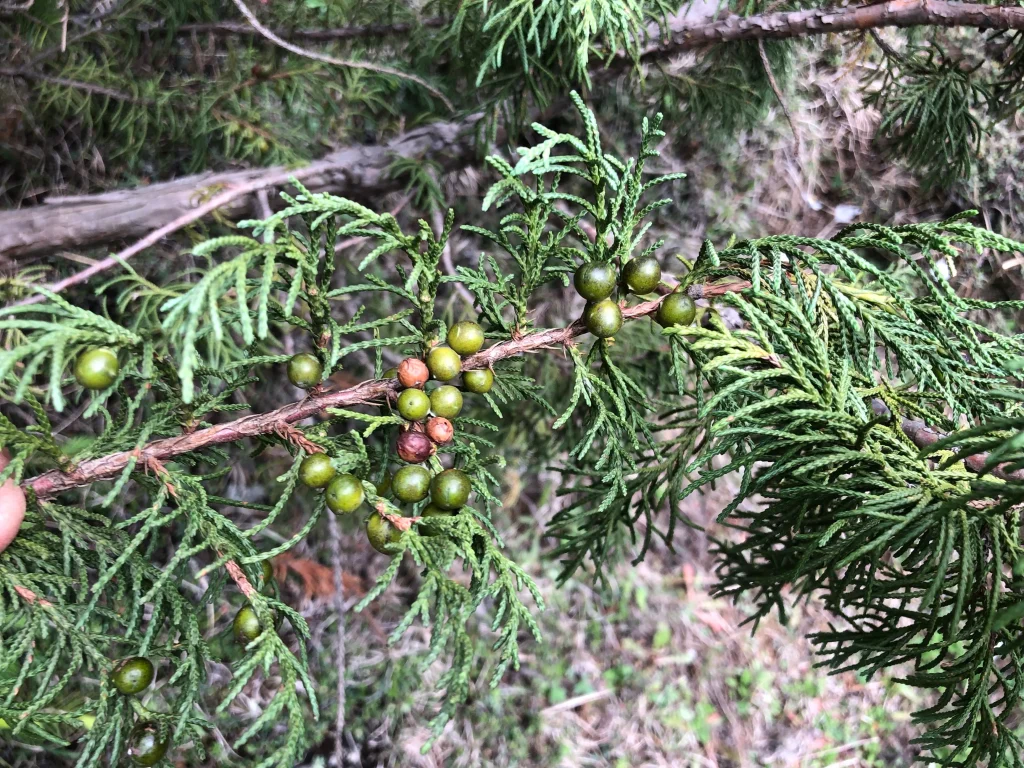
Black juniper, Juniperus indica, is the species at the center of this. Known locally as dhupi, it grows between roughly 3,600 and 4,800 meters across Nepal, China, Bhutan, India and Pakistan, according to the species account summarized in Mongabay’s 2025 reporting from Manang. In much of its Nepali range it is a sprawling shrub rather than a tree.
Manang sits in the rain shadow north of the Annapurna massif, inside the Annapurna Conservation Area. Annual rainfall here is a fraction of what falls on the southern flank of the same range. Juniper does well in exactly these conditions, because deep roots and tolerance of dry, rocky soil let it hold ground where most conifers cannot.


The ecological work juniper does
Shrub juniper is not scenery. On these slopes it performs several functions that are difficult to replace:
- Soil retention. Root systems bind thin, stony soils on steep ground where monsoon runoff and snowmelt would otherwise strip the surface.
- Microclimate. Low dense canopies trap snow, moderate surface temperature, and create the sheltered pockets where herbaceous plants and seedlings establish.
- Forage and habitat. Juniper shrublands structure habitat for birds and small mammals in a landscape with few other woody plants, and form part of the prey base habitat in a region that supports snow leopard. Our reporting on snow leopard corridors in the trans-Himalaya covers that wider system.
- Treeline dynamics. Juniper often occupies the transition zone above the last upright trees, which makes it a sensitive indicator of how warming and drying are shifting vegetation belts.
Removing foliage does not kill a juniper shrub outright. Repeated heavy cutting slows growth, reduces reproductive output, and leaves plants more vulnerable when a dry year arrives. That is the mechanism behind the concern, not sudden mortality.
Sang: what the juniper is used for
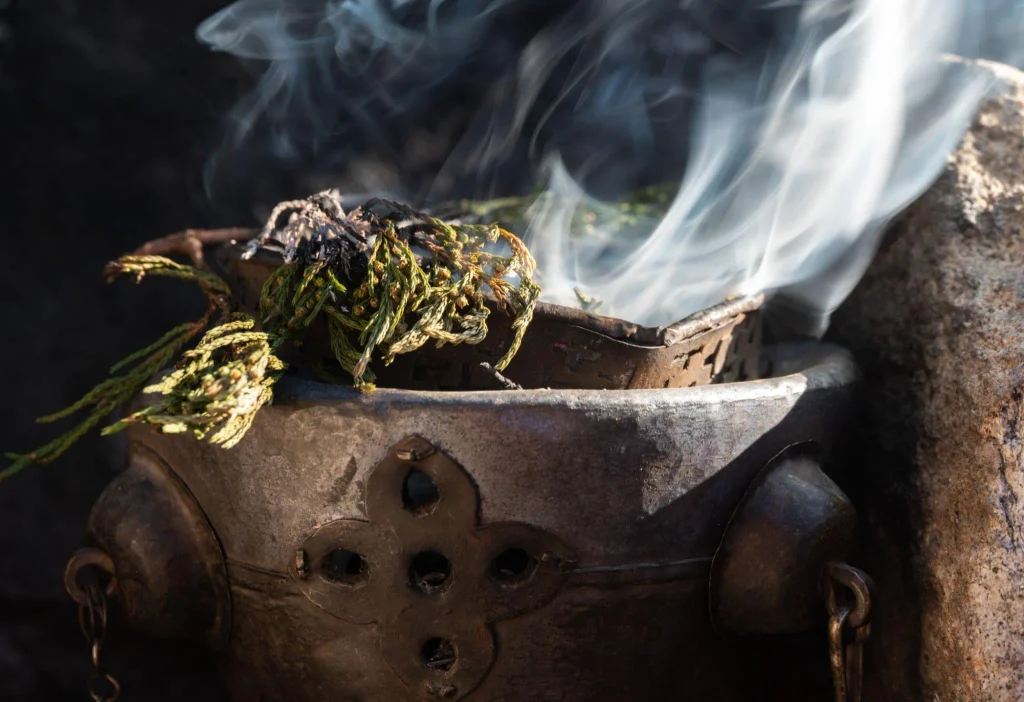
Burning juniper is a daily practice in Buddhist households and monasteries across Manang and neighboring Mustang. The offering is called sang. Black juniper is the main ingredient, combined with wild wormwood, locally titepati, and other plants depending on household and lineage.
Practice is not uniform. Among several trans-Himalayan communities, sang is burned at dawn on a rooftop or household hearth; in monasteries the scale and timing differ. Bhraka village in Manang, with its Kagyu monastery at about 3,475 meters, is one well-documented center of the practice. Traditions vary by community and by valley, and it would be wrong to present one village’s routine as a national custom. Juniper is not used this way in Hindu ritual in the Terai or the middle hills, where entirely different plants and practices apply.
Framing this as an exotic ritual misses the point. Daily sang is closer to how other households use a kitchen staple: it is consumed continuously, in small quantities, by nearly everyone. That is precisely what makes the aggregate demand significant.
What the harvest numbers show
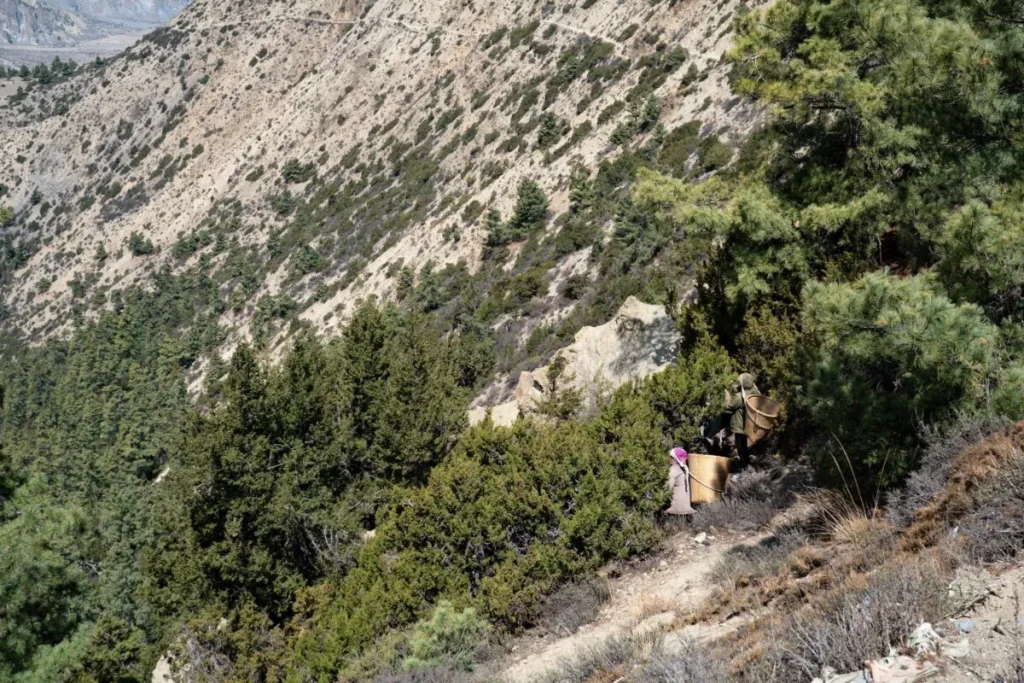
The Annapurna Conservation Area Project, known as ACAP, administers collection permits in Manang. Mongabay reported the following legally recorded volumes from Manang.
| Period | Legally collected juniper (Manang) |
|---|---|
| Two years before 2023-24 | 1,488 kg |
| Year before 2023-24 | 1,593 kg |
| 2023-24 | 5,000 kg |
| Fiscal year to mid-July, as of April 2025 | About 4,490 kg |
Two cautions belong with that table. These are recorded legal collections, not total offtake, and a rise in the recorded figure partly reflects a rule change rather than a pure increase in cutting. Residents quoted in the same reporting said illegal harvesting by outsiders continues, which by definition sits outside the numbers.
The rule that changed
ACAP permits household collection of up to 10 kg per person per year, raised from a previous limit of 3 kg. Commercial collection is not permitted. ACAP chief Rabin Kadariya said the increase followed discussions with local communities, and that the plant must not be commercially exploited.
Raising a per-person allowance more than threefold while total recorded collection roughly tripled is not a coincidence. Whether the higher quota legalized harvesting that was already happening, or genuinely increased it, is not something the published figures can resolve.
What the science says, and how firmly
Two findings are repeatedly cited, and they pull in different directions.
A 2020 study of juniper population structure along an elevation gradient in Manang, by Chapagain and colleagues, found that the shrubs regenerate effectively, helped by deep roots and tolerance of dry, rocky soils. The same study warned that overexploitation remains a risk, and distinguished local religious use, which it did not find threatening to survival, from commercial harvesting, which it flagged as dangerous.
Work published in 2025 by Pandey and colleagues on alpine juniper shrubs across a precipitation gradient in the central Himalayas reports declining growth resilience to drought. Increasing drought frequency makes recovery slower after dry spells. Kadariya made the practical version of the same point: prolonged drought slows the plant’s recovery, and in the season Mongabay reported, snow reached Manang only in April, after winter had effectively ended.
Globally, the species is assessed as Least Concern on the IUCN Red List, with noted concerns about fragmentation and exploitation in Nepal. A global category tells you little about a single valley, and conservation status is not a harvest quota.
Where the evidence runs out
Several things remain genuinely unknown:
- No published figure establishes how much juniper Manang’s shrublands can supply sustainably each year. The 10 kg quota is an administrative decision, not a modeled yield.
- Illegal and unrecorded collection has not been quantified.
- Long-term monitoring plots that would show whether Manang’s juniper stands are thinning under the current regime are not publicly reported.
- The interaction between harvest pressure and drought stress has not been studied directly in this population. Each has been studied separately.
Anyone who tells you confidently that Manang’s juniper is either safe or collapsing is going beyond the published record.
Pressures beyond the incense trade
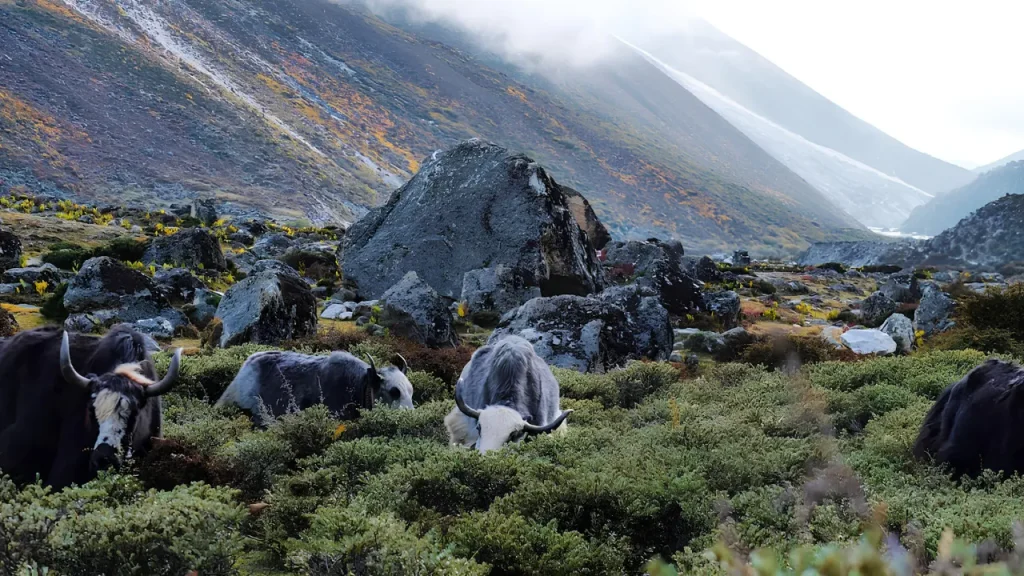
Incense is the headline, but it is not the only force acting on these shrublands.
Road construction has reached far up the Manang valley over the past decade, changing both access and grazing patterns. Easier access cuts both ways: it lowers the cost of bringing alternatives in, and it lowers the cost of carrying juniper out. Tourism adds demand of its own, through lodges, visitor ritual purchases, and a growing market for Himalayan incense products outside Nepal, which is exactly the commercial channel ACAP’s rules are meant to block.
Livestock also matter. Grazing pressure on seedlings and young shrubs affects regeneration independently of cutting, and in a region where pastoralism is long established, separating the two effects requires fieldwork nobody has yet published for Manang specifically.
How Manang compares with its neighbors
Manang is not the only place where this plays out, and the differences are instructive. Mustang, immediately west across the Thorong La, has similar vegetation and similar ritual demand, but a different administrative history and a far longer paved road. Regulation in both districts runs through ACAP, yet enforcement capacity varies with distance from a field post and with the number of outside collectors passing through.
Further east in Dolpo, juniper is also burned, and Shey Phoksundo National Park rather than ACAP sets the rules. A quota written for one conservation area does not automatically apply elsewhere, which is one reason national-level statements about juniper harvesting in Nepal tend to be unreliable. Ask which protected area, which fiscal year, and whether a figure counts permitted collection only.
Scale is the other variable. Manang district had a resident population in the low thousands at the last census, among the smallest in Nepal, while seasonal visitor numbers on the Annapurna Circuit run far higher. A household quota designed around permanent residents behaves differently when the valley’s effective population multiplies for several months a year.
Visiting without adding to the pressure
If you trek the Annapurna Circuit through Manang, a few things are worth knowing. Do not collect juniper yourself, and do not ask a lodge to source it for you as a souvenir. Buying Himalayan incense marketed as wild-harvested juniper feeds the commercial channel ACAP prohibits. Ask before photographing a household performing sang, and do not treat a morning offering as a photo opportunity.
Our guides to the Manang valley, the Tilicho Lake trek, the Annapurna Circuit, and Jomsom and Kagbeni cover routes, permits and acclimatization across this landscape.
Frequently asked questions
Which juniper species is used for incense in Manang?
Black juniper, Juniperus indica, locally called dhupi, is the primary species. It is mixed with wild wormwood and other plants to make sang, the daily smoke offering.
How much juniper can a person legally collect?
ACAP permits up to 10 kg per person per year for household use, raised from a previous 3 kg limit. Commercial collection is not allowed inside the Annapurna Conservation Area.
Is black juniper endangered?
Not globally. The IUCN assesses the species as Least Concern, while noting fragmentation and exploitation concerns in Nepal. Global status does not describe the condition of any particular valley’s population.
Does cutting juniper for incense kill the plant?
Usually not directly. Foliage removal slows growth and reduces reproductive output, and repeated heavy cutting leaves shrubs less able to recover from drought years. Research to date distinguishes modest household use from commercial-scale extraction.
How is climate change affecting these shrublands?
Published work from 2025 reports declining growth resilience to drought in alpine juniper across the central Himalayas. In Manang, officials have described prolonged winter drought, with snow in one recent year arriving only in April. Attribution of a single dry winter to climate change requires separate analysis.
Is sang practiced the same way across Nepal?
No. Burning juniper as sang is characteristic of Buddhist practice in trans-Himalayan communities such as those in Manang and Mustang. Practices differ between villages, lineages and monasteries, and are not shared by Hindu ritual traditions in the Terai or middle hills.
Can visitors buy juniper incense legally?
Commercially harvested juniper from within the conservation area is not permitted, so incense sold as wild Himalayan juniper should be treated with caution. Asking about the source is reasonable, and declining to buy is the safer choice.
What would better management look like?
Researchers and officials point in the same direction: enforcement against outside commercial collection, measured monitoring of shrub density and regeneration, and quotas based on studied yield rather than negotiated allowance. None of those monitoring data are currently published for Manang.
Keep exploring Nepal’s high valleys
Manang is easy to walk through and hard to understand quickly. Save this guide for your trip planning, share it with anyone heading up the Annapurna Circuit, and follow NepalVue for more reporting on the ecology and the communities behind the landscapes.


