



Everyone assumes the writing in Nepal’s high Himalaya is carved into rock. In Dolpo, almost none of it is. The texts that survive above 4,000 meters in the Shey Phoksundo region sit on stacked paper leaves in unheated monastery rooms, written in gold and silver on indigo-dyed sheets, not chiseled into cliff faces. Searches for Shey Phoksundo cave inscriptions turn up a lot of atmosphere and very little evidence. That gap is worth taking seriously, because it tells you something real about how written culture was stored, moved, and lost in one of the most isolated inhabited valleys on earth. Here is what researchers have actually documented, what remains genuinely unknown, and why the distinction matters.
Where the idea of “cave inscriptions” comes from
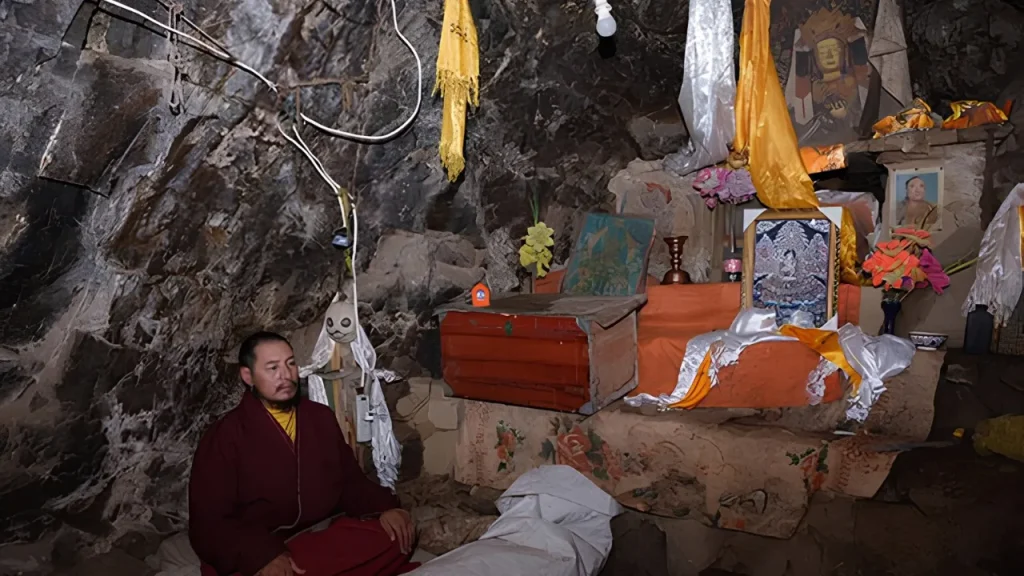
Dolpo sits in Nepal’s northwest, inside Shey Phoksundo National Park, the country’s largest protected area. Culturally it belongs to the Tibetan plateau rather than the middle hills. People here speak Tibetic dialects, follow both Bon and Tibetan Buddhist traditions, and have maintained religious institutions for roughly a thousand years.
Caves are everywhere in the local landscape and in local memory. Hermits used them. Monasteries grew out of them. Several of the region’s temples are literally built against or into rock. So the leap to “cave inscriptions” feels natural, especially for readers who have seen coverage of the cliff cavities in neighboring Mustang.


Mustang is where that image comes from. Excavated cave complexes there have produced murals, manuscript fragments, and human remains, and they have been studied for decades. Dolpo has not seen comparable excavation. Treating the two districts as interchangeable is the most common error in popular writing about this region.
What the architectural record actually shows
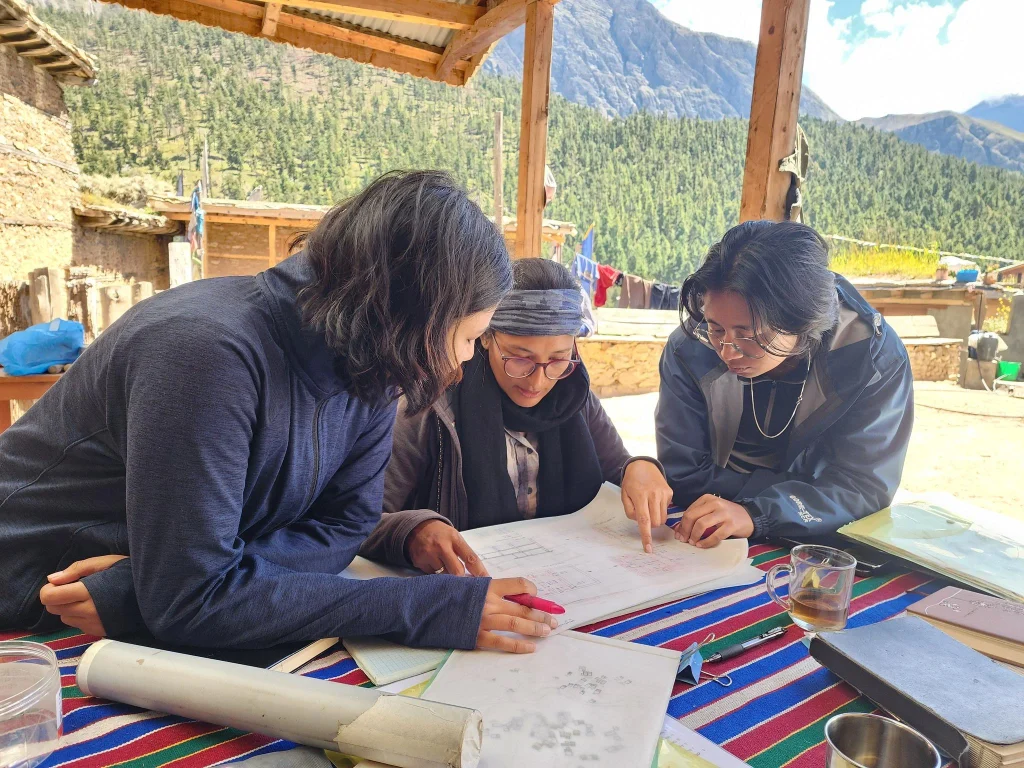
A team from Graz University of Technology carried out the most systematic survey of Dolpo’s Buddhist and Bon architecture to date, across four field missions between 2018 and 2023. They documented 18 sites and comprehensively surveyed 15 of them, using laser distance meters early on and a Leica RTC360 laser scanner paired with a total station from 2022.
Their results, published in the journal Heritage in 2025, include a category the authors call overbuilt cave sanctuaries: four ensembles where a built structure encloses or leans on a rock cavity. Gomoche Gompa is the clearest case. Behind its built facade sits a cave known locally as the Vajra Cave of Shey, roughly 9 meters long and up to 4 meters high. Tsakhang Gompa began as a cave hermitage with a sacred spring and grew into a three-storey building. At Dechen Labrang in Namdo, the altar stands in front of cave-like niches in the rock.
Note what is absent from that list. Not one of those cave spaces is described as an epigraphic site. On dating, the survey is blunt: inscriptions and wall paintings are rarely preserved in Dolpo, so they contribute little, and the researchers lean on written sources and construction evidence instead.
The writing that did survive, and where it is kept
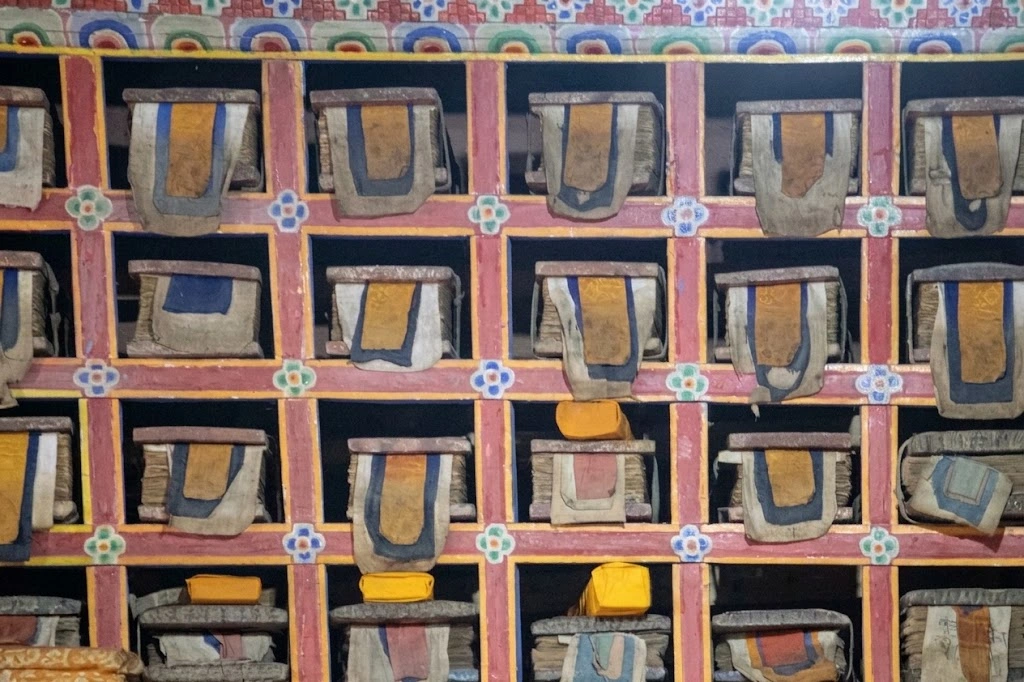
Dolpo’s documentary heritage is overwhelmingly on paper. It is also substantial.
Art historian Amy Heller’s work on Bonpo manuscripts in Dolpo traces a documentation history that starts with David Snellgrove’s 1956 assessment of the library at Samling monastery. Corneille Jest worked in the region around 1961. Klaus-Dieter Mathes microfilmed manuscripts at Samling and Phijor in 1996, 1999, and 2000. In May 2000, a team inventoried the Phijor temple library after a wall was removed and counted more than 600 Buddhist volumes. Heller and Chandra Gurung documented a private Bonpo household library near Phijor in 2012 and 2014, roughly 100 volumes by her own preliminary count.
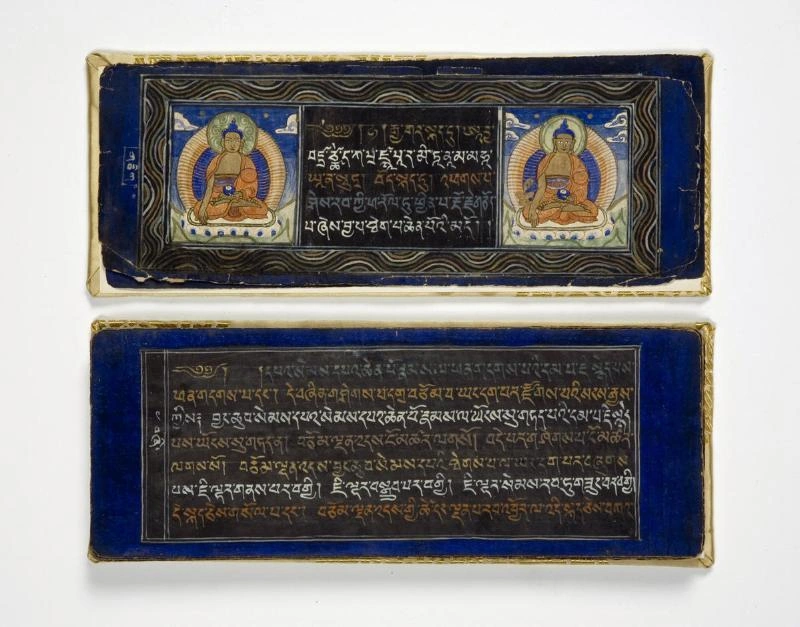
Material details matter here. Many leaves are large-format, written in gold, silver, and red on dark blue paper. Paper analysis by Agnieszka Helman-Ważny identified fibers from Daphne, Edgeworthia, and Stellera plants. Cold, dry air at these elevations has preserved the pages remarkably well, which is precisely why paper rather than stone became the durable medium of record.
How these texts are dated
Dating comes from dedications written into the volumes, not from the physical substrate alone. Heller identifies the oldest dedication she found on a leaf of the Bonpo Khams brgyad, linked to the Yatse kingdom. She places it around the mid-14th century, bounded by the end of the ruler Pritivimalla’s reign in 1354. Across the collections, dedication leaves appear to run from roughly the mid-1300s to the early 1500s.
She also states plainly that the chronology is preliminary, because the volumes have not been fully inventoried. That caveat should travel with every number quoted from this body of work.
| Site | Type | Indicative date | Basis |
|---|---|---|---|
| Nesar Gompa, Bijer | Temple with manuscript library | 11th century material evidence; written sources suggest early 13th | Construction analysis vs. texts (Graz survey) |
| Nesar library manuscripts | Illuminated volumes | 11th to 16th century | Manuscript study |
| Samling monastery | Bon library | Documented from 1956 onward | Snellgrove, later microfilming |
| Jampa Lakhang, Tokyu | Six-pillar temple | 15th century | Written sources |
| Tsakhang Gompa | Cave hermitage, later gompa | 16th century | Graz survey |
| Shey Sumdo | Temple | 17th century | Graz survey |
One number in that table deserves a flag. Shey Gompa is widely described online as an 11th-century foundation. Peer-reviewed survey work does not confirm that date for the Shey complex as it stands, and the popular figure appears to circulate without a traceable source. Readers should treat it as tradition rather than established chronology.
Why rock inscriptions are scarce here
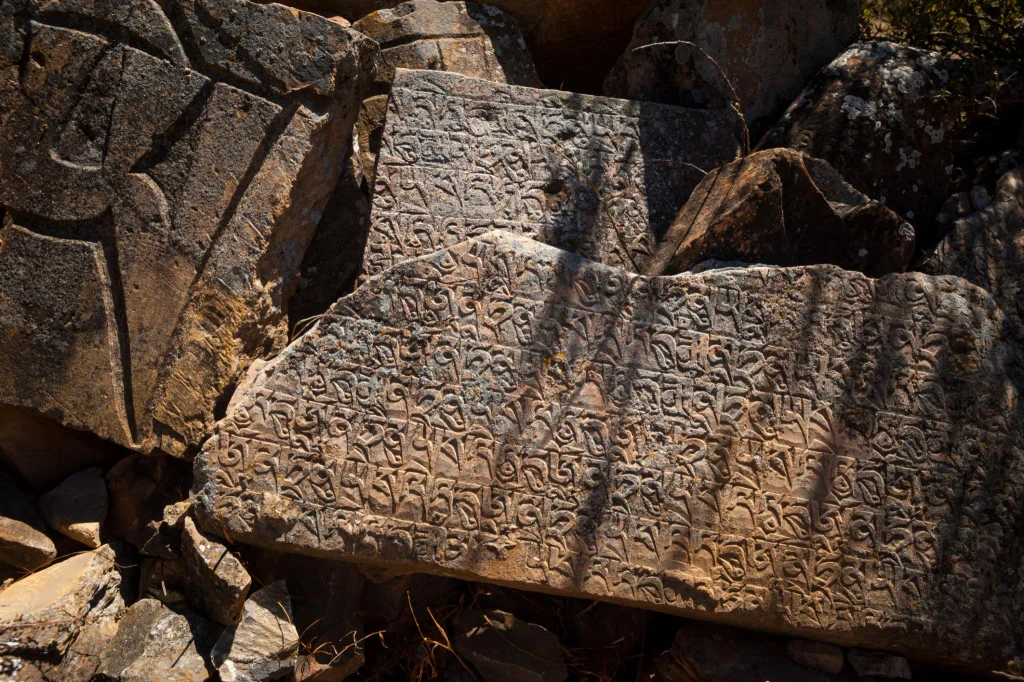
Three factors do most of the explaining.
- Geology. Much of the terrain around Phoksundo is fractured sedimentary and metamorphic rock that spalls and weathers rather than holding a carved surface for centuries. Compare that to the fine sandstone and conglomerate cliffs that made Mustang’s cave excavation possible.
- Function. Caves in Dolpo were used for meditation retreat and for sheltering built sanctuaries. A hermitage does not require a public inscription. A roadside shrine or a royal edict does, and Dolpo had neither in any quantity.
- Portability. In a trading and pastoral economy, text that travels is text that survives. Manuscripts could be carried out of a collapsing building, lent between villages, and recopied. Carved rock cannot be evacuated.
Mani walls and carved stone plaques do exist across Dolpo, as they do across the Tibetan cultural world. Those carry mantras and short dedications, not the historical narratives that popular accounts imagine. Calling them epigraphy is accurate. Calling them lost inscriptions is not.
What is genuinely unexplored
Skepticism about the “lost inscriptions” story is not the same as claiming Dolpo is fully documented. It plainly is not.
No official heritage inventory covers Dolpo’s temples, and the Graz team notes that none of them are yet recognized as government cultural monuments. Absence of protection has consequences. Trangmar Gompa at Kagar, which had high-quality wall paintings and a secret chamber, was demolished in 2023. A building can disappear before anyone records what was written inside it.
Several active research questions remain open:
- Whether painted inscriptions survive under later plaster layers in the overbuilt cave sanctuaries, which would require conservation work rather than survey alone.
- How many private household libraries remain unvisited. Heller’s work reached one near Phijor by invitation, and there is no reason to assume it is unique.
- Whether any Dolpo rock surfaces carry datable carved text beyond mantra formulas. No published survey has set out to answer this systematically.
Research access is also getting harder, not easier. The Graz authors report increasing permit requirements, and they flag the Kali Gandaki road project as a source of major change for the wider region.
Reading the region responsibly
Dolpo is not an abandoned archaeological zone. People live there, maintain these buildings, perform rituals in them, and own the manuscripts in question. Access to the private Bonpo library Heller documented came through relationships, not through a research permit alone.
Two practices follow from that. Visitors should not photograph or handle manuscripts without explicit permission from the custodian, and should not enter cave sanctuaries or chapel interiors uninvited. Communities in Dolpo distinguish sharply between Bon and Buddhist institutions, and between village-owned and family-owned property. Treating the region as one undifferentiated “Tibetan” culture erases distinctions that matter locally.
If you are planning to travel there, our guides to Lower Dolpo and Phoksundo Lake and the Upper Dolpo trek cover permits and routes. For the excavated cave sites that Dolpo is often confused with, see our piece on the sky caves of Chhoser and on Mustang’s caravan route archaeology. The wildlife side of the same landscape appears in our reporting on snow leopard corridors in Upper Dolpo.
Frequently asked questions
Are there confirmed cave inscriptions at Shey Phoksundo?
No published survey confirms a body of carved historical inscriptions in caves there. The 2025 Graz University of Technology survey documents cave-associated sanctuaries but states that inscriptions and wall paintings are rarely preserved in Dolpo. Carved mantra stones are common, which is a different category.
What is the oldest written material documented in Dolpo?
Manuscripts at Nesar Gompa have been attributed to a range running from the 11th to the 16th century. Among Bon volumes, Amy Heller identifies a dedication leaf dated to roughly the mid-14th century. Both datings are described by their authors as preliminary.
Why are Mustang and Dolpo so often confused?
Both are trans-Himalayan Nepali districts with Tibetan-influenced culture and dramatic cliff landscapes. Mustang has excavated cave complexes with murals and burials. Dolpo has not seen equivalent excavation, so findings from one district should not be transferred to the other.
Can visitors see these manuscripts?
Rarely, and only with the custodian’s permission. Many volumes are in monastery libraries or private family collections and are handled as sacred objects, not exhibits. Asking in advance through a local guide is the appropriate route.
What is Bon, and how does it differ from Tibetan Buddhism here?
Bon is a distinct Tibetan religious tradition with its own canon, including the Khams chen and Khams brgyad texts found in Dolpo. It shares ritual vocabulary with Tibetan Buddhism but has separate lineages and institutions. Dolpo contains both, sometimes in neighboring villages, and local people make the distinction clearly.
Is Dolpo’s heritage legally protected?
Not in the way a listed monument would be. Researchers report that no Dolpo temples are currently recognized as government cultural monuments and that no official heritage inventory exists. Shey Phoksundo National Park protects the landscape, which is a separate legal instrument from cultural heritage protection.
What is the biggest threat to these sites?
Loss through unrecorded demolition and alteration. Trangmar Gompa at Kagar was demolished in 2023. Tin roofs added over traditional flat roofs are also changing appearances and adding structural load, according to the Graz survey.
Do researchers expect new discoveries?
Possibly, but through documentation rather than dramatic excavation. Unvisited household libraries and plaster-covered painted surfaces are the most plausible sources of new material. No current published project is searching for carved cave inscriptions in Dolpo.
Keep exploring
Dolpo rewards slow reading as much as slow walking. If this piece was useful, save it for your trip planning, pass it to someone heading northwest, and follow NepalVue for more reporting on Nepal’s landscapes, communities, and the research that keeps revising what we know about them.


