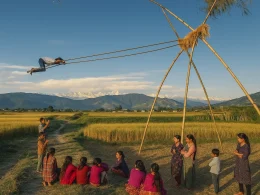



Once a year, Kathmandu’s ancient streets transform into a living stage of gods, demons, and living deities. Indra Jatra stands as the valley’s largest and most anticipated street festival, drawing locals and travelers alike into eight days of masked dances, chariot processions, and centuries-old ritual. In this guide, we will explore the history, legends, and rituals behind Indra Jatra, along with where and how to experience it for yourself.
Understanding Indra Jatra means understanding one of the oldest continuously celebrated festivals in the Kathmandu Valley. So, let’s walk through its origins, its central legends, and everything that unfolds once the celebration begins.
What Is Indra Jatra?
Indra Jatra, known locally as Yenya, meaning “the festival of Kathmandu,” honors Indra, the Hindu god of rain and king of heaven. The festival gives thanks for a successful monsoon season while praying for a bountiful harvest in the months ahead.


Celebrated primarily by the Newar community, Indra Jatra unfolds over roughly eight days, typically falling in September according to the lunar calendar. In 2026, the festival begins around September 25, marking one of the final major celebrations before Nepal moves into its Dashain and Tihar season.
The Ancient Origins of Indra Jatra
Indra Jatra’s roots stretch back further than most festivals still celebrated today. Tradition credits King Gunakamadeva with establishing the festival, tying it to the very founding of Kathmandu city itself. This origin story places Indra Jatra among the oldest surviving cultural traditions in the entire valley.
The Legend of Indra’s Capture
At the heart of the festival lies a rich mythological story. According to legend, Indra disguised himself as an ordinary farmer and descended to earth in search of parijat, a sacred night jasmine flower his mother needed for a ritual. While attempting to pluck the flower, local villagers caught him, unaware of his true identity, and bound his hands as though he were a common thief.
A Mother’s Search
As the story continues, Indra’s mother, sometimes named Dagini or Basundhara, descended to earth herself upon discovering her son had gone missing. Realizing he had been mistakenly captured, she revealed his divine identity to the villagers. In gratitude for his release, she promised to provide the dew and morning fog needed to nourish winter crops, and vowed to help guide the souls of those who had died that year safely to heaven.
How the Legend Shapes the Festival
This story directly explains several rituals still performed today. Statues depicting Indra with his arms bound, much like a captured thief, are displayed on tall scaffolds throughout Kathmandu during the festival. A white elephant, representing Indra’s celestial mount searching for its missing master, also wanders symbolically through the crowds as part of the celebration.
The Addition of Kumari Jatra
While Indra Jatra’s roots are ancient, much of what makes the modern festival so spectacular was actually added centuries later.
King Jaya Prakash Malla’s Contribution
During the 18th century, King Jaya Prakash Malla, the last Malla king of Kathmandu, transformed the festival into the elaborate street celebration recognized today. He introduced chariot processions honoring Ganesh, Bhairav, and the Living Goddess Kumari, alongside an array of masked dances performed throughout the valley.
A Political as Well as Religious Move
Historians note that this addition wasn’t purely religious in nature. Some researchers argue that incorporating Kumari Jatra into Indra Jatra served to legitimize Jaya Prakash Malla’s rule, connecting his kingship visibly to the divine authority of the Living Goddess. Since 1756, Kumari Jatra has been observed alongside Indra Jatra every single year.
The Kumari Chariot Procession
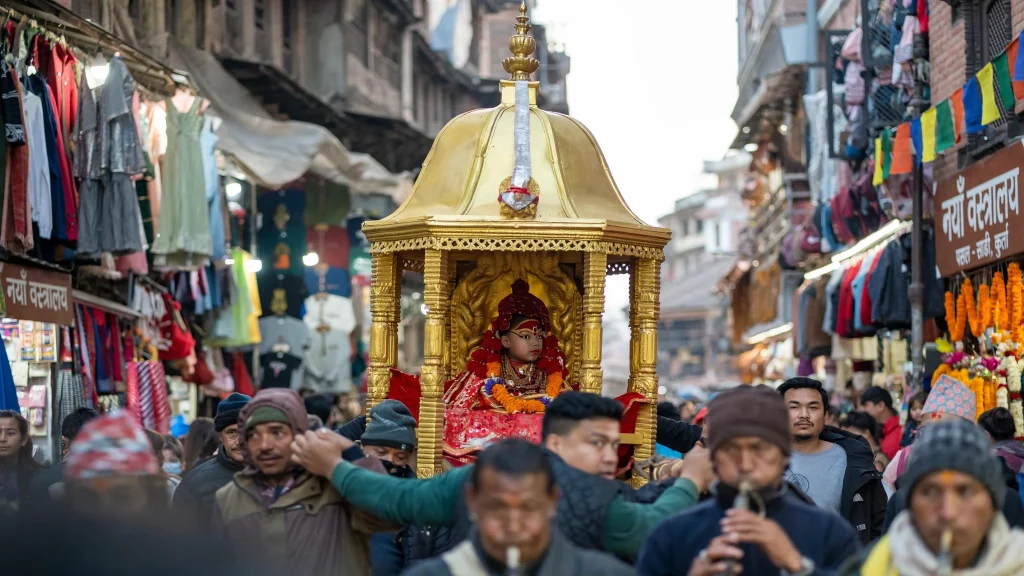
For many visitors, the Kumari chariot procession represents the emotional centerpiece of the entire festival.
Who Is the Kumari?
The Kumari is a young girl worshipped as the living embodiment of divine female energy within Nepal’s Hindu and Buddhist traditions. During Indra Jatra, she rides through the streets of Kathmandu on an elaborately decorated wooden chariot, one of the rare occasions when the public can witness her outside the Kumari Ghar, her residence near Kathmandu Durbar Square.
Ganesh and Bhairav Join the Procession
The Kumari’s chariot doesn’t travel alone. Two additional chariots, carrying human representatives of Lord Ganesh and Lord Bhairav, accompany her through the old city streets, together forming the festival’s central procession, generally beginning in the afternoon or early evening.
A Moment of Royal Recognition
Traditionally, before the chariots begin moving, the head of state and other senior officials pay their respects directly to the Kumari, a custom that has carried through Nepal’s transition from monarchy to republic, reflecting her continued symbolic importance in national life.
Raising the Yosin Pole
Indra Jatra formally begins with a distinctive ceremony known as the raising of the Yosin, a tall wooden pole erected in Kathmandu Durbar Square, directly in front of the historic Hanuman Dhoka Palace.
This pole is closely associated with Lord Indra’s flag and is believed to invite blessings for the year ahead. Hundreds of spectators typically gather in the palace square to witness this pole-raising ceremony, which effectively signals the start of the festival’s public celebrations. At the festival’s conclusion, the pole is ceremonially lowered, marking the official end of Indra Jatra.
The Masks and Dances of Indra Jatra
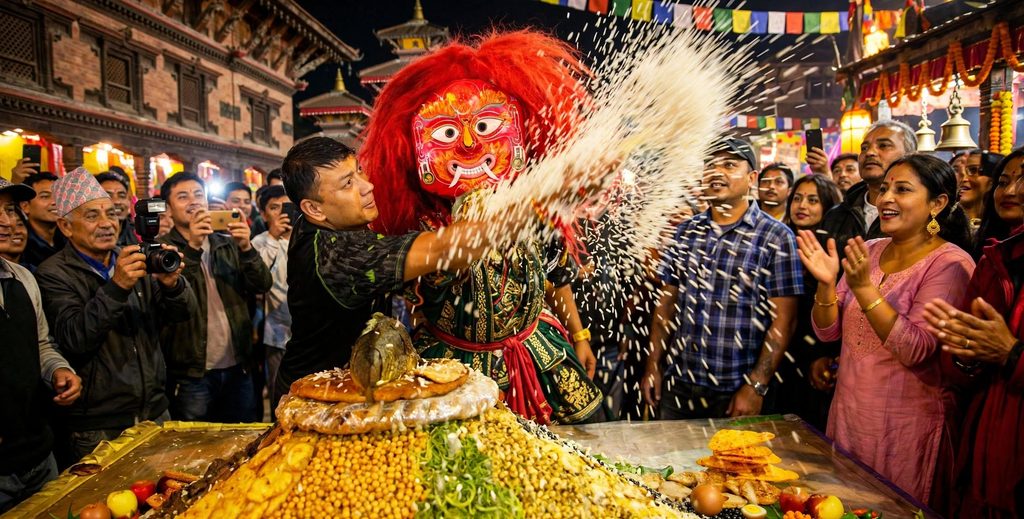
Few elements of the festival capture attention quite like its masked performances, many of which appear publicly only once a year.
Akash Bhairav
In Indra Chowk, an enormous bust of Akash Bhairav is displayed, elaborately decorated with flowers, silver eyes, and a crown. According to legend, this deity’s head is connected to the head of Yalambar, the first Kirat king, who is believed to have gained divine powers through tantric worship. Each night of the festival, crowds gather here to sing devotional hymns.
Majipa Lakhey
Perhaps the most photographed figure of the entire festival, the Majipa Lakhey is a red-faced, fierce-looking demon dancer accompanied by musicians. Alongside Pulukisi, the Lakhey helps manage crowds ahead of the chariot processions, and this is genuinely the only time of year the Lakhey appears publicly in this form.
Pulukisi: The Elephant Dance
Representing Indra’s celestial elephant, Airavata, the Pulukisi dance features a large elephant figure moving playfully through the crowds, searching symbolically for its missing master. This lively performance typically takes place in the evening and remains a highlight for both children and adults.
Sawa Bhakku and Other Dance Groups
Traveling from Halchok on the western edge of the valley, the Sawa Bhakku dance group performs at major squares along the festival route, featuring a blue-clad Bhairav accompanied by two red-clad attendants. Additional performances, including Devi Pyakhan and various Mahakali dances, take place at specific historic squares throughout old Kathmandu.
Honoring the Dead During Indra Jatra
Beyond its more celebratory elements, Indra Jatra also carries a quiet, reflective dimension tied to remembrance.
Upaku Wonegu and Mata Biye
On specific days of the festival, Newar families honor relatives who died during the previous year through a ritual known as Upaku Wonegu. As part of this observance, called Mata Biye, families offer small butter lamps along the festival’s processional route, and often present these lamps to friends and relatives as a gesture of respect and shared mourning.
How Bhaktapur and Patan Celebrate Differently
While Kathmandu hosts the festival’s largest celebrations, nearby Bhaktapur and Patan observe Indra Jatra with their own distinct traditions.
Bhaktapur’s Dey Payo Ceremony
In Bhaktapur, the festival includes the Dey Payo ceremony, a torch-lit procession held on the fourth day of celebrations. Taumadhi Square remains open to visitors throughout the festival, offering excellent opportunities to photograph the chariots and local performances specific to Bhaktapur’s own set of honored deities.
Patan’s Quieter Celebration
Patan, also known as Lalitpur, celebrates Indra Jatra with noticeably smaller crowds, offering a more intimate experience. Visitors here can attend the Kumari Puja at Patan’s own Kumari Ghar, distinct from Kathmandu’s ceremony, and explore the Golden Temple, or Hiranya Varna Mahavihar, where Buddhist rituals blend alongside the broader Hindu celebrations.
Tips for Experiencing Indra Jatra as a Visitor
If you’re planning to witness the festival firsthand, a few practical details can improve your experience considerably.
Choose Your Viewing Location Wisely
Kathmandu Durbar Square offers the largest crowds and the most iconic backdrop for the chariot processions, while Patan’s Durbar Square provides a calmer, more personal alternative. Bhaktapur’s Taumadhi Square remains an excellent choice for photographing the city’s unique Dey Payo ceremony.
Arrive Early for the Best Views
Given how densely crowded the main procession routes become, arriving well before the chariots begin moving, generally in the afternoon, secures a far better vantage point than arriving right as the procession starts.
Respect the Ritual Elements
While much of Indra Jatra feels celebratory, remember that ceremonies like Upaku Wonegu carry genuine emotional weight for grieving families. Approach these moments respectfully, and ask permission before photographing anyone clearly engaged in a private act of remembrance.
Final Thoughts
Indra Jatra offers a genuinely rare window into living Newar tradition, blending ancient mythology, royal history, and heartfelt remembrance into a single, unforgettable celebration. From the ceremonial raising of the Yosin pole to the sight of the Kumari’s chariot moving through Kathmandu’s old streets, every element of the festival carries centuries of meaning behind it. Whether you’re drawn by the masked dances, the mythology of Indra himself, or the rare chance to see Nepal’s Living Goddess in public, Indra Jatra remains one of the most compelling festivals the Kathmandu Valley has to offer.
Frequently Asked Questions
What does Indra Jatra celebrate?
Indra Jatra honors Indra, the Hindu god of rain, thanking him for the monsoon season and praying for a successful harvest ahead.
When does Indra Jatra take place in 2026?
Indra Jatra begins around September 25, 2026, and continues for approximately eight days throughout the Kathmandu Valley.
Who started the Kumari Jatra procession?
King Jaya Prakash Malla introduced Kumari Jatra alongside Indra Jatra in 1756 AD, adding chariot processions for Kumari, Ganesh, and Bhairav.
What is the legend behind Indra Jatra?
According to legend, Indra descended to earth disguised as a farmer to collect a sacred flower and was mistakenly captured by villagers as a thief.
What is the Majipa Lakhey?
The Majipa Lakhey is a fierce, red-faced demon dancer who appears publicly only during Indra Jatra, helping manage crowds during the chariot processions.
Is Indra Jatra celebrated outside Kathmandu?
Yes, Bhaktapur and Patan both celebrate Indra Jatra with their own distinct traditions, including Bhaktapur’s torch-lit Dey Payo ceremony.