



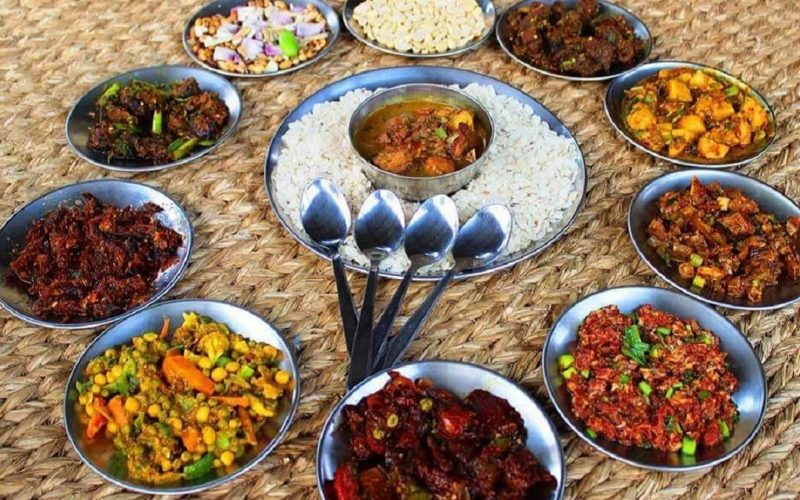
Do you consider yourself a true Nepali? Do you know about the traditional food of Nepal? If no, then have a look. These are the most traditional and typical Nepali food you must try once in your life.
Dhido
It is the most typical food of Nepal made up of millet or maize flour. It is the healthiest food and suitable for diabetic patients. You can also say this flour pudding. To prepare Dhido, flour is poured into boiling water and cooked stirring continuously. You can find Dhido in some restaurants in Kathmandu. It is consumed mostly in the Himalayan region with gundruk soup or with ghee.

Kinema
Kinema is a fermented soybean food mainly consumed in the eastern hills of Nepal. It has a pungent smell due to fermentation. It has a slimy texture and short shelf-life so should not be kept for long after making it.


Khatte
Khatte is popular in the hilly region of Nepal mostly consumed as breakfast. It is made mainly from brown rice which is obtained by manual flaking from Dhiki (local flaking instrument). It is also prepared by soaking rice overnight followed by draining and roasting.
Poko
Poko is a solid fermented food product made of rice. It is soft, juicy, slightly creamy in color, and has a sweet and sour taste with a slightly alcoholic and aromatic flavor. It is the base product for the preparation of jandh and raksi. But only produced for home scale consumption.
Puwa
Puwa is also a traditional sweet dish. it is made from rice flour. it is prepared by roasting rice flour in ghee until it becomes brown-red. Then, it is cooked by adding water and a little sugar and spices.

Chiuri-Ghiu (ghee)
Chiuri-Ghiu is vegetable ghee traditionally obtained from the fruit kernel of the Chiuri plant (Diploknema butyracea). it is available in the hilly region of Nepal and also known as butter-tree. it has several health benefits.
Satoo
Satoo is a nutritionally rich traditional food product. It is also considered a balance food product. It is made by mixing various nutritious grains such as soybean, chickpea, maize, etc.
You can also try tasty dishes made from rice and typical Newari food such as Yomari, Chatamari, Samay bhaji, etc.


