



Most writing about Himalayan honey hunting gets the subject backwards. It treats the harvest as a spectacle, a man on a rope ladder above a drop, and skips the part that actually matters: a bee species that nests nowhere else, a knowledge system built around its movements, and a collapse in colony numbers that threatens both.
Honey hunting in Kaski district is not a vanishing curiosity performed for cameras. It is a seasonal activity carried out by Gurung households within a working landscape, and it is under real pressure from pesticides, infrastructure, and a global market that did not exist thirty years ago.
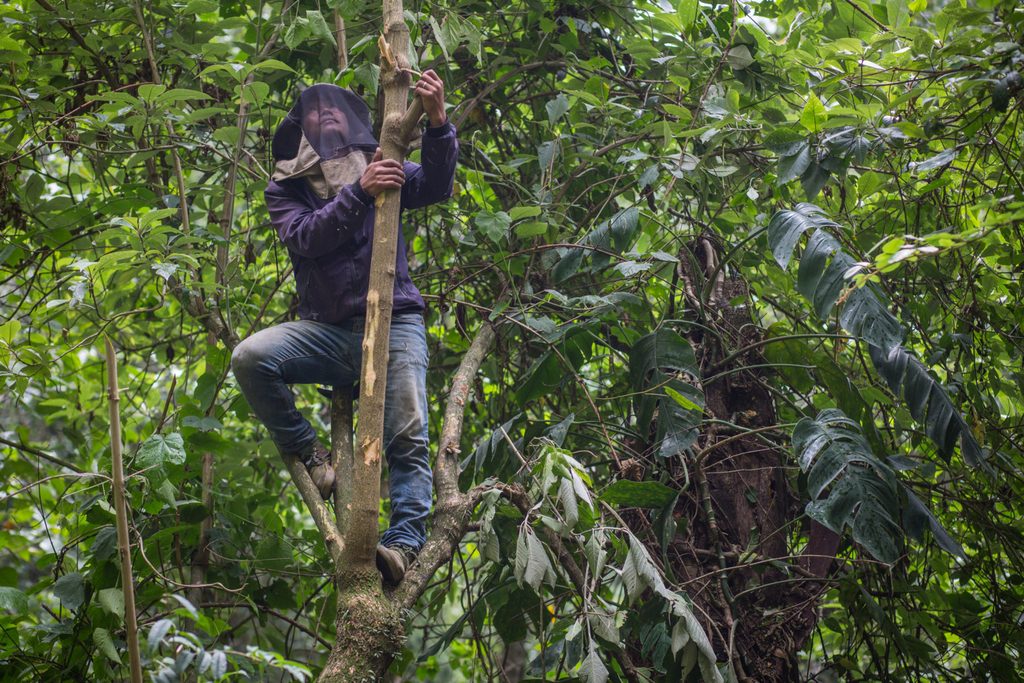
The Bee at the Center of It
Understanding the honey hunters of Kaski starts with the insect, not the rope. Apis laboriosa, the Himalayan giant honey bee, is the world’s largest honey bee. Workers reach about 3 centimeters in length, noticeably bigger than the common hive bee most readers picture.


Taxonomists argued about its status for decades. It was long treated as a subspecies of the giant honey bee Apis dorsata, and was elevated to full species status in 2020 on evidence that the two overlap in range without interbreeding.
Nesting behavior is what makes the harvest possible and dangerous. Colonies build a single large open comb under overhangs on near-vertical cliffs, typically facing southwest, with multiple colonies often clustered on one cliff. Nests sit mostly between 2,500 and 3,000 meters, while foraging reaches as high as 4,100 meters. A single large colony can hold a substantial honey store, with reported figures running up to around 60 kilograms in peak conditions.
Colonies migrate seasonally, shifting altitude as flowering moves up and down the slope. Hunters track those movements, which is why harvest timing is knowledge rather than guesswork.
Who Harvests, and on What Terms
In Kaski and neighboring districts of the Gandaki region, cliff honey harvesting is carried out principally by Gurung communities. Gurung households in the Annapurna foothills have worked these cliffs across generations, and the practice continues in the present tense. Teams are organized by village, and rights to specific cliffs are held and recognized locally.
Several points deserve care here. Harvesting traditions differ between villages, and between Kaski and Lamjung. Magar and other communities in parts of western Nepal also harvest cliff honey, so this is not a single uniform practice belonging to one group across the country. Readers familiar with our guide to Nepal’s ethnic groups will recognize the pattern: a practice is specific to communities and places, not to Nepal as a whole.
Some aspects of the harvest carry ritual significance, including offerings made before a team descends. Where those practices are treated as private or restricted by the community, they are not ours to detail, and visitors should not press for access to them.
The Mechanics of a Harvest
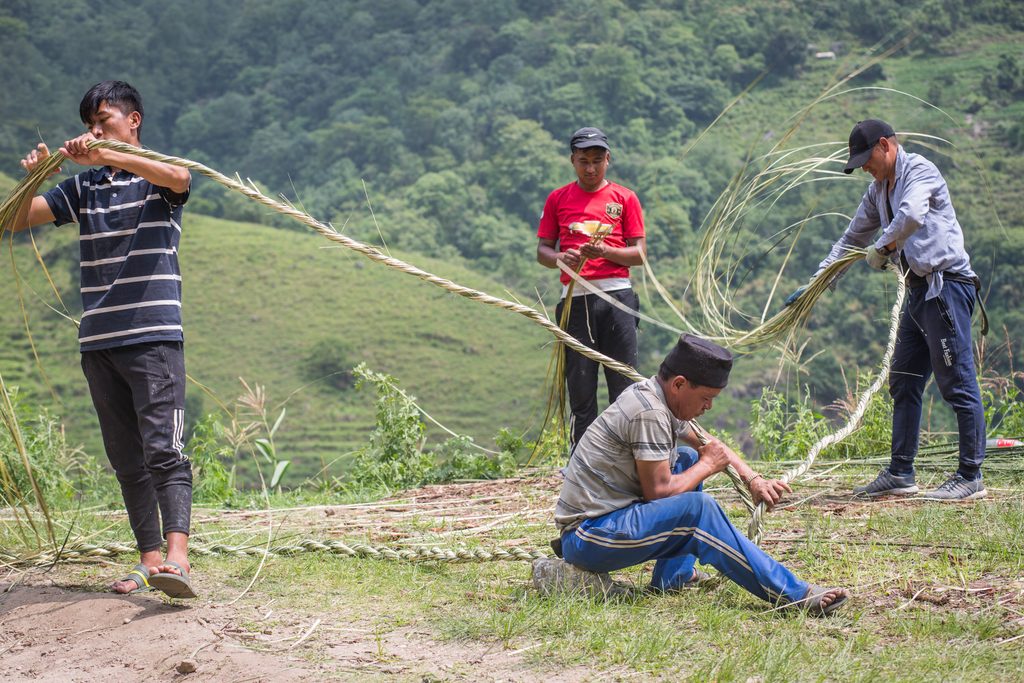
A harvest is a coordinated operation involving a team, not a solo climb. Broad mechanics are consistent across documented sites in the Gandaki hills.
- Equipment. Ladders are made from bamboo and natural fiber rope, assembled before the harvest and anchored at the cliff top.
- Smoke. A fire set at the base of the cliff sends smoke upward to move bees off the comb. Smoke reduces defensive stinging, and does not eliminate it.
- Cutting. A harvester on the ladder uses long poles, one to cut the comb and one to guide it into a basket lowered on a line.
- Ground team. Others manage ropes, fire, and baskets, and relay instructions since the harvester cannot see much below.
- Timing. Harvests happen in spring and autumn, corresponding to different honey types and flowering cycles.
Risk is real. Falls, mass stinging, and rockfall are all documented hazards. Describing the work as thrilling misses the point: for the households involved, it is skilled, dangerous labor with an economic purpose.
Spring Honey, Autumn Honey, and the Grayanotoxin Question
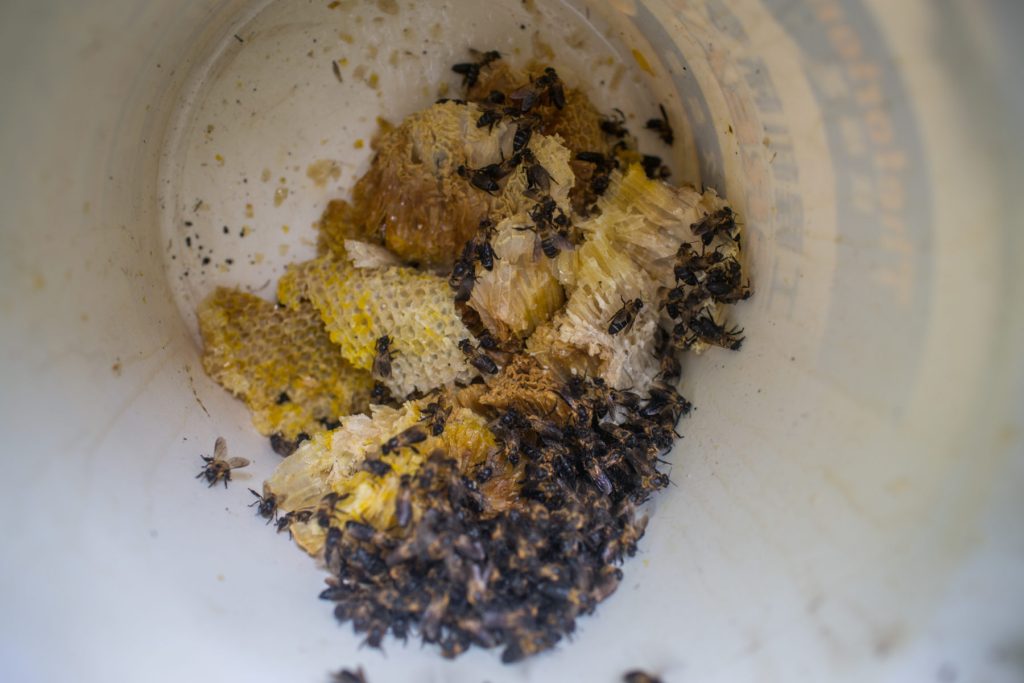
Honey from these colonies is not one product. Three broad types are distinguished: a spring honey from high-altitude flowering, a spring honey from mid and lower altitudes, and an autumn honey.
Interest from abroad concentrates on the first. Where bees forage heavily on certain rhododendron species, nectar carries grayanotoxins, naturally occurring compounds that affect the nervous system in humans. Honey from those harvests is what international buyers market as “mad honey.”
Evidence on effects deserves plain language. Grayanotoxin poisoning in humans is medically documented and can cause low blood pressure, slowed heart rate, nausea, dizziness, and in serious cases, cardiac complications requiring hospital treatment. Claimed medicinal benefits are a separate matter, and researchers studying Nepali cliff honey have disputed them. Ratna Thapa, a bee scientist at Tribhuvan University, has pointed out that documented effects are on the nervous system rather than any proven therapeutic action.
Anyone writing about this honey as a wellness product is making claims the evidence does not support.
The Economics That Changed Everything
Price is the single biggest change in this system over two decades, and it drives most of what follows.
Reporting from Nepal’s hill districts tracks local prices rising from roughly 500 Nepali rupees per liter around twenty years ago to about 2,500 rupees today. In dollar terms, accounts from honey hunting villages describe a move from around 3.50 US dollars to roughly 20 US dollars per liter locally. Export pricing sits in a different universe, with small bottles sold internationally at figures reported above 100 US dollars per 250 grams.
Follow that gradient and the pressure becomes obvious. When a cliff that once supplied household use and modest trade becomes a source of export income, the incentive to harvest more often and more completely rises sharply. Surendra Raj Joshi, who has researched these systems for years, has argued for exactly the opposite approach: harvest only part of each comb, give hunters recognized ownership and management responsibility for cliffs so protection pays, and generate income from bee-watching rather than extraction alone.
| Indicator | Roughly two decades ago | Recent reporting |
|---|---|---|
| Local price per liter | About NPR 500 | About NPR 2,500 |
| Local price in USD per liter | About $3.50 | About $20 |
| Yield from a productive nest (Naiche, Lamjung) | About 15 liters | Under 200 milliliters in recent harvests |
| Nests at one site near Naiche | 22 | Fewer than half remain |
Figures in the lower two rows come from reporting at Naiche village in Lamjung district, not Kaski. They are included because they are among the few site-level numbers in the public record, and they indicate the scale of change across the Gandaki hills. Equivalent published figures for specific Kaski cliffs are harder to find, and should not be assumed identical.
What the Research Shows About Decline
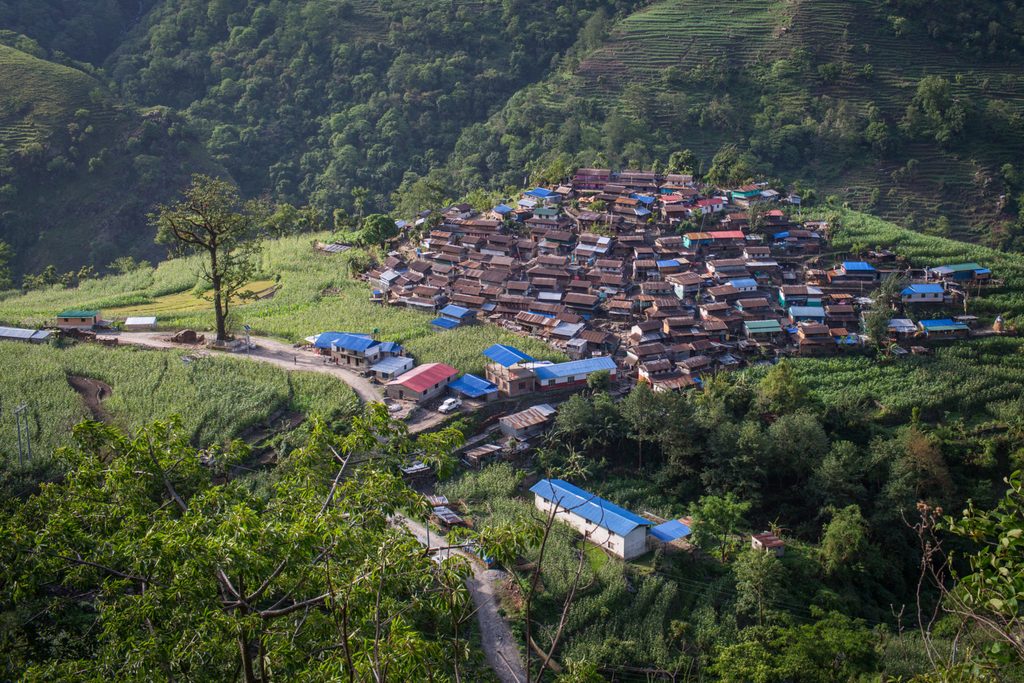
Scientific attention to these populations goes back further than the recent wave of coverage. A 2003 ICIMOD publication by Joshi, Ahmad, and Gurung documented the Himalayan cliff bee and the honey hunter communities of Kaski district, recording nesting site characteristics, local bee flora, and traditional practice, and warning that habitat change and human interference threatened the bee’s continued presence. A related paper on the status of Apis laboriosa populations in Kaski appeared in the Journal of Apicultural Research in 2004.
Subsequent work in Kaski and Lamjung reports declines both in the number of colonies per cliff and in the total number of cliffs holding nests. Causes identified across studies include pesticide use in agricultural areas within foraging range, habitat and forest change, infrastructure development, pest and disease pressure, and unsustainable harvesting.
One widely quoted figure needs a caveat. Thapa has been quoted describing roughly a 70 percent annual decline in the Himalayan cliff honey bee population. Such a rate, applied literally and continuously, would have eliminated the species within a few years, which has not happened. Read that figure as a researcher’s alarm about severity in specific monitored sites, not as a national population trend you can project forward. Honest reporting on this subject means saying that systematic national monitoring of Apis laboriosa does not exist.
On infrastructure, the clearest documented case again comes from Lamjung, where hydropower development in the Nyadi basin has been linked by residents and researchers to pressure on nearby colonies through water diversion and construction disturbance.
Where This Sits in the Wider Landscape
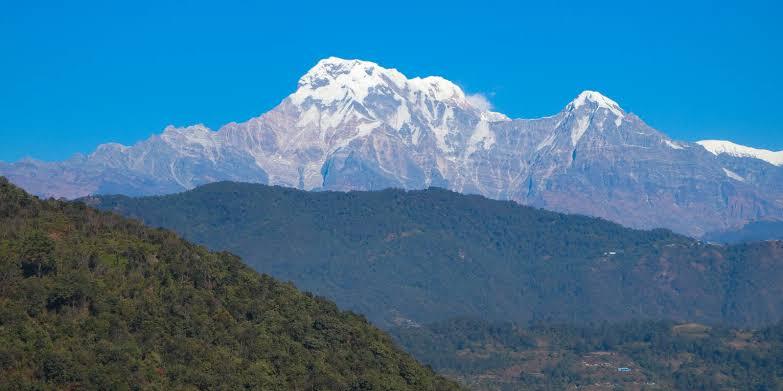
Kaski district is the administrative home of Pokhara and the gateway to much of the Annapurna region. Gurung villages across these hills, including well-known settlements like Ghandruk and Dhampus, sit within a landscape of terraced farming, forest, pasture, and increasingly, tourism income. Honey harvesting is one strand in that mix, not the whole of it, and framing these communities around a single dramatic activity flattens them.
Travelers planning time in the region will find the practical groundwork in our Pokhara travel guide.
Visiting Responsibly, If at All
Commercial honey hunting tours now operate in Nepal, and they raise genuine questions. A harvest staged for a paying group is a harvest driven by a schedule rather than by the condition of the colony. Several researchers have argued that tourism can help if revenue is tied to protecting cliffs rather than to cutting comb.
Practical guidance for anyone considering it:
- Ask who holds rights to the cliff and whether the community agreed to the visit, rather than assuming the operator arranged it properly.
- Ask whether the harvest would happen regardless of your presence.
- Do not ask to photograph or attend rituals that your hosts describe as private.
- Be skeptical of health claims attached to honey you are offered for sale.
- Understand that grayanotoxin honey can cause genuine poisoning, and that dosage is not controlled.
Buying honey directly from harvesting households returns more value locally than buying a branded export bottle. That does not resolve the underlying pressure on colonies, and it is worth being honest that no purchase makes the problem go away.
What Would Actually Help
Researchers working on these systems converge on a short list. Recognize community ownership of cliffs so that protection has a clear beneficiary. Shift harvesting norms toward partial comb removal. Reduce pesticide use within foraging range of known nesting cliffs. Protect the forest flora the bees depend on through the season. Establish monitoring that produces repeatable colony counts, so that decline can be measured rather than estimated from memory.
None of that happens without the households who hold the knowledge. Gurung harvesters in Kaski are the people with multi-generational observation of where colonies nest, when they move, and how yields have changed. Conservation that treats them as an obstacle rather than as the primary source of data will not work.
Frequently Asked Questions
What bee produces Nepal’s cliff honey?
Apis laboriosa, the Himalayan giant honey bee, the world’s largest honey bee species, with workers reaching about 3 centimeters. It builds a single open comb under cliff overhangs, generally between 2,500 and 3,000 meters, and forages as high as 4,100 meters.
When does honey hunting happen in Kaski?
Harvests take place in spring and autumn, timed to flowering cycles and to the colonies’ seasonal altitude movements. Exact timing varies by cliff and village, and is decided locally rather than by a fixed calendar.
Is “mad honey” dangerous?
It can be. Honey from colonies foraging on certain rhododendrons contains grayanotoxins, and poisoning is medically documented, with effects including low blood pressure, slowed heart rate, nausea, and dizziness. Severe cases need hospital treatment. Potency varies between harvests and is not standardized.
Does mad honey have proven medicinal benefits?
No. Marketing claims are widespread, but researchers working on Nepali cliff honey have disputed them, noting that what is documented are effects on the nervous system rather than therapeutic action.
Are cliff bee populations really declining?
Studies in Kaski and Lamjung report fewer colonies per cliff and fewer occupied cliffs, and site-level accounts describe sharp drops in yield. National systematic monitoring does not exist, so the scale of decline across Nepal is not precisely known. Causes identified include pesticides, habitat change, infrastructure, pests, and over-harvesting.
Which communities harvest cliff honey in Nepal?
In Kaski and the surrounding Gandaki hills, Gurung communities are the principal harvesters. Practices and rights are village-specific. Elsewhere in western Nepal, Magar and other communities also harvest, so this is not one uniform national tradition.
Can tourists watch a honey harvest?
Commercial tours exist. Whether to join one is a judgment call, and the honest answer is that a harvest timed around visitors is a harvest driven by a schedule rather than by colony health. If you go, ask who holds rights to the cliff, whether the community consented, and whether the harvest would occur anyway.
How much honey does one colony produce?
Large colonies in good conditions have been reported holding up to around 60 kilograms of honey. Real harvests vary enormously, and recent accounts from declining sites describe yields of a fraction of a liter where 15 liters was once normal.
Key sources for this article include ICIMOD’s study of the Himalayan cliff bee and the honey hunters of Kaski and Dialogue Earth’s reporting from honey hunting villages in the Gandaki hills.
NepalVue reports on Nepal’s communities and landscapes with the detail they deserve. Save this guide, share it with anyone who has only seen the rope-ladder photographs, and follow NepalVue for more from the Gandaki hills.