



An invitation to a Nepali home during Dashain is worth rearranging your itinerary for. It is also the moment most travelers realize they have no idea what is expected of them. Here is the short version, and then the detail: arrive in the late morning or early afternoon, bring a small gift of fruit or sweets, wear something clean and modest with shoes you can slip off, expect to receive tika and jamara from an elder, and expect to be fed considerably more than you planned. Everything else in this guide is about the edge cases: what to do if you are uncomfortable, what not to photograph, and how to say no without causing hurt.
Why This Is Different From Watching a Festival
Public festival etiquette and household etiquette are not the same subject. Our guide to attending a Newari jatra respectfully covers street rituals, where you are one of many spectators and the main duties are about crowd behavior and photography. Dashain works differently. You will be inside someone’s home, on the most significant family day of their year, in the middle of a rite about lineage and blessing. Your role is guest, not observer.
Good news: Nepali hospitality is forgiving. Hosts expect foreigners to get details wrong and rarely mind. Understanding Dashain etiquette for tourists is not about performing the rituals perfectly. It is about not putting your host in an awkward position.


When Invitations Happen, and Which Day You Are Being Asked For
Most invitations land on or after Vijaya Dashami, which falls on Wednesday, October 21 in 2026. Tika visiting continues for the following four or five days, until Kojagrat Purnima on October 25, as families work through their rounds of relatives. An invitation for day 11 or 12 is completely normal and no less meaningful.
| Day | 2026 date | What the invitation likely means |
|---|---|---|
| Maha Ashtami | Oct 18 | Possible meal invitation. Sacrifice may occur in some households. |
| Maha Navami | Oct 20 | Puja day. Invitation usually for food rather than ritual participation. |
| Vijaya Dashami | Oct 21 | Tika day. The main event. Eldest family members give blessings. |
| Days 11 to 15 | Oct 22 to 25 | Extended tika visiting. Relaxed, social, still significant. |
Confirm dates against a current Nepali patro. For the full calendar, see our 2026 festival dates guide.
Receiving Tika and Jamara
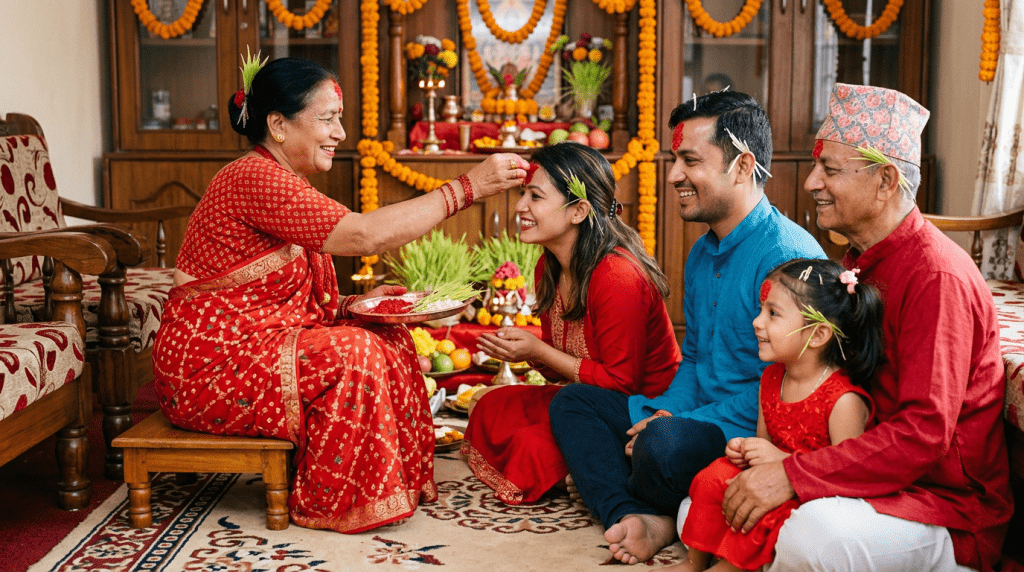
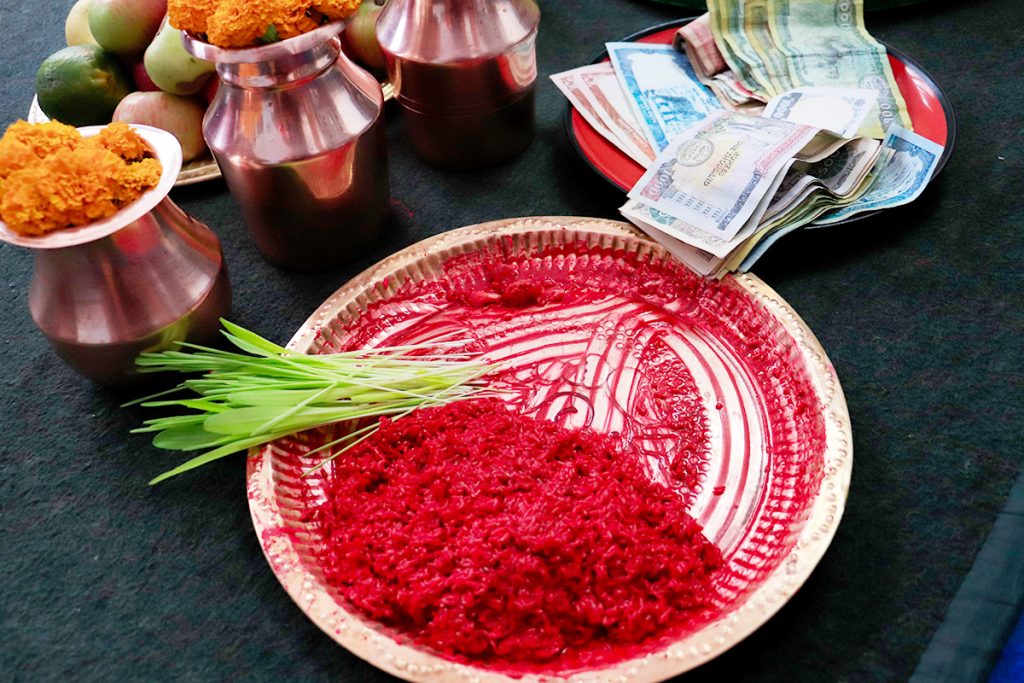
Tika is a paste of rice, yogurt and red vermilion, pressed onto the forehead by someone older than you. Jamara is the pale yellow barley grass sown on Ghatasthapana fifteen days earlier, tucked behind your ear or over your ear and hair. Both come with a blessing, sometimes a spoken Sanskrit mantra, sometimes just a few words in Nepali.
What to do, step by step
- Remove your shoes at the door. Always, without being asked.
- Wait to be called. Tika follows seniority, oldest to youngest, and there is an order to it. Do not step forward out of turn.
- Bow your head slightly and stay still. Many people join their palms in a namaste gesture at chest height.
- Some younger Nepalis touch an elder’s feet, called dhog. You are not expected to. A namaste is sufficient and no one will think less of you.
- Accept the jamara. Leaving it in is polite for the rest of the day.
- Say dhanyabad, or simply thank you. Both work.
Afterward an elder may hand you dakshina, a small amount of cash, often 100 or 500 rupees. Take it with your right hand, or both hands. Do not refuse it and do not try to give it back. It is a blessing, not payment, and refusing reads as rejecting the blessing itself.
If you do not want tika on your forehead
Say so gently and early, before the plate reaches you, not as the thumb is coming toward your face. A simple line works: “I would love the blessing and the jamara, but may I skip the tika?” Most hosts will place a tiny mark or hand you the jamara only. Reasons people ask vary: religious commitments, skin sensitivity, a work meeting later. You do not owe a detailed explanation, and a calm one-sentence version is far better than visible flinching at the moment itself.
What to Wear
Dashain is a new-clothes festival. Families buy new outfits for it, and your host has dressed up. Matching that effort is the main courtesy.
- Cover shoulders and knees. Long trousers or a long skirt, sleeved top.
- Clean, easily removable shoes. You will take them off repeatedly if you visit more than one house.
- Avoid black as the dominant color. Bright colors, especially red, suit the occasion. Nobody will correct you, but you will fit in better.
- Women are welcome to wear a kurta surwal if they have one. Nepali hosts generally find it a compliment rather than costume, provided it is worn as ordinary clothing.
- Leather items are best left outside the puja room in some households. If your host mentions it, comply without discussion.
Gifts
Nobody expects a gift. Bringing a small one is still appreciated and easy to get right.
- Fruit, boxed sweets or a good packet of tea are safe and standard.
- If there are children, sweets or a small toy is welcome.
- Something from your home country, even inexpensive, is often more appreciated than something expensive bought locally.
- Alcohol is risky. Many Bahun-Chhetri households do not drink or serve it, while in many Janajati and Newar households it is entirely normal. Ask your host or leave it out.
- Avoid giving cash to adults. Cash flows downward in this festival, from elder to younger, and reversing it is awkward.
Food, and How to Handle Being Overfed
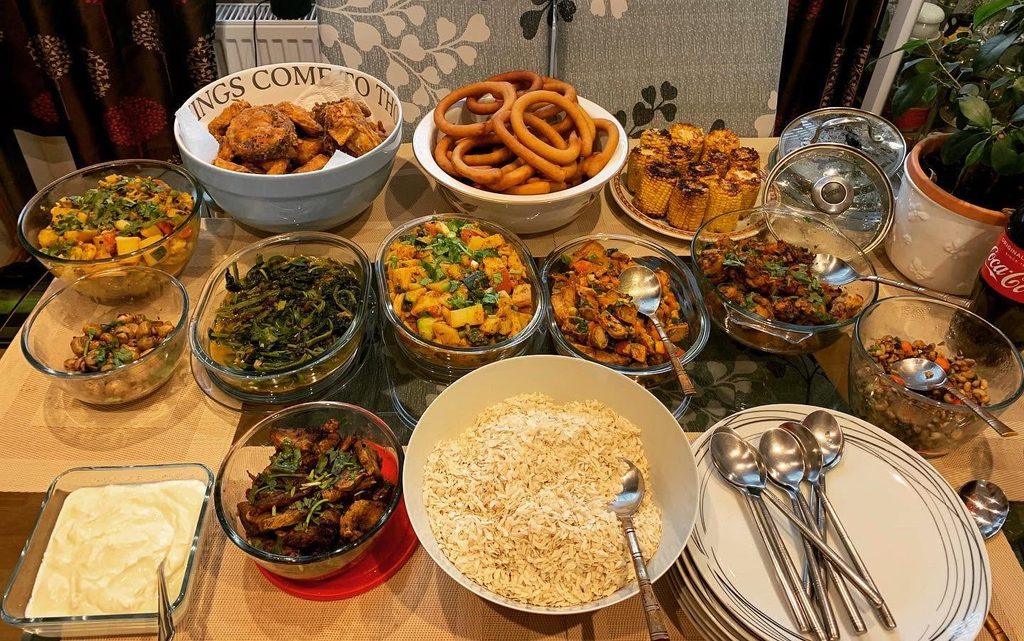
You will be served more than you can eat. Dashain food varies by household, community and region, so do not assume a fixed menu. In many hill Hindu households the festival meal centers on goat curry, rice, and seasonal vegetables. Among Newar families the spread may include bara, chhoyla, aila and a sequence of items with their own order. In many Terai households the emphasis differs again, and plenty of families across all communities eat entirely vegetarian.
Practical rules for the table:
- Eat with your right hand if you are eating by hand. Spoons are usually available and using one is fine.
- Do not offer food from your plate to anyone else. Once food touches your plate or lips it becomes jutho, ritually used, and sharing it is unclean in many households.
- Do not touch serving spoons or common dishes with a used utensil.
- Refusing a second and third helping takes several attempts. Covering your plate lightly with your hand and saying “pugyo,” meaning enough, is the local move.
- If you are vegetarian, vegan or have an allergy, say so when you accept the invitation, not at the table. Nepali cooking uses ghee and dairy widely, and a host needs warning.
For more on festival food across communities, see our guide to sel roti, the ring-shaped rice bread more associated with Tihar than Dashain but present at both in many homes.
Animal Sacrifice: What It Is and What to Do
This is the part most visitors worry about, so let us be plain about it.
What it means
In the Shakta Hindu tradition that underpins Dashain, blood offering to Durga and her fierce forms is an act of devotion, most concentrated on Maha Ashtami and Maha Navami. Animals offered are usually goats, ducks, chickens or buffalo. Meat is not discarded. It is taken home, cooked and eaten as prasad, blessed food shared by the family. Within the tradition, this is an offering and a meal, not a display, and the same animals would be eaten in any case.
Where you may encounter it
Sacrifice happens at specific shrines such as Dakshinkali and Bhadrakali, at the Kot courtyard in Hanuman Dhoka where the army conducts large-scale rites on Ashtami night, and in some private courtyards and neighborhoods. Away from those places and days, you are unlikely to see it.
Many households do not sacrifice at all
Assume nothing about your host. A large and growing number of Hindu families offer coconut, pumpkin, ash gourd, cucumber or sugarcane instead, either from personal conviction, family tradition or animal-welfare sentiment. Vegetarian households are common. Among many Himalayan Buddhist communities, and in Kirat communities in the eastern hills whose main festivals are Ubhauli and Udhauli rather than the Durga cycle, the question may not arise at all. Traditions vary by community and region, and it is entirely reasonable to ask your host what their family does.
How to decline participation
If you are invited to attend or witness a sacrifice and do not want to, decline simply and without judgment. “Thank you, I would rather wait here” is complete. Do not explain that you find it cruel, do not describe your ethical position, and do not compare it to practices at home. Your host is not asking for your assessment. Stepping outside for ten minutes is completely normal behavior, including for Nepalis who do not enjoy it.
If you would like to attend, ask first, stand well back, do not block participants, and do not film unle3s you are explicitly told it is fine. A camera raised at a sacrifice without permission is the single most common way visitors give real offense during this festival.
Photography Inside a Home
- Ask once, clearly, before taking the first photo of the day. A yes generally covers the visit.
- Do not photograph the puja room, the family shrine or the kalash unless invited to.
- Tika being applied to a child is charming and is also a family moment. Ask the parent, not the child.
- Never photograph anyone mid-prayer with their eyes closed.
- Offer to send the photos, and then actually send them. Nepali families appreciate this far more than most visitors expect.
Declining the Invitation Itself
Sometimes you genuinely cannot go: a flight, a trek start, illness, or simply exhaustion. Turning down a Dashain invitation is not rude, but how you do it matters.
- Decline quickly rather than leaving it open. Hosts cook for numbers.
- Give a concrete reason. “I am leaving for Pokhara that morning” lands much better than a vague no.
- Express real regret and, if possible, propose an alternative. Tea the day before, or a visit after Kojagrat Purnima, keeps the relationship warm.
- If your guide or driver invited you, be aware they may have already told their family. Decline as early as you can.
- A small gift sent anyway, with a short note, closes the loop gracefully.
Things Visitors Get Wrong
- Treating the tika as a photo prop. Getting tika and then immediately posing for a series of selfies before the elders have finished blessing everyone reads badly.
- Wiping the tika off in the house. If you must remove it, wait until you leave.
- Stepping over people or over food. Walk around, always.
- Pointing feet at the shrine or at people. Sit cross-legged or tuck your feet under you.
- Assuming everyone celebrates. In many Nepali households Dashain is central. In others it is a public holiday and nothing more, and in some it is actively declined for historical and political reasons. Asking “do you celebrate Dashain?” is a better opener than “happy Dashain.”
- Turning up empty-handed and late on tika day. Late afternoon on Dashami, the household has been doing this since morning and is tired.
Frequently Asked Questions
Can non-Hindus receive tika?
Yes. Tika within a household is a family blessing and foreigners are routinely included. If your own faith makes a forehead mark uncomfortable, say so in advance and accept the jamara instead.
Should I take off my shoes?
Always, at the door, without being asked. Keep socks on if you prefer. Shoes come off again at any temple you visit afterward.
What should I bring to a Dashain invitation?
Fruit, boxed sweets or good tea. Sweets for the children. Skip alcohol unless you know the household drinks, and skip cash gifts to adults.
Do I have to eat meat?
No. Say you are vegetarian when you accept the invitation, and your host will cook accordingly. Many Nepali households are vegetarian anyway, and Nepali vegetarian cooking is excellent.
Is it rude to refuse dakshina money?
Yes, mildly. Accept it with your right hand and thank the giver. It is a blessing tied to seniority, not a transaction.
What if I am upset by seeing animal sacrifice?
Step away. Nobody will be offended by you leaving quietly. Avoid Dakshinkali and Hanuman Dhoka on Ashtami and Navami if you would rather not encounter it at all.
How long should I stay?
Two to three hours is typical for a tika and meal visit. Watch for other relatives arriving, which is the natural cue to make room.
Do I say “Happy Dashain”?
“Happy Dashain” is widely used and understood. Bijaya Dashami ko subhakamana is the fuller Nepali greeting and is always well received if you attempt it.
Before You Accept
Read up on the festival’s structure so the rituals make sense while you are in the room: our Dashain festival guide covers the fifteen days, and what closes during Dashain explains why your host’s neighborhood has gone quiet. For official guidance on festival travel, the Nepal Tourism Board publishes holiday and visitor information each season.
One last thing. Hosts remember guests who showed up, took their shoes off, ate what was offered and asked questions with genuine curiosity. Nobody remembers whether you bowed correctly. Save this guide, share it with anyone traveling to Nepal in October, and explore more of NepalVue for the rest of the festival season.


