


Most people arrive in Pokhara planning to trek, and then they look up. A few hundred colorful wings are circling above Phewa Lake on any clear morning, and within a day or two the plan changes. That is how paragliding in Pokhara, Nepal went from a niche activity to one of the country’s signature adventures, drawing tens of thousands of first-time flyers every single season. You do not need experience. You do not need to be fit. You just need a clear sky and the nerve to run a few steps off a grassy hill.
Here is what most tour pages will not tell you up front, and what actually matters before you book.
Why paragliding in Pokhara is world-class
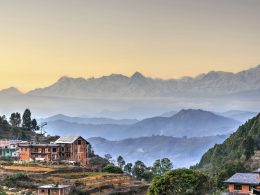
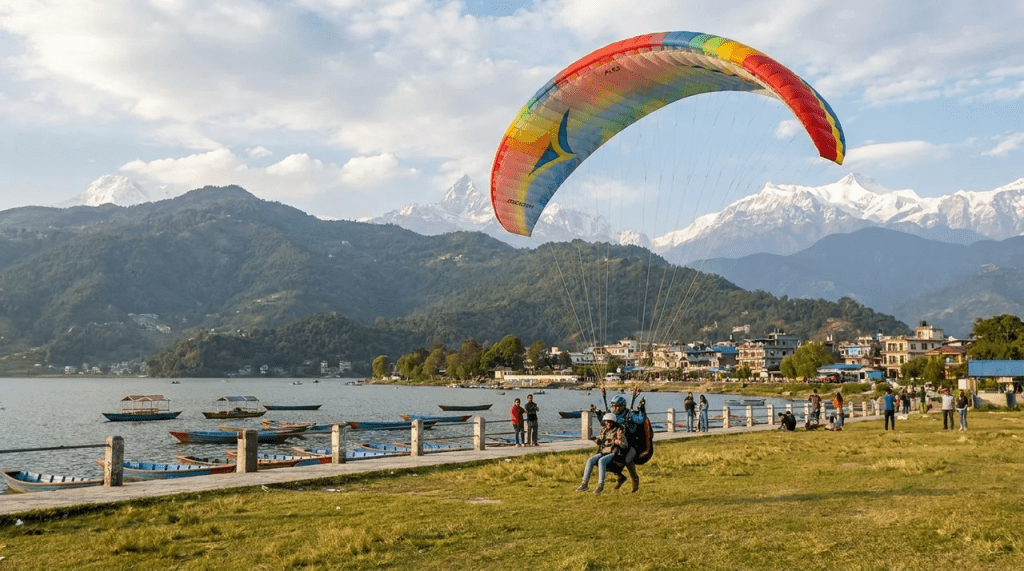
Pokhara is regularly ranked among the top five tandem paragliding sites on the planet, and the reason is geography, not marketing. Few places on Earth let you launch a wing with an 8,000-meter mountain range filling the horizon. Sarangkot, the main launch hill, sits at roughly 1,592 meters and faces directly toward the Annapurna massif and the unmistakable spike of Machhapuchhre, the fishtail peak.
What makes the flying so reliable is the valley itself. Warm air rising off the lowlands hits the steep wall of the Himalaya and produces consistent, predictable thermals almost every day of the dry season. Pilots here are not seasonal hires. Many are career tandem pilots with thousands of hours logged in this exact valley, and they know every wind quirk and every reliable lift band. That local knowledge is the quiet reason the experience feels so smooth.
Combine the mountains, the mirror-flat lake below, and stable air, and you get something rare: a flight that beginners can do safely while still being genuinely spectacular. Pretty much nowhere else delivers all three at once.
What a tandem flight actually feels like
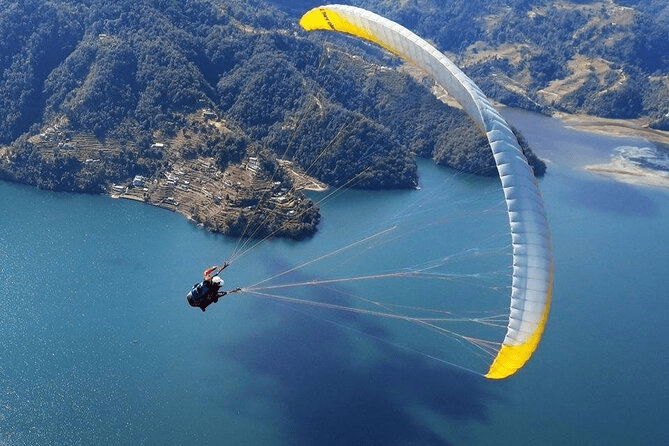
Forget the idea of jumping off a cliff. A tandem launch is gentle. Your pilot clips you into a harness in front, the wing inflates behind you, and the two of you jog maybe five or six steps down the slope of Sarangkot. Then the ground simply drops away and you are sitting in a comfortable seat in the sky.
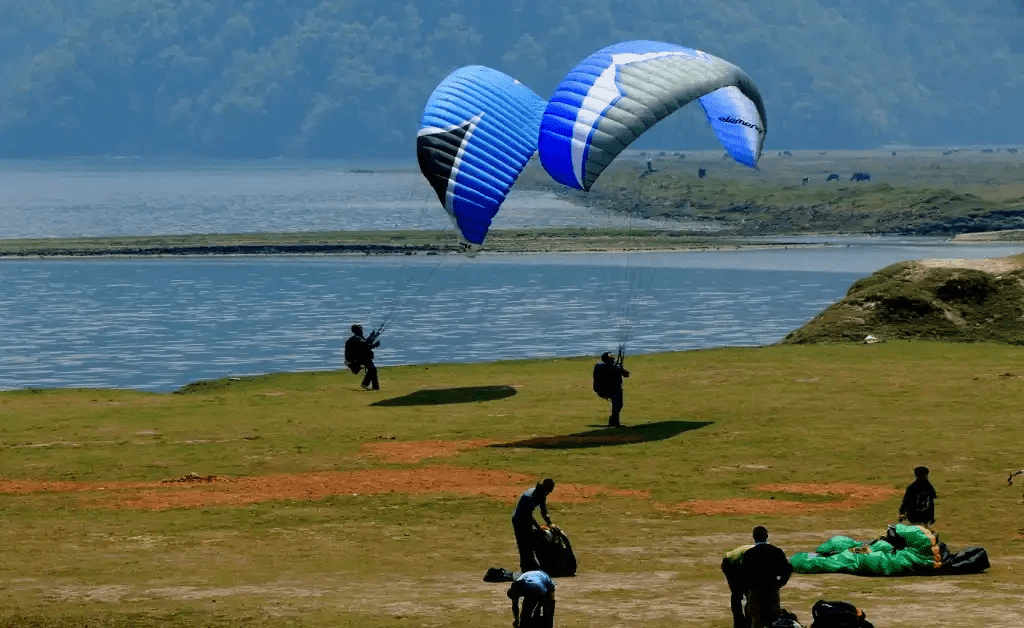
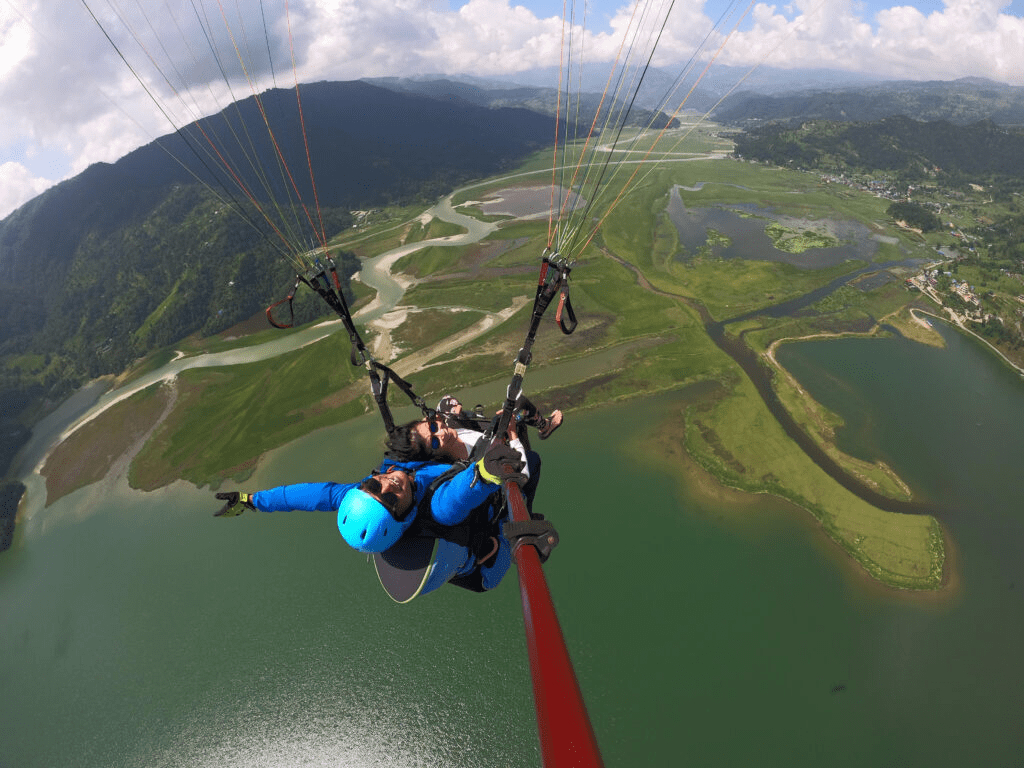
For the next 20 to 30 minutes on a standard flight, you drift over terraced hillsides and the deep green of Phewa Lake. On a good thermal day your pilot will spiral upward, sometimes sharing the airspace with hawks and eagles riding the same lift. Then comes the landing, which happens on a flat field right beside the lake at Lakeside. You lift your legs, the pilot does the work, and you touch down walking.
Flight types you can choose
- Standard tandem: 20 to 30 minutes, the default choice for almost everyone. Calm, scenic, and beginner-friendly.
- Cross-country tandem: 40 to 60 minutes, using thermals to travel several kilometers across the wider valley. Best if you want maximum air time and do not get queasy easily.
- Acro or adventure flights: spirals, wing-overs, and other maneuvers added on request. These cost extra and are not for nervous stomachs. Tell your pilot clearly if you do not want any acro.
How much does it cost in 2026?
Prices move with the season and the operator, so treat any single number with suspicion. As of early 2026, a standard tandem flight typically runs between roughly NPR 8,000 and NPR 13,000, which works out to about USD 80 to 120 per person. Cross-country flights cost more because you are in the air far longer.
What that fee almost always covers: hotel pickup and drop-off within Lakeside, all equipment, the licensed pilot, insurance, and a set of photos and video shot from a camera mounted on the pilot’s wrist or wingtip. Adding acro maneuvers usually costs a small amount more, often around NPR 1,500 extra.
One honest warning. If someone quotes you a price that looks dramatically cheaper than everyone else, ask why. Rock-bottom operators sometimes cut corners on gear maintenance or pilot certification, and that is precisely the wrong place to save money. Pay the going rate and fly with a properly licensed company.
When to go paragliding
Season matters more than almost anything else for this activity. The flying window runs from roughly early October through the beginning of May, when the skies are dry and the air is stable. November and December are the standout months: crisp visibility, snow on the peaks, and dependable thermals.
September and the March-to-May stretch are also excellent and a little less crowded. Monsoon season, from June through August, mostly grounds flights because of cloud, rain, and unstable air. A few clear monsoon mornings happen, but you cannot plan a trip around them.
Within any given day, late morning is prime time. Thermals usually switch on around 11 a.m., so flights from about 11:00 to early afternoon tend to give the longest, smoothest rides. Most operators take their last takeoff around 3 p.m. If you want to understand how the seasons shape every kind of trip here, our guide to the best time to visit Nepal breaks it down month by month.
How to get to the launch site
Sarangkot sits on a ridge northwest of the city, about a 30-minute drive from Lakeside on a winding uphill road. You will not need to arrange this yourself. When you book, the operator includes a jeep or van transfer that collects you from your hotel and carries you up to the launch point. After landing back at Lakeside, you are already in the heart of town.
If you are new to the city and figuring out where to stay, eat, and base yourself, our full Pokhara travel guide covers Lakeside and the surrounding area in detail.
Is it safe? An honest look
The truth is that paragliding carries real risk, but in Pokhara the overall safety record is strong given how many flights happen each season. Where things have gone wrong over the years, the cause has usually traced back to one of three things: an unlicensed operator, failing or budget equipment, or flying in conditions that should have grounded everyone that day.
You can stack the odds heavily in your favor. Choose a company with internationally certified pilots and visible licensing. Do not pressure a pilot to fly if they say the wind is wrong, because a canceled flight is annoying but a bad-weather flight is dangerous. A reputable operator will simply rebook you rather than launch into sketchy air.
Who can fly
Most operators set a passenger weight range of roughly 25 kg to 100 kg. Going over the upper limit may mean an extra fee or a larger wing, so mention your weight when booking if it is near the cap. Age limits are flexible, and children can fly with parental consent, though each company sets its own rules. If you have a serious heart condition or are pregnant, skip it and talk to a doctor first.
What to wear and bring
Dress for a cool, breezy morning even if Lakeside feels warm at ground level. It is several degrees colder up at Sarangkot and colder still in the air.
- Long pants and a t-shirt, with a windproof jacket over the top.
- Sturdy closed shoes or sneakers. Flip-flops and sandals are not allowed for the running launch.
- Sunglasses and a little sunscreen, since you are facing open sky.
- Light gloves in the colder months, which make a real difference.
Leave loose items behind. Your phone can slip out of a pocket fast at altitude, so let the pilot’s mounted camera handle the photos.
Booking tips that save you hassle
You can book two ways. Walk into any licensed operator office along Lakeside the day before, or reserve online in advance through a certified company. For the October-to-December peak, booking 24 hours ahead is smart because flights fill up and good weather windows get busy.
A few practical notes. Arrive at the Lakeside office about 30 minutes before your slot. Confirm exactly what is included, especially photos and video, before you pay. And build flexibility into your schedule, since wind can push your flight to a later slot or the next morning. If Pokhara is part of a bigger trip, our Nepal travel guide for beginners helps you fit the adventure into a sensible itinerary.
Frequently asked questions
Do I need any paragliding experience to fly in Pokhara?
No. Tandem flights are built for complete beginners. Your certified pilot controls everything from launch to landing, and your only job is to run a few steps at takeoff and lift your legs at landing.
How long does a paragliding flight in Pokhara last?
A standard tandem flight is about 20 to 30 minutes in the air. Cross-country flights run longer, roughly 40 to 60 minutes, using thermals to travel farther across the valley.
What is the best month for paragliding in Pokhara?
November and December offer the clearest skies, the best mountain views, and the most stable thermals. The wider season runs from early October to early May, while monsoon months from June to August are mostly unsuitable.
How much should I expect to pay?
As of early 2026, a standard tandem flight generally costs around NPR 8,000 to 13,000, or roughly USD 80 to 120. That price usually includes transport to and from Lakeside, equipment, insurance, the pilot, and photos and video.
Is paragliding in Pokhara safe?
It has a strong safety record relative to the volume of flights, especially with licensed operators and certified pilots. Most incidents have involved unlicensed companies, poor equipment, or flying in bad conditions, so choosing a reputable operator matters more than anything.
Will I get motion sickness?
Some people feel queasy during tight spiral maneuvers, not during calm gliding. If you are prone to motion sickness, tell your pilot before takeoff and ask for a smooth, straight flight with no acro.
Where do paragliders take off and land?
Flights launch from Sarangkot, a ridge at about 1,592 meters northwest of the city, and land on flat ground beside Phewa Lake at Lakeside. The launch site is roughly a 30-minute jeep ride from town. You can read more about the hill on its Sarangkot Wikipedia page.
Can children or older travelers fly?
Yes, within each operator’s weight range of roughly 25 to 100 kg and with parental consent for minors. Older travelers fly often, since the activity is low-effort. Anyone with a serious heart condition or who is pregnant should not fly. For background on the city itself, see the Pokhara Wikipedia entry.
Few adventures pack so much reward into so little effort. Twenty minutes in the air over the Himalaya, no training required, and a memory that tends to outlast most of the trek photos. If you are heading to Pokhara during the dry season, build in a clear morning and look up.