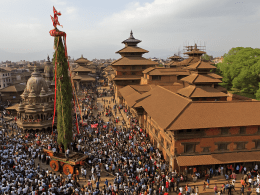



Before the sun has cleared the ridgeline, the rooftops of Nepal are already awake. In the cold blue hour, a woman climbs a narrow stair with a plate held carefully in both hands. Marigold garlands hang over a nearby doorway. A small diyo, the traditional oil lamp, glows beside a threshold. And from the wires, the eaves, and the neighbor’s tin roof comes a sound every Nepali ear knows: the rough, insistent caw of crows.
This is Kaag Tihar, the first day of the five-day festival of Tihar, also known as Yamapanchak. In 2026, it falls on Saturday, November 7 (Kartik 21, 2083 BS). Long before the rangoli, the fireworks, and the singing groups arrive, the festival begins with something quieter and stranger. It begins by feeding the birds that most households spend the rest of the year shooing away.
Kaag Tihar carries a distinctive cultural philosophy. It honors scavengers rather than scorning them. It faces death openly, on the very first morning of a festival of light. And it opens a sacred conversation between humans and the natural world, conducted not in words but in grains, sweets, and a plate left on a roof.


Mythological Significance and Spiritual Meaning
The Crow as Messenger of Yama
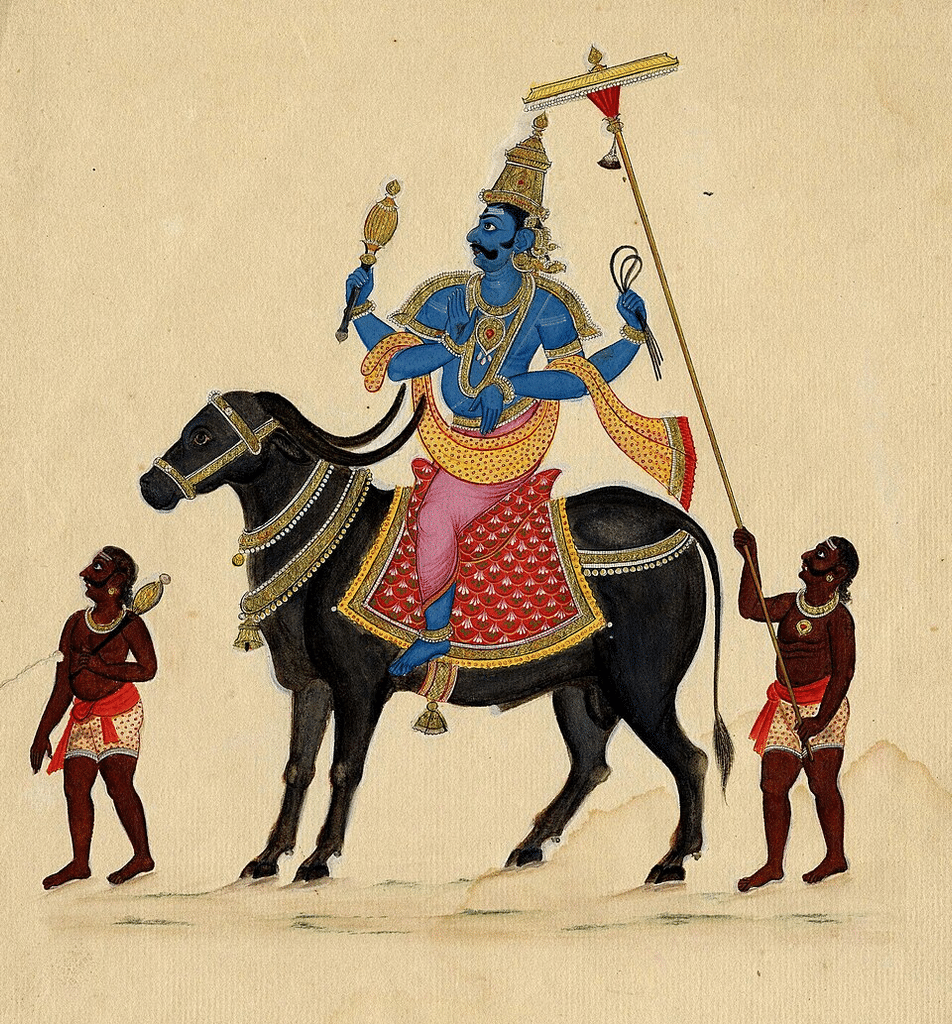
In Hindu cosmology, Yama is the god of death and righteousness, the keeper of the final reckoning. He does not work alone. Crows and ravens are regarded as his messengers, and in some tellings his vehicle. Dogs, honored the following day on Kukur Tihar, are counted among his companions too.
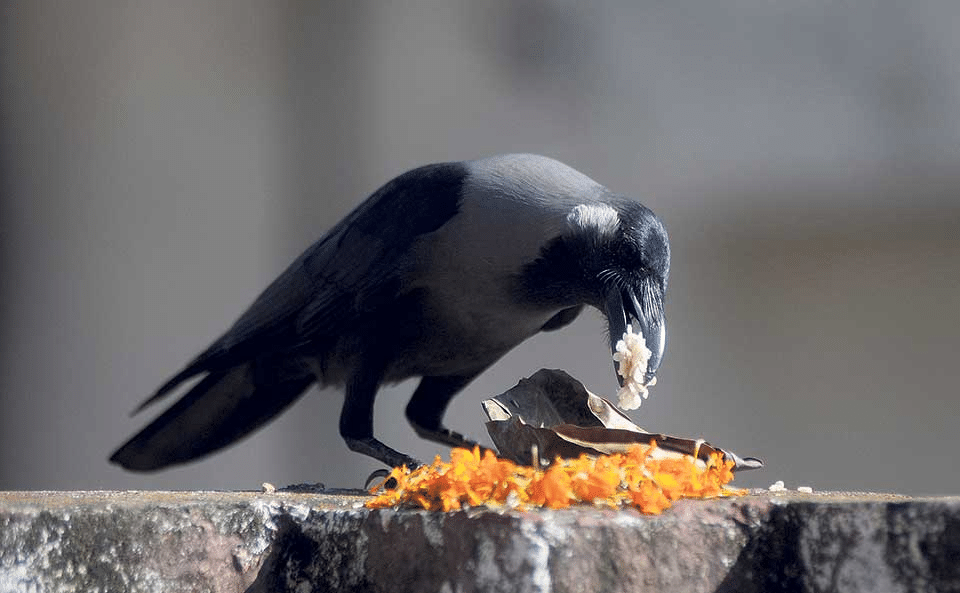
This explains why the crow’s call has long carried a heavy weight in Hindu tradition. A caw at the wrong moment is read as sorrow, a sign that a message from the realm of death may be traveling toward the household. Kaag Tihar turns that old unease into a ritual. Rather than flinching from the messenger, the family welcomes it.
Feeding the Crow to Keep Grief at Bay
The logic is one of respect and diplomacy. A messenger insulted might carry a warning. A messenger honored might carry a blessing. By feeding crows before the household has eaten, families seek to appease Yama and ward off sorrow, bad news, and untimely death in the year ahead. Some accounts frame it as protection against dying before one’s time.
The practice is not driven by fear alone. It is a way of acknowledging that death is a real presence in life, and of meeting it with courtesy.
Crows and the Ancestors
There is a second layer to the crow’s sacred role. Across Hindu practice, crows are also linked with the Pitri, the ancestors. During rites for the departed, food is often set out for crows, and their willingness to eat is widely read as a sign that the ancestors are content. In this wider belief, the crow stands at a threshold. It is a bird of ordinary rooftops that also moves between the living and the dead.
It is worth being careful here. The core story of Kaag Tihar centers on Yama and his messengers. The ancestral link belongs to the broader Hindu understanding of crows. But the two ideas naturally resonate, and many families hold them together: the crow that carries news from death’s realm is also the bird through which the departed are remembered.
The Rituals: How Kaag Tihar Is Observed
Preparing the Offering
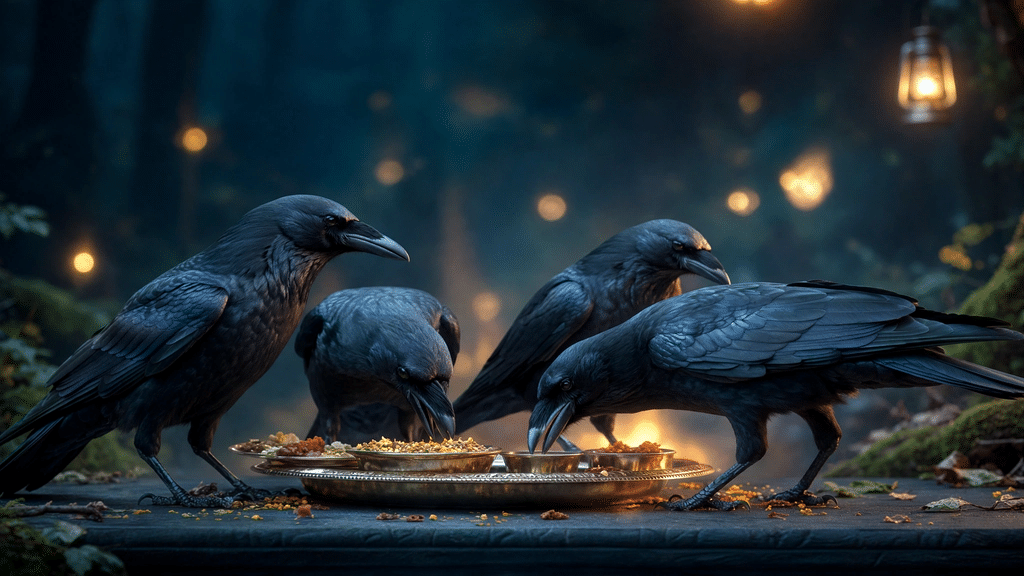
The day begins early. Typically, the women of the household prepare the offering before dawn or at first light, and it is set out before anyone in the family eats. This detail matters. The food must be chokho, a Nepali word for ritually clean and pure. It is prepared in a clean kitchen, usually after bathing, and it is not tasted before it is offered.
The offering is simple and generous. Families commonly prepare cooked rice or beaten rice, grains and seeds, fruits, and sweets. Sel roti, the ring-shaped, deep-fried rice bread made with rice flour, sugar, and cardamom, often appears. So does puri with vegetable curry. Water is offered too. In some households, small pieces of meat are included.
The Rooftop Setting
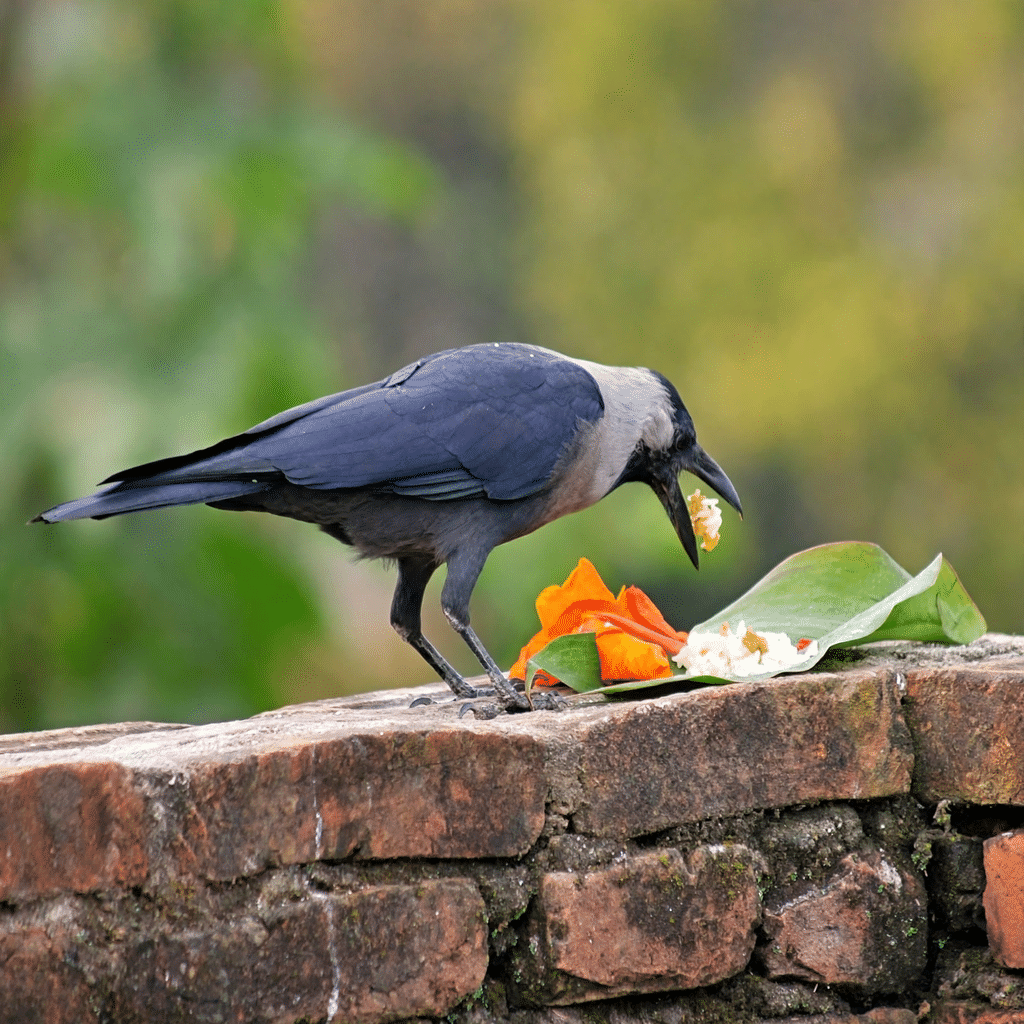
The offering is laid out on rooftops, terraces, courtyards, doorsteps, or open ground near the home. Many families serve it on a tapari, a plate made of leaves stitched together, which is natural, biodegradable, and traditionally used in religious offerings. A small diyo, lit with oil and a cotton wick, often adds a point of light in the pre-dawn dark.
Among the Newar community of the Kathmandu Valley, the day is known as Kwah Puja, the first day of their own five-day celebration called Swanti. The principle is the same. Treats are left on the roof for the crows to feast upon.
Reading the Crows’ Response
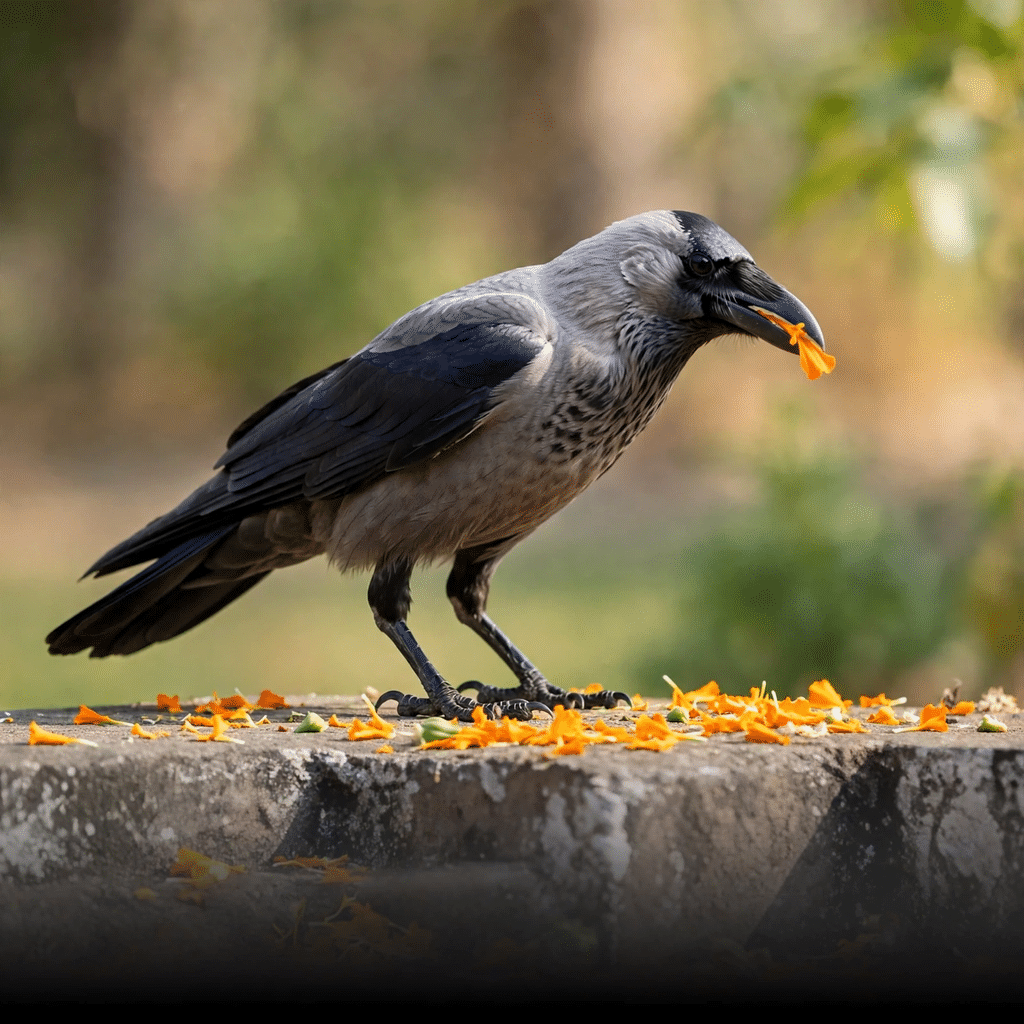
Then comes the waiting. Families watch for the birds to arrive. When crows gather, caw, and eat, the moment is read as acceptance. The cawing is understood as a sign that the offering has been received and that blessings and protection have been granted to the household. There is a quiet drama in this small scene. An ordinary bird, perched on a roof edge, becomes an envoy of something vast.
The Gentlest Day
Kaag Tihar is often described as the softest day of the festival. It needs no elaborate puja apparatus, no expensive materials, and no long sequence of ritual steps. A plate of food, placed thoughtfully, and attention paid to the birds that arrive: that is the heart of it.
On the same date, Dhanwantari Jayanti, known as Dhanteras in much of South Asia, is also observed. It is traditionally a time when people buy utensils, jewelry, and household items. The day thus holds two moods at once, an appeal to death’s messenger and a small celebration of prosperity.
An Ecology of Reverence
Animals at the Center of the Sacred
Nepali religious life does not keep animals at the edge of the sacred. Tihar places them at its center. Crows are honored on the first day. Dogs follow on Kukur Tihar, when they are given a tika on the forehead, a marigold garland, and a feast. Cows are worshipped on Gai Tihar, seen as embodiments of abundance and motherhood. Oxen are honored on Goru Tihar, recognizing the animals whose labor turns the fields.
The pattern is striking. These are not exotic or distant creatures. They are the crow on the roof, the dog at the gate, the cow in the lane, the ox in the field. Tihar asks people to look at the animals that share their daily lives and to see them as participants in the order of things.
From Nuisance to Sacred Being
Crows are scavengers. They pick through scraps and waste, thrive in towns, and rarely win affection. Kaag Tihar reverses that judgment. The bird dismissed as a pest becomes a messenger deserving of the first meal of the day.
There is ecological wisdom in this, whether or not it was designed that way. Scavengers quietly clear away what others leave behind. They are part of the cycle that turns death and decay back into the conditions for life. In a region where vultures were pushed toward the brink by veterinary drugs, the notion that scavengers deserve care feels less like folklore and more like foresight.
Life and Death, Held Together
The deepest idea in Kaag Tihar may be its refusal to separate life from death. A festival of lights opens by acknowledging mortality. This is not morbid. It is balanced. The lamps of Laxmi Puja burn brightest against the darkest night of the lunar month, and the festival seems to understand that light means more when darkness has been honestly named.
By feeding the messenger first, Nepalis make a kind of peace with endings. They say, in effect, that death is not an enemy to be ignored, but a presence to be treated with respect, and that gratitude and fear can share the same rooftop.
Cultural Context: Setting the Stage for Yamapanchak
The word Yamapanchak joins Yama, the god of death, with panchak, meaning a group of five. Literally, it means the five days of Yama. Tihar is the second-largest festival of Nepali Hindus after Dashain, and Kaag Tihar is the doorway through which the whole celebration enters.
The Five Days in 2026
- Day 1, Kaag Tihar (Saturday, November 7): Crows are honored with offerings of food on rooftops.
- Day 2, Kukur Tihar and Laxmi Puja (Sunday, November 8): Dogs are garlanded and blessed. In the evening, homes glow with diyos and rangoli for Laxmi Puja, the worship of the goddess of wealth, on the night of the new moon.
- Day 3, Gai Tihar (Monday, November 9, in most calendars): Cows are worshipped. Some calendars place this on November 8, so check a local Nepali calendar.
- Day 4, Govardhan Puja, Goru Tihar, and Mha Puja (Tuesday, November 10): Oxen are honored, and Newar families perform Mha Puja, the worship of the self, which also marks the start of the Nepal Sambat new year, 1147.
- Day 5, Bhai Tika (Wednesday, November 11): Sisters place a seven-colored tika on their brothers’ foreheads, garland them with marigolds, and offer walnuts, dried fruits, sweets, and sel roti.
From Stillness to Spectacle
The arc of the festival rises gently. After the hush of Kaag Tihar’s dawn comes the warm, animal-filled second day, then the dazzling light of Laxmi Puja. Groups of singers and dancers move from house to house playing the madal, a hand drum, and the harmonium. This is Deusi Bhailo, in which they sing blessings in exchange for sel roti, fruit, and money. Streets fill with color and sound.
Seen against that crescendo, the first morning takes on its true role. It is the pause before the music, a moment of attention and humility. The festival begins not with a bang but with a bow.
Conclusion: A Lesson in Gratitude
Kaag Tihar teaches something simple and enduring. Gratitude should reach beyond what is beautiful or convenient. Coexistence means making room for the creatures we usually ignore. And the transitions of life, including the last one, deserve respect rather than avoidance.
When the first crow lands on the rooftop and takes a grain of rice from a leaf plate, a small circle closes. A household has spoken to the realm of death, a bird has answered, and the day of light can begin. In that ordinary and extraordinary moment, humanity, nature, and the divine sit very close together, sharing a single morning meal.